
CAR-T Gene Packaging and Delivery Service
InquiryWhen people think about metabolic disorders, cellular immunotherapies don't usually jump to mind first. But looking closely at the pathology of chronic obesity, it is pretty clear that traditional interventions often fall short when dealing with hyperplastic or highly resistant dysfunctional fat accumulation.
Engineering Success: High-Titer CAR-T Gene Packaging Services Tailored for Adipose Tissue Research
At Protheragen, we are watching a massive paradigm shift unfold. Researchers are successfully repurposing chimeric antigen receptor (CAR) T-cell platforms to selectively target and clear pathological adipocytes or metabolic stromal cells.
Core Technologies
To successfully reprogram T cells to navigate the dense, inflammatory environment of adipose tissue, the choice of gene delivery machinery is everything. We have built our preclinical platform around a few highly optimized vector architectures that handle the unique payload requirements of metabolic CAR constructs.
Lentiviruses remain a core workhorse because they integrate directly into the genome, providing long-term receptor expression. We utilize third-generation packaging setups that split the necessary helper components across multiple plasmids, maximizing biosafety during early testing phases. Our viral pseudotyping options are particularly useful here. By swapping out standard envelopes for alternative glycoproteins, we can alter the tropism of the vectors, making them more resilient during the ex vivo modification of T cells intended for lipid-rich environments.
For researchers exploring transient or tissue-directed gene delivery within metabolic research, AAV vectors offer an attractive alternative. AAVs are excellent for driving high-level episomal expression without the strict requirement of genomic integration. We customize AAV capsids to improve their stability and transduction efficiency when interacting with primary immune cells or surrounding support cells in fat tissue matrices, avoiding the common pitfalls of off-target accumulation.
Sometimes, avoiding viral insertion altogether is the preferred route, especially when trying to minimize long-term genomic toxicity or transiently test a novel receptor design. We deploy advanced electroporation protocols and lipid-nanoparticle (LNP) formulations optimized for fragile primary T cells. This allows for high-efficiency delivery of mRNA or transposon systems, giving researchers a flexible tool to evaluate CAR expression dynamics without the longer timelines associated with producing viral batches.
Solution Scope
The path to building a viable anti-obesity cell therapy requires highly precise engineering, and our service scope covers every step of vector optimization before clinical phases. We handle everything from the initial structural blueprint of the gene carrier to the final verification that the engineered cell can actually execute its metabolic target destruction.
- Custom Vector Engineering
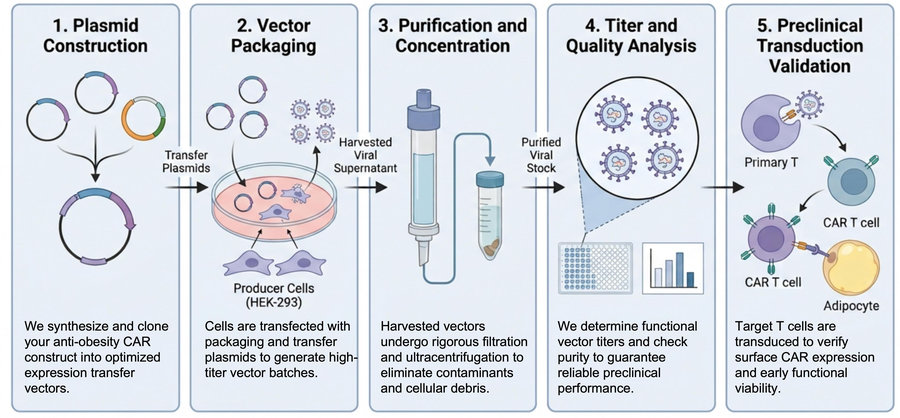
We design and assemble transfer plasmids incorporating cell-specific promoters, elongation factors, and reporter genes tailored to maintain stability in metabolic test systems.
- High-Titer Viral Production
Our laboratory scales up lentiviral and AAV vectors under strict quality controls, delivering functional titers that ensure consistent transduction across large cohorts of Preclinical Models.
- Adipocyte-Targeted Envelope Pseudotyping
We modify viral surface proteins to optimize cell-to-cell interaction dynamics, improving transduction rates for primary cells destined for fat tissue environments.
- Payload Optimization for Metabolic Vectors
We assist in configuring multiplexed constructs, allowing the co-expression of the CAR along with specific metabolic modulators or safety switches within a single delivery vehicle.
- Comprehensive Quality Control Testing
Every batch undergoes strict assessment for replication competency, endotoxin levels, total-to-full particle ratios, and transgene structural integrity.
Connect with our engineering team to customize a high-titer delivery system.
Workflow
Our process is broken down into highly structured phases, moving your initial receptor sequence into verified cellular models.
Fields of Application
Our services are built to accelerate discoveries across several expanding areas of metabolic and immunology research.
- Adipocyte Ablation Studies
Researchers looking to selectively eliminate specific subsets of mature, dysfunctional fat cells use our optimized vectors to generate CAR-T cells targeting surface markers like ROR1. This helps map out the systemic metabolic effects of reducing visceral fat mass in animal models. - Chronic Inflammation Mitigation
Obesity is heavily driven by a state of chronic, low-grade meta-inflammation. Our packaging services support the development of cell therapies designed to target and clear pro-inflammatory M1 macrophages or senescent stromal cells within adipose tissue, resetting the local immune landscape. - Metabolic Syndrome and Insulin Resistance Research
By providing reliable gene delivery mechanisms, we enable labs to study how targeted cellular interventions affect downstream systemic markers, including insulin sensitivity, hepatic steatosis, and circulating lipid profiles in diet-induced obesity models.
Advantages
Partnering with Protheragen means gaining access to a platform built around the unique demands of non-traditional cell therapy applications. We recognize that treating obesity requires looking past the standard oncology playbooks.
Tailored for Metabolic Microenvironments
Our delivery vectors are engineered specifically to overcome the stressful, lipid-dense, and highly inflammatory conditions characteristic of obese tissue models. This customization ensures your engineered cells don't lose their receptor expression or viability prematurely during functional testing.
Exceptional Purity and High Transduction Efficiencies
We utilize proprietary multi-step purification protocols that eliminate residual plasmid fragments, host cell proteins, and empty capsids. Achieving this level of purity prevents non-specific cell activation, yielding highly accurate and reproducible preclinical data.
Deep Domain Expertise in Novel Targets
Our scientific team understands the nuances of targeting receptors found on hypertrophic adipocytes or inflammatory macrophages, such as ROR1 or senescent markers. We match this biological understanding with advanced engineering to optimize vector design for these specific cell types.
Robust, Documented Validation Data
Every single project we deliver is accompanied by an extensive quality dossier containing functional titration curves, purity assays, and expression verification. Our optimized packaging methods routinely deliver up to a threefold increase in expression stability compared to standard off-the-shelf vector systems.
Contact Our Team for More Information and to Discuss Your Project.
Publication Data
Title: Strategies for Altering Delivery Technologies to Optimize CAR Therapy
Journal: International Journal of Molecular Sciences, 2025
DOI: https://doi.org/10.3390/ ijms26073206
Summary: This review summarizes in vitro/in vivo CAR-T delivery strategies to overcome solid tumor barriers, covering 5 generations of CAR structures, viral/nonviral vectors, local administration, and combination therapies, alongside key toxicity and manufacturing hurdles with future translational outlooks.
Key Findings
- CAR-T achieves remarkable blood tumor efficacy yet fails solid tumors due to poor T cell infiltration, immunosuppressive TME, antigen escape and severe toxicities like CRS and neurotoxicity. Its high cost stems from complex personalized ex vivo manufacturing.
- Five iterative CAR generations optimize function: 1st lacks co-stimulation; 2nd/3rd add co-stimulatory domains for better persistence; 4th secretes cytokines to remodel TME; 5th universal CAR enables off-the-shelf application.
- Ex vivo delivery includes systemic intravenous infusion (effective for hematological cancers) and local intratumoral, hydrogel implantation, intracavitary injection to boost tumor T retention for solid malignancies.
- In vivo CAR generation simplifies workflows and cuts costs via viral (lentivirus, AAV) and nonviral vectors (transposons, LNPs). LNPs deliver CAR mRNA/plasmid safely, while transposons support large gene cargo integration.
- Synergistic regimens combining CAR-T with checkpoint inhibitors or cytokine overexpression reverse TME suppression and boost anti-tumor activity.
- Core unresolved challenges cover off-target toxicity, vector safety, scalable automated production, and in vivo CAR-T controllability; targeted carrier engineering and dynamic tracking are critical future breakthrough directions.
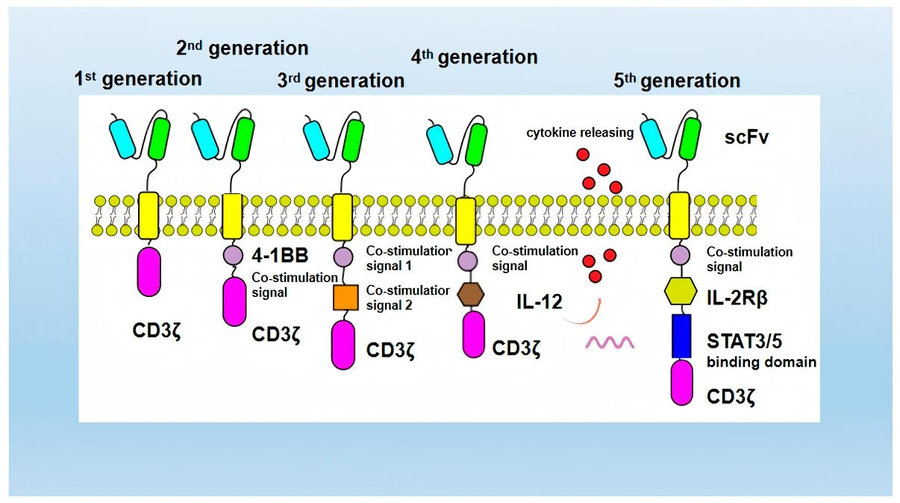 Fig.1 Structural evolution and functional iteration of first- to fifth-generation chimeric antigen receptors for CAR-T therapy. (Cao, et al., 2025)
Customer Review
Overcoming Transduction Bottlenecks in Anti-ROR1 Construct Validation
"We were hit with massive consistency issues when trying to package our anti-ROR1 constructs using standard commercial kits; the transduction efficiency in our primary immune cell lines was completely unpredictable. Protheragen stepped in and re-engineered our transfer vectors, delivering a high-titer lentiviral batch that completely turned the project around. The expression levels were steady, and we finally got the clean, reproducible adipocyte clearance data we needed for our upcoming paper."
Dr. E. R., Lead Principal Investigator
Accelerating In Vivo Proof-of-Concept in High-Fat Diet Cohorts
"Working on metabolic cell therapies means navigating a lot of unknown biological territory, so having a partner that focuses exclusively on tightening up the preclinical vector quality was huge for us. Their team didn't just give us a vial of virus; they gave us a complete analytical breakdown that helped us understand the expression dynamics in our high-fat diet mouse cohorts. We are already mapping out our next structural construct series with them."
Dr. M. V., Senior Director of Immunometabolism Research
Frequently Asked Questions
-
Why do we need a specialized packaging service for obesity-targeted CAR-T cells?
Obese tissue environments are full of inflammatory cytokines and lipids that can impact cell stability and transduction. Standard vectors often struggle with expression longevity in these settings, which is why we optimize our packaging to resist these specific environmental stressors.
-
Can Protheragen help us select the best target antigen for our anti-obesity project?
While you provide the core target concept, our team can definitely share technical feedback on vector design, promoter selection, and structural considerations that align best with known metabolic cell profiles like ROR1 or senescent markers.
-
What vector system do you recommend for long-term expression in fat tissue models?
Lentiviral vector platforms are usually the best choice for long-term tracking because they integrate the CAR construct directly into the host cell genome, ensuring the receptor is passed down as the immune cells expand.
-
Do you provide non-viral delivery alternatives for metabolic cell engineering?
Yes, we offer optimized mRNA synthesis and lipid-nanoparticle formulation services if your preclinical study calls for a transient, non-integrating approach to avoid permanent genomic modifications.
-
How do you ensure that your viral vector batches are safe for our animal models?
Every single vector lot we produce goes through comprehensive quality checks to ensure absence of replication-competent viruses and minimal endotoxin levels, keeping your test animals safe from non-specific inflammatory reactions.
-
What is the typical timeline from providing a sequence to receiving the ready-to-use vector?
Timelines generally range from 4 to 8 weeks depending on the complexity of your construct and the specific scale of purification required for your preclinical study layout.
-
Can your vectors accommodate large or multiplexed CAR designs?
Lentiviral systems handle payloads up to around 8 kilobases quite well. If you are looking to include reporters or metabolic modulators alongside your CAR sequence, we can optimize the internal architecture to ensure correct expression.
-
Do you provide clinical manufacturing or support for human trials?
No, our operations are strictly focused on preclinical research and validation phases. We do not provide clinical-grade or GMP services, allowing us to focus entirely on flexible, high-efficiency early-stage asset development.
-
How do your packaging services improve the reproducibility of our in vivo experiments?
By strictly controlling the full-to-empty particle ratios and eliminating background cellular debris, we deliver highly uniform lots that ensure your animals receive consistent, predictable dosing.
Contact Us
Protheragen is dedicated to delivering the high-quality, ultra-pure vector packaging architectures required to advance the next generation of metabolic cell therapies. Our specialized preclinical expertise takes the guesswork out of gene delivery, letting your team focus entirely on evaluating your therapeutic targets. Welcome to Contact Protheragen to explore tailored solutions.
Reference
- Cao, L.; et al. Strategies for Altering Delivery Technologies to Optimize CAR Therapy. Int. J. Mol. Sci. 2025, 26, 3206 (CC BY 4.0).
All of our services and products are intended for preclinical research use only and cannot be used to diagnose, treat or manage patients.