
De Novo Fatty Acid Synthesis Metabolic Flux Analysis Service
InquiryObesity is a complex metabolic disorder characterized by the excessive accumulation of adipose tissue, often driven by a dysregulation in lipid metabolism. A critical component of this process is de novo lipogenesis (DNL)—the metabolic pathway that converts excess dietary carbohydrates into fatty acids. In the context of anti-obesity drug discovery, quantifying the flux of this pathway is essential for validating the efficacy of inhibitors targeting enzymes such as acetyl-CoA carboxylase (ACC), fatty acid synthase (FASN), and ATP citrate lyase (ACLY).
De Novo Fatty Acid Synthesis Metabolic Flux Analysis Service for Anti-Obesity Therapeutics
Protheragen provides a specialized de novo fatty acid synthesis metabolic flux analysis service. By utilizing stable isotope tracers (e.g., 13C-glucose, 13C-acetate, or D2O), we offer a dynamic view of lipid metabolism that static lipidomic profiles cannot provide. Our service is specifically designed for preclinical researchers looking to understand how candidate compounds modulate the rate of fatty acid synthesis, breakdown, and turnover in various biological models.
Core Technologies
To deliver high-precision metabolic maps, Protheragen leverages a suite of advanced analytical and computational platforms:
- Stable Isotope Tracing
We employ 13C-labeled substrates and deuterated water (D2O) to trace the incorporation of carbon and hydrogen atoms into the fatty acid backbone.
- High-Resolution Mass Spectrometry (HRMS)
Our state-of-the-art gas chromatography–mass spectrometry (GC–MS) and liquid chromatography tandem mass spectrometry (LC-MS/MS) platforms provide the sensitivity required to detect minute changes in mass isotopomer distributions (MIDs).
- Mass Isotopomer Distribution Analysis (MIDA)
A robust mathematical technique based on combinatorial probabilities is used to calculate the fractional synthesis rate of polymers (like palmitate) from monomeric precursors (acetyl-CoA).
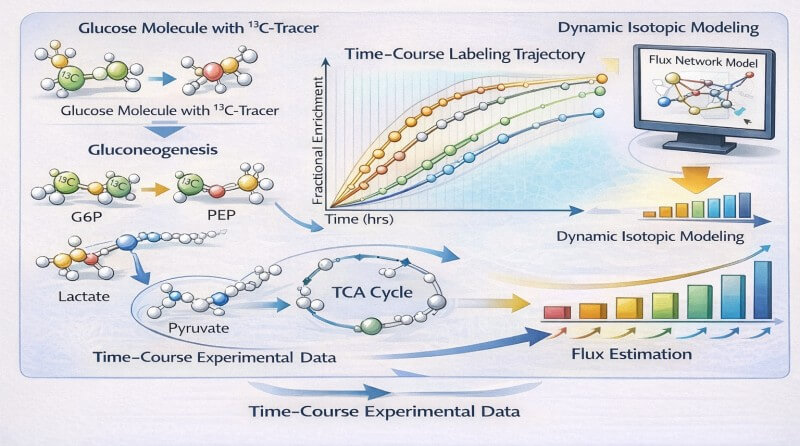
- Isotopically Non-Stationary MFA (INST-MFA)
For systems that do not reach isotopic steady state quickly, we use dynamic modeling to estimate fluxes from time-course labeling data.
- Advanced Computational Flux Modeling
Utilizing proprietary algorithms and established software frameworks like INCA, we reconcile experimental data with biochemical network models to produce quantitative flux maps.
Service Scope
Our MFA service is versatile, catering to diverse preclinical research needs:
- Pathway-Specific Flux
Quantitative measurement of flux through ACLY, ACC, and FASN.
- Organ-Specific Analysis
Differential DNL rates in the liver (hepatic lipogenesis) versus white/brown adipose tissue.
- Substrate Contribution
Assessing the relative contribution of different carbon sources (glucose vs. fructose vs. acetate) to the fatty acid pool.
- Lipid Turnover Studies
Measuring the half-life and degradation rates of specific lipid species like triglycerides and phospholipids.
Evaluating metabolic reprogramming in HFD-fed mice or rats.
Contact Our Team for More Information and to Discuss Your Project.
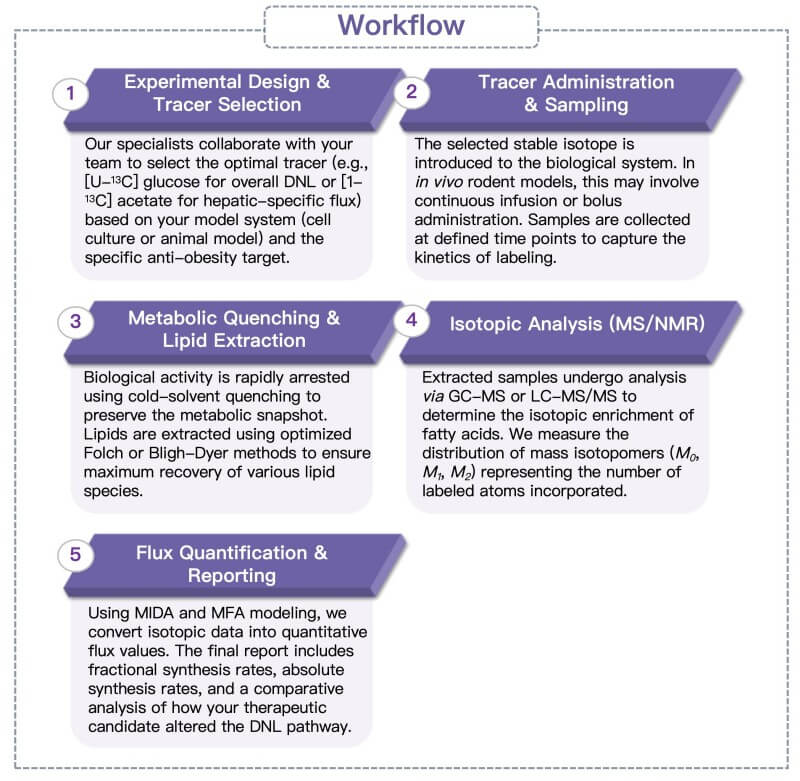
Workflow
Our service is structured into five comprehensive stages to ensure data integrity and biological relevance for your preclinical studies:
Fields of Application
Our de novo fatty acid synthesis metabolic flux analysis service provides critical, high-resolution insights across a broad spectrum of metabolic research, enabling investigators to move beyond static concentrations to a functional understanding of lipid kinetics.
- Target Validation: Confirming the biochemical impact of novel anti-obesity targets.
- Lead Optimization: Comparing the potency of different chemical analogs in reducing DNL flux.
- Mechanism of Action (MoA) Studies: Determining if a compound affects DNL via direct enzyme inhibition or upstream signaling (e.g., AMPK activation).
- Biomarker Discovery: Identifying circulating lipid flux signatures that correlate with weight loss or metabolic improvement.
- NAFLD/NASH Research: Quantifying the reduction of liver fat synthesis, a common comorbidity of obesity.
Advantages
Choosing Protheragen ensures your anti-obesity research is backed by the highest standards of metabolic flux science:
- Dynamic Insight
Unlike static lipidomics, our MFA service reveals the rate of synthesis, identifying whether a drug reduces lipid accumulation by inhibiting production or stimulating oxidation. This allows you to pinpoint the exact enzymatic bottleneck your compound is hitting, providing a definitive MoA (mechanism of action) rather than just a phenotypic observation.
- Unparalleled Precision
By using stable isotope tracers, MIDA provides an inherent internal standard for enrichment. This mathematically eliminates the common errors and "noise" caused by fluctuations in endogenous metabolite pool sizes.
- High-Fidelity Translational Value
As the gold standard in metabolic research, our metabolic flux analysis delivers the definitive evidence required to bridge the gap between initial discovery and clinical readiness. By strictly aligning our methodologies with high-impact biological benchmarks, such as the role of FASN inhibition in reducing DNL and hepatic steatosis, we ensure that your research is built on a foundation of exceptional data integrity and mechanistic depth.
Contact Our Team to Initiate Your Project Design.
Customer Review
High-Resolution Insights for Definitive Mechanism of Action (MoA) Validation
"The team at Protheragen provided us with clarity that we couldn't get from standard lipidomics. Our lead compound showed a reduction in weight, but we weren't sure if it was due to appetite suppression or metabolic changes. Their MFA service proved that our drug was specifically inhibiting DNL in the liver by over 40%."
Dr. A. R., Biotech Startup
Consistent Kinetic Data Empowering Multi-Model Preclinical Development
"Working with Protheragen has been a seamless experience. Their expertise in stable isotope modeling is second to none. We've used their DNL service across three different animal models now, and the consistency of the flux data has given us the confidence to move our candidate into late-stage preclinical development. We look forward to our next project on brown fat thermogenesis."
Ms. J. Z., Pharmaceutical Lead Discovery
Frequently Asked Questions
-
Why should I use MFA instead of just measuring total fat content?
Total fat content is a static measure. MFA tells you why the fat changed—whether the drug stopped new fat from being made or increased the burning of existing fat.
-
What is the best tracer for measuring de novo lipogenesis?
Deuterated water D2O is often preferred for long-term in vivo studies due to its ease of administration, while 13C-acetate is excellent for acute hepatic DNL measurements.
-
Can you perform this analysis on frozen tissue samples?
Yes, provided the samples were flash-frozen and stored at -80°C to maintain metabolic integrity.
-
How many time points are needed for a kinetic study?
Typically, 3–5 time points are recommended to accurately model the labeling curve and calculate turnover.
-
Does Protheragen provide the tracers?
We can provide the tracers as part of the service package or work with tracers provided by the client.
-
Is your service applicable to human clinical trials?
Our current service is strictly for preclinical models (cell lines, organoids, and animal models).
-
What is the typical turnaround time for a DNL flux report?
Generally, 4–6 weeks from the receipt of samples, depending on the complexity of the model.
-
How do you handle data for complex mixtures like triglycerides?
We use LC-MS/MS to separate lipid classes and then analyze the fatty acid tails specifically to determine their synthesis origin.
-
Can this service detect inhibition of the pentose phosphate pathway (PPP)?
Yes, because the PPP provides the NADPH required for fatty acid synthesis, we can track 1-13C-glucose to estimate PPP flux.
-
What kind of report will I receive?
A comprehensive PDF report featuring flux maps, statistical comparisons between groups, and raw isotopic distribution data.
Contact Us
Protheragen's de novo fatty acid synthesis metabolic flux analysis service is the definitive tool for researchers seeking to quantify the dynamic effects of anti-obesity therapeutics. By moving beyond static snapshots to real-time metabolic flow, we empower you to make data-driven decisions in your drug development journey.
Contact Protheragen for More Information and to Discuss Your Project
All of our services and products are intended for preclinical research use only and cannot be used to diagnose, treat or manage patients.