
Fatty Acid Oxidation Metabolic Flux Analysis Service
InquiryFatty acid oxidation (FAO) is a cornerstone of systemic energy homeostasis, and its dysregulation is a primary driver in the pathogenesis of obesity and its associated metabolic comorbidities. In the search for next-generation anti-obesity therapeutics, merely measuring static metabolite levels is insufficient.
Fatty Acid Oxidation Metabolic Flux Analysis Service for Anti-Obesity Therapeutics
Protheragen offers a specialized fatty acid oxidation metabolic flux analysis (MFA) service, providing a dynamic and quantitative map of carbon flow through the β-oxidation pathway and the tricarboxylic acid (TCA) cycle. By utilizing stable isotope labeling (e.g., [U-13C]-palmitate), we move beyond "snapshots" of lipid profiles to deliver "movies" of metabolic activity. This allows for the precise evaluation of drug efficacy in promoting weight loss and improving metabolic flexibility in various preclinical models.
Core Technologies
To ensure the highest resolution of metabolic flux, Protheragen leverages a multi-platform approach:
- Stable Isotope Tracing (13C/2H)
We utilize sophisticated labeling strategies, introducing heavy-atom isotopes into fatty acid precursors to track their incorporation into downstream metabolites like acetyl-CoA, citrate, and ketone bodies.
- High-Resolution Liquid Chromatography-Mass Spectrometry (HR-LC-MS/MS)
Our state-of-the-art Orbitrap and Q-TOF systems provide the sensitivity required to detect low-abundance isotopologues in complex biological matrices.
- Isotopomer Spectral Analysis (ISA)
We apply advanced mathematical modeling to calculate the fractional synthesis and oxidation rates, allowing us to differentiate between exogenous fat uptake and endogenous lipid mobilization.
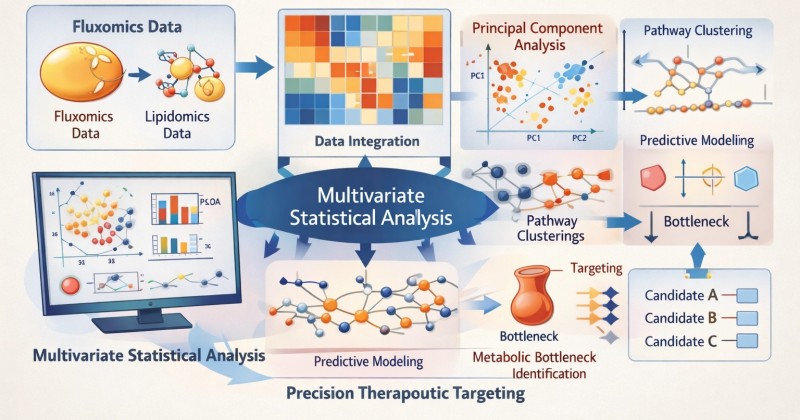
- Multivariate Statistical Modeling
Our proprietary bioinformatics pipeline integrates flux data with broader lipidomic profiles to identify metabolic "bottlenecks" targeted by your therapeutic candidates.
Service Scope
Protheragen provides FAO flux analysis across a wide range of preclinical biological contexts:
- Adipose Tissue Dynamics
Quantifying FAO in white, brown, and beige adipocytes to assess thermogenic activation and browning effects.
- Skeletal Muscle Metabolism
Evaluating mitochondrial efficiency and lipid oxidation rates to study the reversal of obesity-induced metabolic inflexibility.
- Hepatic Lipid Flux
Measuring the partitioning of fatty acids between oxidation and esterification (VLDL/TG synthesis) to support NAFLD/NASH research.
- In Vitro Screening
High-throughput flux assays in primary cells or immortalized lines (e.g., C2C12, 3T3-L1) to rank lead compounds.
- Organ-Specific Profiling
Simultaneous flux assessment across multiple tissues to understand systemic drug distribution and metabolic crosstalk.
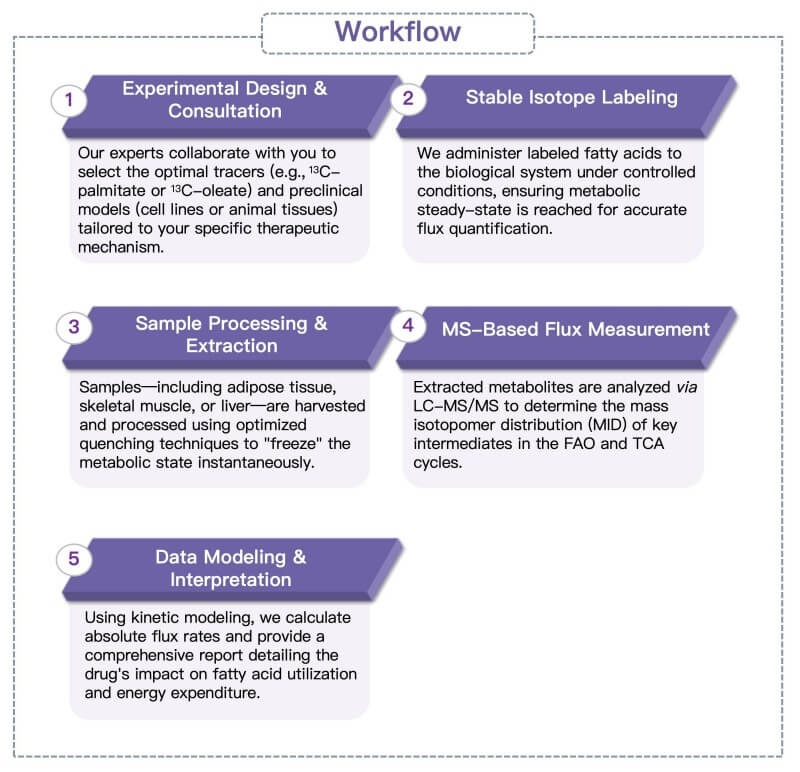
Workflow
Our streamlined preclinical workflow ensures reproducible data and rapid turnaround times for your drug development programs:
Fields of Application
Our fatty acid oxidation (FAO) metabolic flux analysis service provides critical mechanistic insights across a diverse range of preclinical research areas, enabling a deeper understanding of how therapeutic interventions reshape energy metabolism.
- MoA Validation: Confirming if a drug increases fat oxidation vs. simply suppressing appetite.
- Biomarker Discovery: Identifying flux-based signatures that predict therapeutic response in preclinical cohorts.
- Safety & Toxicity: Assessing if increased FAO leads to excessive oxidative stress or accumulation of toxic lipid intermediates.
- Combination Therapies: Evaluating synergistic effects of multi-agonist treatments on total lipid throughput.
Advantages
Choosing Protheragen means partnering with a leader in metabolic phenotyping. Our FAO MFA service offers:
- True Dynamic Quantification
While traditional assays primarily measure the oxygen consumption rate (OCR) as a proxy for metabolism, our FAO MFA provides a granular, high-resolution map of carbon flow. We don't just tell you that the engine is running; we identify exactly which fuels are being burned. By tracing stable isotopes, we deliver molecular-level detail on specific pathway contributions, allowing you to distinguish between genuine fatty acid oxidation and compensatory shifts in glucose or glutamine metabolism.
- High Sensitivity for Preclinical Models
We recognize that primary cells and clinical biopsies are often the bottleneck of a study. Our analytical pipeline is specifically engineered for ultra-low-input samples, including small-scale tissue punch biopsies and sparse cell cultures. This sensitivity ensures that you can gather robust, high-fidelity metabolic data without the need to pool samples, thereby preserving precious experimental materials and reducing the number of animal subjects required for a statistically significant study.
- Expert Insight
Data is only as valuable as the narrative it supports. With over 20 years of specialized experience, our team goes beyond delivering raw spreadsheets. We provide a comprehensive interpretation of complex fluxomic signatures within the framework of modern pharmacology. Whether you are evaluating the downstream effects of GLP-1 agonists, the thermogenic efficiency of mitochondrial uncouplers, or the metabolic "rewiring" of novel small molecules, we help you translate flux data into actionable biological insights.
- Proven Success
We help biotech partners navigate the transition from discovery to validation with optimized metabolic workflows. By defining mechanisms of action (MoA) that correlate with established benchmarks—such as FAO restoration in DIO models—we deliver the high-fidelity evidence needed to confirm your candidate's metabolic effects are both real and reproducible.
Contact Our Experts Today to Initiate Your Study Design.
Publication Data
Title: Gene and protein expression and metabolic flux analysis reveals metabolic scaling in liver ex vivo and in vivo
Journal: eLife, 2023
DOI: https://doi.org/10.7554/eLife.78335
Summary: For over 80 years, metabolic scaling (the inverse correlation between metabolic rate and body mass) has been studied mostly through mathematical modeling of caloric intake and oxygen consumption—leaving other metabolic processes largely unexamined. This study fills this gap by using a systems approach (transcriptomics, proteomics, and stable isotope tracer analysis) to explore metabolic scaling across five species (mice, rats, monkeys, humans, cattle) with a 30,000-fold body mass range, focusing on liver metabolism (the mammalian metabolic hub).
Key methods included comparing gene/protein expression in liver tissues, measuring metabolic fluxes in isolated hepatocytes (in vitro), liver slices (ex vivo), and live animals (in vivo) using modified positional isotopomer NMR tracer analysis (PINTA). Results showed that metabolic scaling extends beyond oxygen consumption to pathways like glycolysis, gluconeogenesis, and fatty acid metabolism: liver genes/proteins linked to these pathways (e.g., GLUL, GPX1, MDH1) are inversely expressed with body mass. Notably, no scaling was observed in isolated hepatocytes, but mouse liver slices had 3-fold higher glucose production than rat slices, and in vivo mice showed 2–3-fold higher hepatic mitochondrial oxidation and gluconeogenesis than rats. The study concludes that metabolic scaling is regulated at multiple levels—gene/protein expression, enzyme activity, and substrate supply—and depends on cell-extrinsic signals absent in isolated cells.
Key Findings
- Metabolic scaling expands beyond oxygen consumption to core pathways like glycolysis, gluconeogenesis, and fatty acid oxidation—with smaller animals (e.g., mice) showing 2–3-fold higher hepatic metabolic fluxes in vivo than larger ones (e.g., rats).
- Liver metabolic genes (e.g., GLUL, GPX1) and ~50% of their corresponding proteins are inversely expressed with body mass across five species (30,000-fold mass range), focusing on energy metabolism and oxidative damage detoxification.
- Cell-extrinsic signals drive scaling: Isolated hepatocytes show no interspecies flux differences in vitro, but mouse liver slices produce 3x more glucose than rat slices, and in vivo mice have 2.5x higher whole-body fatty acid turnover.
- Enzyme activity scales with body size—rat liver peroxidase and pyruvate carboxylase are 30–40% less active per mg tissue than in mice, with plasma transaminases (ALT, AST) decreasing from mice to humans.
- The scaling pattern is consistent across species: Human hepatic gluconeogenic fluxes are 50–60% lower than in rats, aligning with the inverse body mass-metabolic flux relationship observed from mice to cattle.
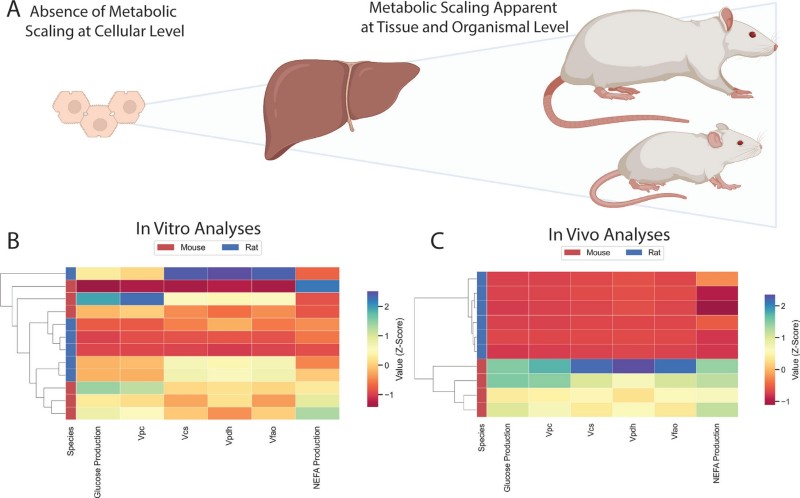 Fig.1 In vivo vs. in vitro metabolic flux clustering: how body size shapes liver metabolism. (Akingbesote, et al., 2023)
Customer Review
Insightful Validation of Mechanism for Series A Funding
"Working with Protheragen was a game-changer for our lead optimization phase. We were struggling to prove that our compound was actually increasing fatty acid turnover in the muscle. Their MFA service provided the definitive proof of mechanism we needed for our Series A funding. The data was clear, precise, and the team's biology expertise was evident in the way they interpreted the results."
Dr. S. R., Mid-sized Biotech
Unparalleled Functional Understanding of Metabolic Reprogramming
"The depth of information provided by Protheragen's flux analysis is unparalleled. They didn't just give us a list of metabolites; they gave us a functional understanding of how our drug was reprogramming the adipose tissue of our DIO mice. We look forward to continuing this partnership as we move our next three candidates into the pipeline."
Mr. L. S., Metabolic Disease Research Institute
Frequently Asked Questions
-
How does MFA differ from a standard lipidomics profile?
Standard lipidomics measures "what is there," while MFA measures "how fast it is moving." MFA is essential for understanding the rate of fat burning, which lipid levels alone cannot show.
-
Which labels are best for tracking fatty acid oxidation?
[U-13C]-Palmitate is the gold standard, as it allows us to track the carbon backbone through the entire β-oxidation spiral and into the TCA cycle.
-
Can you perform this service on frozen tissue samples?
While fresh tissue is ideal for some kinetic studies, our optimized extraction protocols allow for high-quality flux estimation from properly flash-frozen preclinical samples.
-
How do you handle the high complexity of adipose tissue?
We use specialized lysis and separation techniques to ensure that we are measuring the intracellular flux of adipocytes without interference from the large lipid droplet.
-
Is this service suitable for screening large libraries?
Yes, we offer a "flux-lite" version of our service designed for higher throughput screening of lead compounds in cell-based models.
-
Can you distinguish between the oxidation of different types of fats?
Absolutely. We can use different tracers (e.g., saturated vs. unsaturated) to see how your drug affects the metabolism of various fatty acid species.
-
Do you provide bioinformatic support for the data?
Every project includes a comprehensive report with pathway mapping and statistical analysis.
-
How long does a typical project take?
Most preclinical FAO flux projects are completed within 4–6 weeks from sample receipt.
-
Can this service help with NASH research?
Yes, measuring hepatic FAO is a critical component of assessing drugs designed to reduce liver fat accumulation.
Contact Us
Protheragen provides the most advanced fatty acid oxidation metabolic flux analysis dedicated to the preclinical development of anti-obesity therapeutics. By combining stable isotope tracing with high-resolution mass spectrometry and expert modeling, we deliver the functional insights necessary to move your drug from the lab to the next stage of development with confidence.
Contact Protheragen for More Information and to Discuss Your Project
Reference
- Akingbesote, N. D.; et al. Gene and protein expression and metabolic flux analysis reveals metabolic scaling in liver ex vivo and in vivo. eLife. 2023, 12:e78335. (CC BY 4.0)
All of our services and products are intended for preclinical research use only and cannot be used to diagnose, treat or manage patients.