
Free Fatty Acid Analysis Service
InquiryFree fatty acids (FFAs) are no longer viewed merely as passive energy substrates; they are potent signaling molecules that orchestrate metabolic homeostasis via G-protein coupled receptors (GPCRs) and nuclear receptors. In the realm of anti-obesity drug discovery, FFAs serve as critical biomarkers for lipolysis, insulin sensitivity, and mitochondrial function.
Free Fatty Acid Analysis Service for Anti-Obesity Therapeutics
Protheragen provides an industry-leading free fatty acid analysis service specifically optimized for preclinical research. Our platform allows researchers to quantify the full spectrum of saturated and unsaturated fatty acids, providing the granular data necessary to evaluate the efficacy of GLP-1 agonists, lipase inhibitors, and thermogenic activators. By mapping the lipidome's response to therapeutic intervention, we enable our partners to accelerate candidate selection with high-confidence metabolic profiling.
Core Technologies
To ensure the highest levels of sensitivity and specificity, Protheragen utilizes a dual-platform approach tailored to the chemical properties of fatty acids:
- Gas Chromatography-Mass Spectrometry (GC-MS)
This is the gold standard for FFA analysis. Through professional derivatization (alkylation or silylation), we achieve superior separation of isomeric fatty acids and high-sensitivity detection of even low-abundance long-chain FFAs.
- Liquid Chromatography-Tandem Mass Spectrometry (LC-MS/MS)
For high-throughput screening and the analysis of highly polar or unstable fatty acid derivatives, our LC-MS/MS platforms offer rapid quantitation without the need for extensive heating, preserving the integrity of polyunsaturated species (PUFAs).
- Targeted Metabolomics Panels
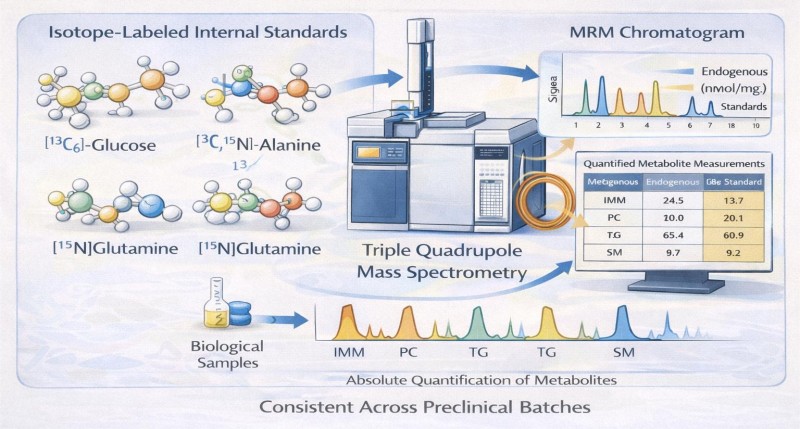
We employ isotope-labeled internal standards to provide absolute quantification (nmol/mg or µmol/L), ensuring that data across different preclinical batches is robust and reproducible.
Service Scope
Our analysis extends across a wide range of molecular species and biological matrices to provide a holistic view of lipid metabolism:
Critical for gut microbiome and satiety signaling studies.
- Medium and Long-Chain Fatty Acids (LCFAs)
Essential for monitoring beta-oxidation and systemic lipotoxicity.
- Specialized Lipid Panels
Including omega-3/omega-6 ratios and branched-chain fatty acids (BCFAs) involved in adipose tissue remodeling.
- Matrix Versatility
Validated protocols for serum, isolated adipocytes, hepatic tissue, and fecal matter for microbiome-related obesity studies.
Inquire Now to Get a Customized Quote for Your Preclinical Study.
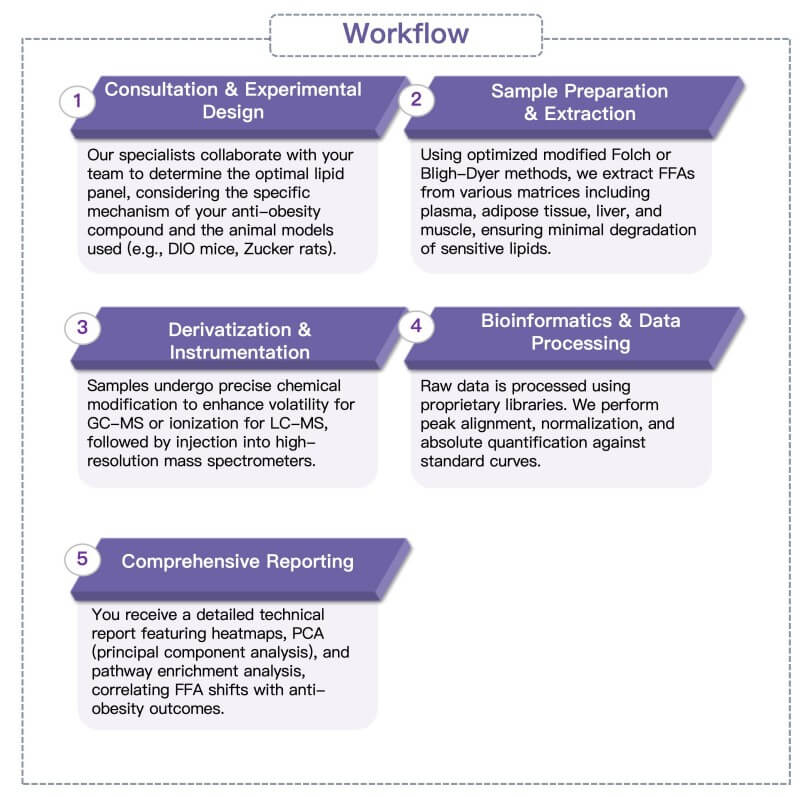
Workflow
Our streamlined service process is designed to integrate seamlessly into your preclinical development timeline:
Fields of Application
Our FFA analysis platform provides critical metabolic insights across diverse therapeutic contexts, enabling researchers to map the complex lipid alterations associated with metabolic dysfunction and pharmacological intervention.
- Drug Efficacy Testing: Measuring the reduction of systemic FFAs as a marker for improved insulin sensitivity.
- Mechanism of Action (MoA) Studies: Evaluating how new chemical entities (NCEs) affect fatty acid transport and mitochondrial uptake.
- Lipid Signaling Research: Investigating FFA-mediated activation of GPR40/GPR120 in glucose-dependent insulin secretion.
- Safety & Toxicology: Monitoring unintended changes in lipid profiles that might indicate hepatic steatosis or metabolic dysregulation.
Advantages
Protheragen stands at the forefront of lipidomics by offering a service that combines rigorous chemistry with biological insight.
- Exceptional Sensitivity
While standard assays often require large sample volumes that necessitate sacrificing animals at every time point, our platform detects free fatty acids (FFAs) at the picomolar level. This sensitivity allows researchers to perform serial sampling from a single mouse over weeks or months.
- Absolute Quantitation
Most core facilities provide "relative fold-change," which tells you that something changed, but not by how much, in a biological context. Protheragen delivers exact molar concentrations. This is the gold standard for pharmacokinetic/pharmacodynamic (PK/PD) modeling.
- Anti-Obesity Specialization
Obese tissues are notoriously difficult to analyze due to high lipid interference that can "clog" signals and skew results. We don't treat these like standard samples; we utilize specialized clean-up steps.
- Methodological Validation
Our analytical platforms consistently deliver data that aligns with established metabolic benchmarks. This includes the precise tracking of non-esterified fatty acids (NEFAs) suppression following treatment—a key physiological indicator that mirrors high-impact research findings and ensures the scientific integrity of your results.
Contact Our Specialists Today to Schedule Your Sample Submission.
Publication Data
Title: Free fatty acid receptors as therapeutic targets for the treatment of diabetes
Journal: Frontiers in Pharmacology, 2014
DOI: https://doi.org/10.3389/fphar.2014.00236
Summary: This review focuses on free fatty acid receptors (FFARs), a family of G protein-coupled receptors activated by fatty acids of different chain lengths, and their potential as therapeutic targets for type 2 diabetes and obesity. FFARs are categorized by ligand specificity: FFAR1 (GPR40) and FFAR4 (GPR120) respond to medium/long-chain fatty acids (MCFAs/LCFAs), while FFAR2 (GPR43) and FFAR3 (GPR41) are activated by short-chain fatty acids (SCFAs). The review details how FFARs regulate key metabolic processes—including insulin secretion, adipocyte differentiation, gut incretin release, and sympathetic activity—across tissues like the pancreas, intestine, adipose, and immune cells. It also highlights clinical progress (e.g., FFAR1 agonists in phase III trials) and challenges (e.g., liver toxicity leading to trial discontinuation) in developing FFAR-targeted drugs for metabolic disorders.
Key Findings
Free fatty acid receptors (FFARs)—GPCRs activated by fatty acids—are key therapeutic targets for type 2 diabetes and obesity, with four core subtypes:
- FFAR1/FFAR4: Triggered by medium/long-chain fatty acids (MCFAs/LCFAs); FFAR1 boosts pancreatic insulin secretion (critical for glucose control, though phase III agonists faced liver toxicity), while FFAR4 reduces obesity/inflammation and improves insulin sensitivity.
- FFAR2/FFAR3: Activated by gut microbiota-derived short-chain fatty acids (SCFAs); FFAR2 curbs fat accumulation and promotes GLP-1 release, while FFAR3 enhances energy expenditure via sympathetic activity.
Mutations in FFARs (e.g., FFAR4 p.R270H) link to obesity, and subtype-specific expression (e.g., FFAR1 in pancreas, FFAR4 in adipocytes) enables targeted metabolic regulation. FFARs act via GPCR signaling and gene modulation, addressing diabetes/obesity drivers like insulin resistance, inflammation, and fat buildup. Clinical progress includes FFAR1/4 agonists in trials, with structural insights advancing safer, selective ligands to overcome prior challenges (e.g., liver toxicity).
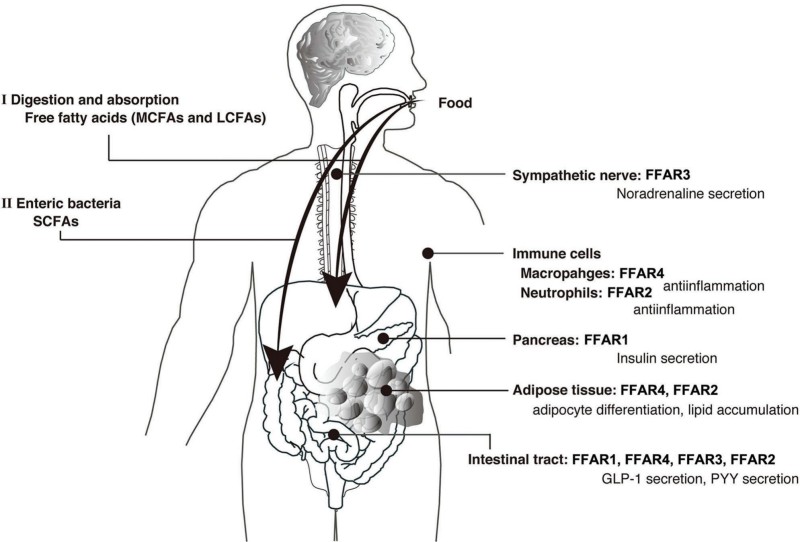 Fig.1 FFARs (FFAR1/FFAR2/FFAR3/FFAR4): how short/medium/long-chain fatty acid-activated receptors regulate insulin secretion, fat metabolism, and energy homeostasis for type 2 diabetes & obesity. (Ichimura, et al., 2014)
Customer Review
Precision Data for Lead Optimization: A Pharmacologist's Perspective
"Working with Protheragen was a turning point for our lead optimization phase. We were struggling with the variability of FFA levels in our high-fat diet models, but their absolute quantification service provided the clarity we needed. The data were so precise that we could clearly correlate FFA suppression with the activation of our target receptor. We have already integrated their lipidomics platform into our next three preclinical trials."
Dr. S. P., Biotech Therapeutics
Exceptional Technical Support and Biological Insight: A Director's Experience
"The technical support at Protheragen is exceptional. They didn't just send us a spreadsheet of numbers; they provided a comprehensive biological interpretation that helped us understand the shift in the omega-3 index of our treated groups. Their expertise in adipose tissue processing is unmatched. We look forward to a long-term partnership as we move our candidates toward the next phase."
Dr. M. R., Global Pharma
Frequently Asked Questions
-
What sample volume is required for a standard FFA panel?
We typically require 50-100 µL of plasma or 20-50 mg of tissue, though we can optimize for smaller micro-samples if necessary.
-
How do you prevent the oxidation of unsaturated fatty acids during shipping?
We provide detailed protocols for flash-freezing and recommend the addition of antioxidants like BHT during the initial collection phase.
-
Can you distinguish between branched-chain and linear fatty acids?
Yes, our high-resolution GC-MS platform is specifically configured to separate these isomers.
-
Is your service applicable to fecal samples?
Absolutely. This is a common request for researchers studying the gut-brain axis and obesity.
-
Do you provide statistical analysis?
Yes, every project includes basic statistical comparisons, including volcano plots and multivariate analysis.
-
How long does a typical analysis take?
From sample receipt to final report, our standard turnaround time is 3-4 weeks.
-
Can we customize the list of fatty acids in the panel?
We offer a standard library of over 40 FFAs, but we can integrate specific custom standards upon request.
-
How do your results compare to traditional colorimetric assays?
Mass spectrometry offers much higher specificity, as colorimetric kits often suffer from cross-reactivity with other lipid species.
Contact Us
Protheragen is dedicated to providing the high-resolution metabolic data required to bring innovative anti-obesity therapies to light. Our expertise in SCFA analysis ensures that your preclinical studies are built on a foundation of accuracy and scientific excellence.
Contact Protheragen for More Information and to Discuss Your Project
Reference
- Ichimura, A.; et al. Free fatty acid receptors as therapeutic targets for the treatment of diabetes. Frontiers in Pharmacology. 2014, 5. (CC BY 4.0)
All of our services and products are intended for preclinical research use only and cannot be used to diagnose, treat or manage patients.