
Short-Chain Fatty Acid Analysis Service
InquiryIn the rapidly evolving landscape of metabolic disease research, the gut microbiome has emerged as a central regulator of host energy homeostasis. Protheragen provides a specialized short-chain fatty acid (SCFA) analysis service specifically designed to accelerate the development of next-generation anti-obesity therapeutics.
Precision Short-Chain Fatty Acid Analysis for Anti-Obesity Therapeutics
Our preclinical analytical platform empowers researchers to quantify these volatile metabolites with unparalleled sensitivity. By integrating high-resolution metabolomics with deep biological insights, we help our partners decode how experimental compounds influence the gut-brain axis and metabolic inflammation, turning complex microbiome data into actionable leads for weight-management drug discovery.
Core Technologies
To overcome the inherent challenges of SCFA analysis—such as high volatility, low molecular weight, and matrix complexity—Protheragen utilizes a dual-platform approach:
- Gas Chromatography-Mass Spectrometry(GC-MS)
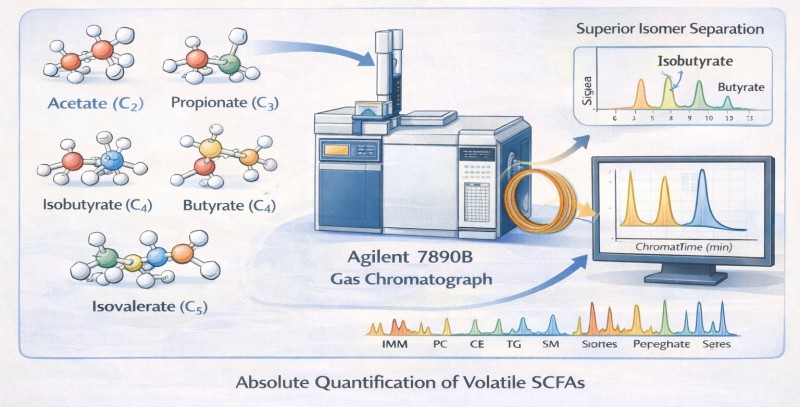
Our primary platform for absolute quantification of volatile SCFAs (C2-C6). Utilizing Agilent 7890B systems equipped with high-resolution DB-FFAP columns, we ensure superior separation of isomers like isobutyrate and isovalerate.
- Liquid Chromatography-Tandem Mass Spectrometry (LC-MS/MS)
For projects requiring ultra-trace detection or high-throughput screening, we utilize chemical derivatization (e.g., 3-nitrophenylhydrazine) to improve ionization efficiency and stability.
- Isotope Dilution Quantification
We employ stable isotope-labeled internal standards for every analyte to correct for matrix effects and extraction losses, ensuring the highest level of data integrity.
Service Scope
Our SCFA analysis service covers a broad spectrum of metabolites and matrices essential for preclinical obesity research:
- Standard SCFA Panel
Acetate, propionate, butyrate.
- Expanded SCFA Panel
Isobutyrate, valerate, isovalerate, caproate (hexanoate), and heptanoate.
- Related Organic Acids
Lactate, succinate, and pyruvate (critical for understanding metabolic flux).
- Biological Matrices
Mouse/rat feces, cecal contents, portal vein blood, peripheral plasma, and adipose tissue extracts.
Inquire Today for a Customized Project Quote and Technical Consultation.
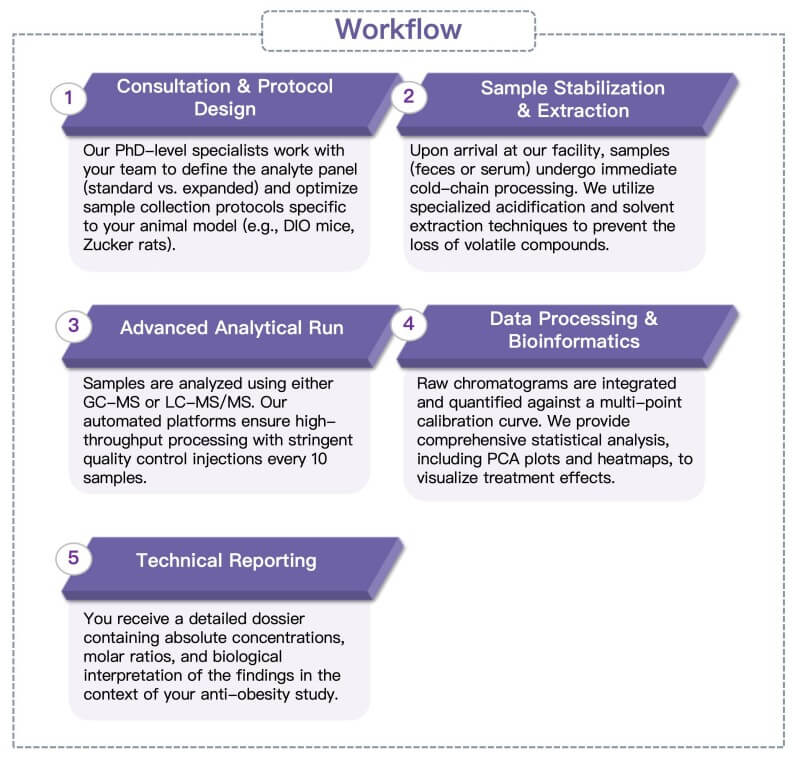
Workflow
Protheragen has streamlined the preclinical analytical process to ensure rapid turnaround without compromising scientific rigor.
Fields of Application
The identification of specific short-chain fatty acid profiles is a critical milestone in characterizing the efficacy of metabolic interventions and establishing the mechanistic bridge between gut microbial activity and systemic anti-obesity effects.
- GLP-1 Secretion Studies: Quantifying how SCFAs trigger enteroendocrine cells to release satiety hormones.
- Lipid Metabolism Research: Assessing the role of propionate in inhibiting hepatic lipogenesis.
- Anti-Inflammatory Screening: Monitoring butyrate-mediated suppression of low-grade systemic inflammation in adipose tissue.
- Dietary Intervention Trials: Evaluating the efficacy of prebiotics or high-fiber diets in animal models of obesity.
Advantages
Choosing Protheragen means partnering with a leader in preclinical metabolic profiling. Our advantages include:
- Preclinical Specialization
Unlike general-purpose labs, our entire facility and workflow are architected specifically for animal model research. We move beyond basic serum analysis to provide deep, tissue-specific insights. Whether distinguishing between the metabolic signatures of brown adipose vs. white adipose tissue or analyzing site-specific gut segments, our assays are designed to capture metabolites in their true biological context, ensuring the data reflects actual physiological states.
- Unmatched Sensitivity
The systemic concentration of short-chain fatty acids (SCFAs) is often orders of magnitude lower than in the gut. Our platform achieves ultra-low detection limits (down to 0.1 µmol/L), enabling the quantification of circulating SCFAs that other labs miss. This precision is vital for researchers studying the gut-brain axis, specifically the distal effects of metabolites on the hypothalamus and other extra-intestinal targets.
- Strict Preclinical Focus
We maintain a strict preclinical focus, specializing exclusively in animal models and in vitro systems. This allows us to master the unique "matrix effects" inherent in rodent studies—such as the high lipid content in specific tissues or the small sample volumes available from neonatal mice. We don't apply human protocols to animal samples; we build bespoke pipelines optimized for the rigors of preclinical discovery.
- Exceptional Reproducibility
In drug development, the ability to detect subtle therapeutic shifts is paramount. Protheragen delivers industry-leading precision with a coefficient of variation (CV) consistently below 5%. This high level of reproducibility increases your study's statistical power, allowing you to achieve "p-value significance" with smaller cohorts and providing the confidence required for critical go/no-go decisions.
- Validated Preservation Protocols
The integrity of SCFA data is often compromised the moment a sample is collected. To combat this, we provide proprietary collection kits and stabilization protocols engineered to "freeze" the metabolic profile for up to 72 hours. By neutralizing enzymatic activity and preventing volatile metabolite loss, we eliminate the common pitfalls of degradation during transport, ensuring the samples arriving at our lab are an exact reflection of the point of collection.
Consult with Our Scientists to Design a Customized Workflow for Your Next Preclinical Study.
Publication Data
Title: The Role of Short-Chain Fatty Acids in Metabolic Dysfunction-Associated Steatotic Liver Disease and Other Metabolic Diseases
Journal: Biomolecules, 2025
DOI: https://doi.org/10.3390/biom15040469
Summary: This review explores the critical role of gut microbiota-derived short-chain fatty acids (SCFAs)—acetate (60%), propionate (20%), and butyrate (20%)—in metabolic dysfunction-associated steatotic liver disease (MASLD, formerly NAFLD) and related conditions (obesity, type 2 diabetes/T2DM). SCFAs, produced by fermenting dietary fiber via gut bacteria (e.g., Faecalibacterium, Bifidobacterium), regulate gut barrier integrity, immune responses, and metabolic pathways. The review highlights that SCFA depletion correlates with gut dysbiosis in MASLD/metabolic diseases, while SCFA supplementation or targeted interventions (prebiotics, dietary fiber) improve liver health, insulin sensitivity, and weight management. It also details MASLD's pathogenesis (lipid accumulation, insulin resistance, gut-liver axis disruption) and therapeutic advances (GLP-1RAs, resmetirom), linking SCFAs to reversing disease progression.
Key Findings
- SCFA Basics & Production: The three main SCFAs (acetate, propionate, butyrate) make up 95% of gut microbial metabolites, produced by fermenting dietary fiber. Acetate dominates (60%) and supports other SCFA producers; butyrate fuels colonocytes and strengthens gut barriers.
- MASLD-SCFAs Link: MASLD patients (even mild cases) have lower fecal/plasma SCFAs (especially butyrate) and reduced SCFA-producing bacteria (Faecalibacterium, Roseburia). SCFAs improve MASLD by suppressing hepatic lipogenesis, enhancing insulin sensitivity, and reducing liver inflammation.
- SCFAs in Obesity: SCFAs dual role—they curb obesity by boosting satiety hormones (GLP-1, PYY) and fat oxidation, but excess may increase energy absorption. Clinical trials show sodium butyrate/inulin-propionate supplements reduce visceral fat, BMI, and liver lipid content in obese adults/children.
- SCFAs in T2DM: T2DM correlates with depleted butyrate-producing bacteria. SCFAs enhance insulin secretion (via pancreatic β-cell protection) and lower fasting glucose; combining sodium butyrate with inulin reduces postprandial blood sugar and HOMA-IR in T2DM patients.
- Mechanisms of Action: SCFAs act via two key paths—activating GPCRs (FFAR2/3) to regulate metabolism, and inhibiting histone deacetylases (HDACs) to modulate gene expression. They also strengthen gut tight junctions (e.g., ZO-1, mucin 2) to block liver-damaging toxins.
- Therapeutic Potential: SCFA-based interventions (butyrate supplements, prebiotic fiber) improve MASLD liver parameters (triglycerides, cholesterol) and metabolic health. They complement existing therapies like GLP-1RAs (semaglutide) and resmetirom (THR-β agonist) for MASLD.
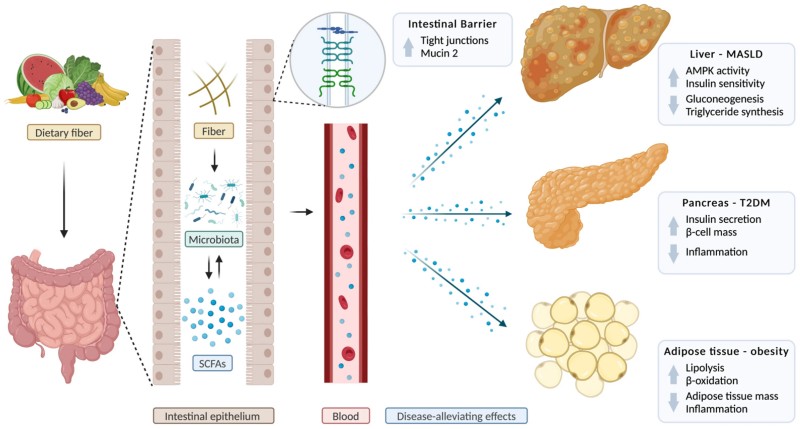 Fig.1 How gut microbiota-derived SCFAs (acetate, propionate, butyrate) regulate liver health, weight, and blood sugar: mechanisms linking SCFAs to MASLD, obesity, and type 2 diabetes. (Münte & Hartmann, 2025)
Customer Review
Accelerating Mechanism of Action Discovery for Lead Candidates
"The precision of Protheragen's SCFA analysis was a game-changer for our lead candidate selection. Their ability to quantify propionate in portal blood samples provided the definitive evidence we needed for our GPR43-targeting mechanism. We look forward to scaling our next study with their team."
Dr. M. R., Mid-size Biotech
Unmatched Data Consistency and Expert Preclinical Support
"We were struggling with high variability in our fecal SCFA data until we switched to Protheragen. Their stabilization protocols and expert consultation significantly reduced our experimental noise. Their focus on preclinical models makes them the ideal partner for our drug discovery pipeline."
Dr. P. S., Obesity Therapeutics Division
Frequently Asked Questions
-
Why is SCFA analysis critical for anti-obesity drug development?
SCFAs are the functional link between the diet and host metabolism. Measuring them allows you to verify the mechanism of action of your drug if it targets the microbiome or its metabolites.
-
What is the minimum sample volume required?
For fecal samples, we require approximately 50-100mg. For plasma/serum, we can achieve high-quality results with as little as 50µL.
-
How do you prevent the loss of volatile SCFAs during shipping?
We provide specific guidelines for flash-freezing and shipping on dry ice. For certain projects, we provide stabilization buffers that "lock" the SCFAs in place at the time of collection.
-
Can you differentiate between branched-chain (BCFA) and straight-chain fatty acids?
Yes, our GC-MS platform provides baseline separation between isomers like butyrate and isobutyrate, which is crucial as they originate from different fermentation pathways (carbohydrate vs. protein).
-
Do you provide services for human clinical trials?
Protheragen focuses strictly on preclinical research. We do not provide clinical diagnostic services.
-
What is the standard turnaround time?
Typically, QC-verified data is delivered within 10-15 business days following sample receipt.
-
Can we combine SCFA analysis with 16S rRNA sequencing?
Absolutely. We often correlate metabolic profiles with microbial composition to provide a "multi-omic" view of your therapeutic's impact.
-
Do you assist with data interpretation for publication?
Yes, our PhD scientists provide a summary report that interprets the findings in the context of current obesity literature.
Contact Us
Protheragen is dedicated to providing the high-resolution metabolic data required to bring innovative anti-obesity therapies to light. Our expertise in SCFA analysis ensures that your preclinical studies are built on a foundation of accuracy and scientific excellence.
Contact Protheragen for More Information and to Discuss Your Project.
Reference
- Münte, E.; Hartmann, P. The Role of Short-Chain Fatty Acids in Metabolic Dysfunction-Associated Steatotic Liver Disease and Other Metabolic Diseases. Biomolecules. 2025,15, 469. (CC BY 4.0)
All of our services and products are intended for preclinical research use only and cannot be used to diagnose, treat or manage patients.