
Obesity-related Peptides
InquiryMetabolic disorders, particularly obesity, stem from complex dysregulation of energy homeostasis, central neural processing, and peripheral hormonal signaling. Peptide hormones originating in the gastrointestinal tract and pancreas—such as glucagon-like peptide-1 (GLP-1), glucose-dependent insulinotropic polypeptide (GIP), glucagon, peptide YY (PYY), ghrelin, and leptin—serve as vital physiological regulators of satiety, insulin secretion, and nutrient partitioning. The therapeutic validation of long-acting GLP-1 and dual GIP/GLP-1 receptor agonists has transformed metabolic research. Current drug discovery efforts focus heavily on multi-agonist peptide architectures capable of targeting multiple receptors simultaneously to optimize glycemic control and weight reduction. Replicating and advancing these findings requires high-purity peptide standards with defined counter-ions, verified primary sequences, and consistent batch quality for downstream biochemical and biological evaluations.
Obesity-Related Peptides for Biomedical Research and Drug Discovery
This product line features research-grade peptides engineered for target validation, receptor pharmacology, and preclinical metabolic studies. The portfolio contains native mammalian sequences, modified analogs, multi-target co-agonists, lipidated derivatives, and stable isotope-labeled internal standards. Peptides are produced using appropriate synthesis methods and purified according to product-specific requirements. Available in scales ranging from milligram quantities for initial high-throughput screening to multigram batches for animal administration, these materials facilitate receptor binding assays, enzymatic degradation profiling, and pharmacokinetic investigations.

Product Portfolio
- Full Agonists and Antagonists: Unmodified and modified signaling peptides designed for functional cell-based reporter assays, second-messenger profiling (such as cAMP generation), and receptor binding studies. Antagonistic options, such as Exendin (9-39), enable competitive pathway inhibition experiments.
- Receptor Epitope Blocking Peptides: Dedicated blocking peptides matching specific antigenic sequences of metabolic G-protein coupled receptors (such as GLP-1R, GIPR, GCGR, and Y2R). These peptides serve as immunogen controls in Western blot, ELISA, immunohistochemistry (IHC), and immunocytochemistry (ICC) to pre-absorb receptor-targeted antibodies, confirming target binding specificity and eliminating false-positive background staining.
- Hormone Epitope Blocking Peptides: Synthetic peptide fragments corresponding to specific linear immunogenic epitopes of endogenous peptide hormones and prohormones (such as GLP-1, GIP, PYY, and Ghrelin). These controls enable researchers to pre-block antibodies raised against circulating hormone ligands, verifying assay specificity across immunoassay platforms.
Applications
- Structure-Activity Relationship (SAR) Mapping
Systematic sequence variations, including single-point mutations and alanine-scanning libraries, allow investigators to map key binding epitopes within target receptors. These SAR studies identify specific amino acid residues responsible for receptor selectivity, operational agonist efficacy, and resistance to proteolytic cleavage.
- Multi-Agonist Scaffold Engineering
Designing unimolecular dual and triple agonists requires precise balance across multiple signaling pathways. Investigators use these multi-agonist peptides to optimize multi-receptor signaling profiles, ensuring proportional engagement of dual or triple pathways without compromising physical stability or solubility.
- Metabolic Profiling
These peptides can be investigated in diet-induced obesity (DIO) rodent models to characterize their effects on metabolic function. Assessment endpoints may include food consumption, body weight, energy expenditure, and oral glucose tolerance, allowing researchers to examine physiological responses across different dosing regimens and study durations.
Advantages
High-Purity Peptides
Peptides are purified according to their individual characteristics to meet applicable quality requirements, supporting their use in a range of biochemical and biological research applications.
Flexible Peptide Production Scales
Peptide quantities can be tailored to project requirements, from small-scale research needs to larger batches for extended preclinical studies, subject to synthesis feasibility and production capacity.
Direct Scientific Consulting
Our experienced peptide chemists offer technical consultation regarding sequence solubility prediction, reconstitution protocols, and molecular design considerations prior to synthesis.
Publication Data
Title: The novel chimeric multi-agonist peptide (GEP44) reduces energy intake and body weight in male and female diet-induced obese mice in a glucagon-like peptide-1 receptor-dependent manner
Journal: Frontiers in endocrinology, 2024
DOI: https://doi.org/10.3389/fendo.2024.1432928
Summary: This study investigated the effects of the chimeric peptide GEP44 on energy intake, body weight, core temperature, physical activity, and fasting blood glucose in male and female mice with diet-induced obesity. By comparing mice with and without functional glucagon-like peptide-1 receptors (GLP-1Rs), the researchers examined the role of GLP-1R signaling in mediating these effects. GEP44 reduced food intake and body weight in both male and female mice with functional GLP-1Rs and also lowered fasting blood glucose levels. These effects were largely absent in mice lacking GLP-1Rs, indicating that the receptor plays a major role in GEP44 activity, although some effects on food intake in males may involve additional pathways. GEP44 also reduced core temperature and physical activity, suggesting potential effects on energy expenditure. These findings provide further evidence for the potential of multi-agonist peptides in obesity research and support further investigation of GEP44 as a candidate for addressing excess body weight and associated metabolic dysfunction.
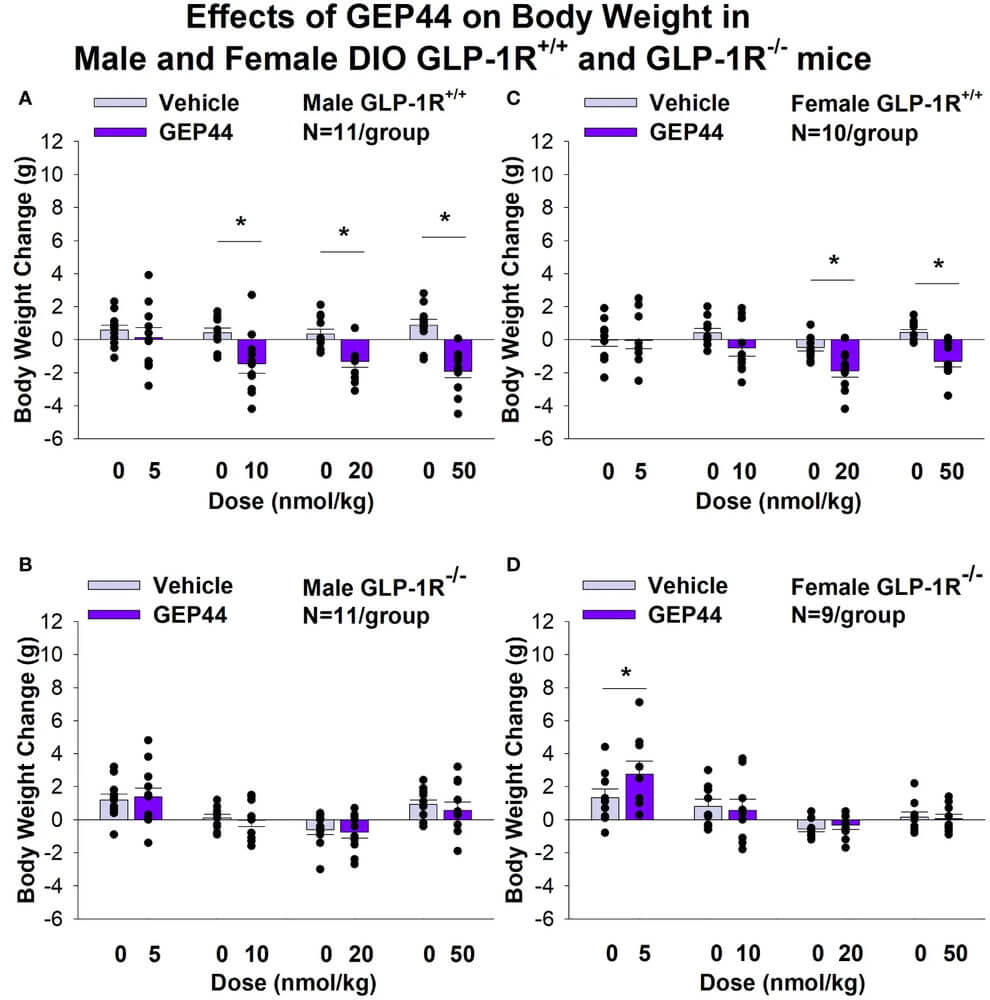 Fig. 1 GEP44 effects on body weight in male and female obese mice with or without GLP-1 receptors. (Blevins, et al., 2024)
Customer Review
High Specificity with Blocking Peptides
"Using the hormone epitope blocking peptides allowed us to unambiguously confirm antibody specificity in our sandwich ELISAs. The pre-absorption step effectively eliminated non-specific background signal."
S. J., Research Scientist
Consistent Quality for In Vivo Dosing
"We utilized the multi-agonist reference standards across a six-month rodent feeding study. The verified low endotoxin levels and batch consistency ensured reproducible metabolic data without confounding inflammatory responses."
K. T., Bioanalytical Specialist
Frequently Asked Questions
-
Are these peptides suitable for human administration?
No. All products listed in this catalog are strictly designated for research use only (RUO) in laboratory settings. They are not cleared for clinical diagnostic, human therapeutic, or food additive uses.
-
What are the recommended long-term storage conditions?
Lyophilized peptides should be stored at -20°C or -80°C in a desiccated container away from direct light. Reconstituted stock solutions should be aliquoted and frozen to avoid repeated freeze-thaw cycles.
-
What is the standard lead time for custom peptide orders?
Most custom peptide orders are synthesized, purified, characterized, and prepared for shipment within 2 to 3 weeks, depending on sequence complexity and modification requirements.
-
How are peptides protected against temperature fluctuations during transit?
Products are shipped in insulated containers with gel packs or dry ice as appropriate to ensure thermal stability throughout transit.
Accessing reliable, structurally validated peptide reagents is fundamental to generating reproducible data in metabolic disease research. Protheragen offers a range of research-grade obesity-related peptides, including native metabolic hormones, multi-agonist peptides, lipidated derivatives, blocking peptides, scrambled controls, and stable isotope-labeled standards. Backed by rigorous analytical characterization, custom counter-ion options, and dedicated technical support, our offerings empower research teams to advance target discovery, receptor pharmacology, and pharmacokinetic evaluations. We welcome you to contact us to discuss your project requirements, request custom synthesis quotes, or explore how our peptide portfolio can support your metabolic research initiatives.
Reference
- Blevins, J.E.; et al. The novel chimeric multi-agonist peptide (GEP44) reduces energy intake and body weight in male and female diet-induced obese mice in a glucagon-like peptide-1 receptor-dependent manner. Frontiers in Endocrinology. 2024, 15: 1432928. (CC BY 4.0)
Obesity-related Peptides
- Origin: Synthetic
- Conjugation: Unconjugate
- Species Reactivity: Human; Mouse; Rat; Dog

- Origin: Synthetic
- Conjugation: Unconjugate
- Species Reactivity: Human; Dog,
- Origin: Synthetic
- Conjugation: Unconjugate
- Species Reactivity: Human; Mouse; Rat; Cow
- Origin: Synthetic
- Conjugation: Unconjugate
- Species Reactivity: Human; Mouse; Rat
- Origin: Synthetic
- Conjugation: Unconjugate
- Species Reactivity: Human; Mouse; Porcine; Cow
- Origin: Synthetic
- Conjugation: Unconjugate
- Species Reactivity: Human
- Origin: Synthetic
- Conjugation: Unconjugate
- Species Reactivity: Human; Dog
- Origin: Synthetic
- Conjugation: Unconjugate
- Species Reactivity: Mouse
- Origin: Synthetic
- Conjugation: Unconjugate
- Species Reactivity: Mouse; Rat
- Origin: Synthetic
- Conjugation: Unconjugate
- Species Reactivity: Human; Mouse; Rat; Dog
