
NK Testing Service
InquiryObesity is no longer viewed simply as an issue of fat storage. It is fundamentally a chronic inflammatory condition that alters the entire immune landscape. Recent scientific breakthroughs show that metabolic dysfunction impairs natural killer (NK) cell activity, compromising their ability to regulate systemic inflammation and clear senescent adipocytes.
NK Testing Service in NK Cell Therapy Development for Obesity
At Protheragen, our specialized preclinical NK testing services are explicitly designed to bridge this gap. We help therapeutic developers evaluate how novel NK cell therapies, or small molecules targeting NK metabolic pathways (such as GLP-1 receptor modulators and cytokine combinations), can restore compromised NK cell function. By providing highly specific, robust in vitro and ex vivo assays, we empower our partners to screen candidates effectively and gather the rigorous preclinical data necessary to advance their pipelines.
Core Technologies
Our preclinical validation platform leverages cutting-edge molecular and cellular analytical tools to assess NK cell behavior under simulated metabolic stress:
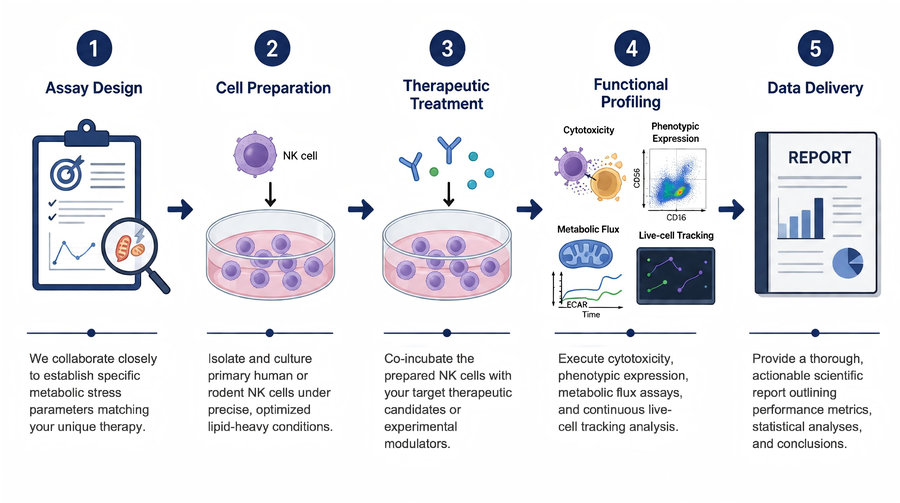
Multi-color immunophenotyping panels that track NK cell activation markers (NKp46, NKG2D, CD69) and inhibitory receptors in fatty acid-rich environments.
Direct monitoring of oxygen consumption rate (OCR) and extracellular acidification rate (ECAR) to evaluate glycolysis and mitochondrial function in NK cells exposed to lipotoxic conditions.
Continuous monitoring of NK cell-mediated lysis of target adipocytes or inflamed cell lines over extended periods.
Accurate quantification of granzyme B, perforin, interferon-γ (IFN-γ), and tumor necrosis factor-ɑ (TNF-α) production from minute sample volumes.
Solution Scope
Protheragen provides an expansive suite of preclinical testing options tailored exclusively to the complex intersection of immunology and metabolic disease. Our service scope encompasses:
We replicate the microenvironment of obese adipose tissue by culturing NK cells in media enriched with free fatty acids (like palmitate or oleate) or high glucose concentrations. This lets us test whether your therapeutic candidate can successfully reverse the metabolic exhaustion typical of NK cells in obese hosts.
- NK Cell Cytotoxicity and Degranulation Assays
We measure the direct killing capacity of NK cells against hypertrophic adipocytes or target cell lines. Our team quantifies cell-surface CD107a expression along with intracellular granzyme and perforin release, ensuring you understand the raw lytic power of your treatment.
- Phenotypic Alteration and Signaling Pathway Tracking
Obesity shifts the balance of activating and inhibitory receptors on NK cells. We look closely at how your drug candidate alters expressions of critical pathways, including mTOR activation, which is often severely blunted in metabolically compromised immune cells.
- Cytokine Secretion Profiling
NK cells do more than just kill targets; they secrete vital regulatory cytokines that help clean up chronic tissue inflammation. We evaluate the secretion profiles of IFN-γ and other chemokines to confirm your therapy promotes a favorable, anti-inflammatory tissue microenvironment.
Explore our full testing capabilities today.
Workflow
Our streamlined preclinical workflow ensures your therapeutic candidates are evaluated with maximum precision through five distinct, carefully controlled stages.
Fields of Application
Our specialized testing platform bridges the gap between immunology and metabolic research, providing critical data across several expanding therapeutic areas.
- GLP-1 and Multi-Incretin Therapy Validation
Assessing how GLP-1 receptor agonists or related dual/triple agonists indirectly or directly rescue NK cell metabolic fitness and functional competence. - Adoptive NK Cell Therapy Development
Testing engineered or expanded NK cells to confirm they can withstand the hostile, lipid-dense environment of inflamed fat tissue without losing their activity. - Small Molecule Phenotypic Screening
Evaluating chemical libraries for their ability to restore intracellular signaling or mitochondrial function in exhausted immune cells. - Cytokine-Induced Memory Training Studies
Exploring how specific cytokine pre-treatments can "train" NK cells to maintain robust functional outputs even when challenged by metabolic stressors.
Advantages
Partnering with Protheragen gives your preclinical program a decisive competitive edge by combining deep metabolic expertise with highly accurate, reproducible data.
Deep Metabolic Disease Expertise
Our laboratory team possesses deep specialized experience simulating the metabolic conditions of obesity in vitro. We do not just run generic immune assays; we tailor our protocols to model authentic lipotoxicity and nutrient excess. This ensures your data is genuinely reflective of the physiological challenges your therapy will face in vivo. It is confirmed that mimicking specific lipid profiles is essential for predicting accurate preclinical outcomes.
Highly Tailored, Scalable Assay Panels
We recognize that every preclinical pipeline has distinct requirements, so we avoid rigid, one-size-fits-all testing templates. Protheragen builds custom multiplexed workflows that look at phenotypic changes, killing kinetics, and metabolic fitness all from a single experimental setup. This customized approach maximizes data yield per sample, saving you precious budget and time.
Rigorous Quality Control and Data Fidelity
Our instrumentation undergoes strict validation to guarantee high reproducibility across all experimental batches. We eliminate operational variability through automated fluidics and precise liquid handling, so you can trust your statistical trends completely. Our baseline datasets are carefully calibrated against established reference standards, which aligns with verified data across the immuno-metabolism sector.
Submit a project inquiry to get a detailed proposal and custom assay design.
Publication Data
Title: Natural killer cell therapy: A new frontier for obesity-associated cancer
Journal: Cancer Letters, 2022
DOI: https://doi.org/10.1016/j.canlet.2022.215620
Summary: This mini-review details NK cell dysfunction driving poor immunotherapy outcomes in obesity-linked cancers, where visceral adipose tissue diverts NK cells from tumours. It evaluates CAR-NK, checkpoint and cytokine therapies, plus chemokine-targeted strategies to redirect NK tumour infiltration for better patient responses.
Key Findings
- Obesity triggers chronic visceral adipose inflammation that sequesters NK cells away from solid tumours, creating immune-excluded "cold" tumours with low NK infiltration across oesophageal, colorectal, endometrial and breast cancers. Obese NK cells show blunted cytotoxicity, reduced NKp46/NKG2D activating receptors, impaired glycolysis and lipid overload, plus TGF-β-mediated conversion to less cytotoxic ILC1-like cells.
- Standard checkpoint inhibitors yield weak efficacy for obesity-associated malignancies; NK cell therapies (CAR-NK, cord/iPSC NK) offer "off-the-shelf" advantages over CAR-T with minimal GVHD risk. Multiple CAR-NK platforms targeting HER2, ROBO1, GPC3 and NKG2D suppress tumour growth in preclinical solid tumour models.
- Combination regimens pairing CAR-NK with IL-15 superagonists, anti-angiogenics or checkpoint blockers deliver durable disease control in phase trials. CX3CR1 antagonists block misdirected NK migration to omentum; engineered chemokine receptor NK cells improve tumour homing.
- Major barriers include short NK persistence, TME immunosuppression and obese metabolic impairment of autologous NK priming; future work prioritises chemokine reprogramming and dual CARs countering TGF-β suppression.
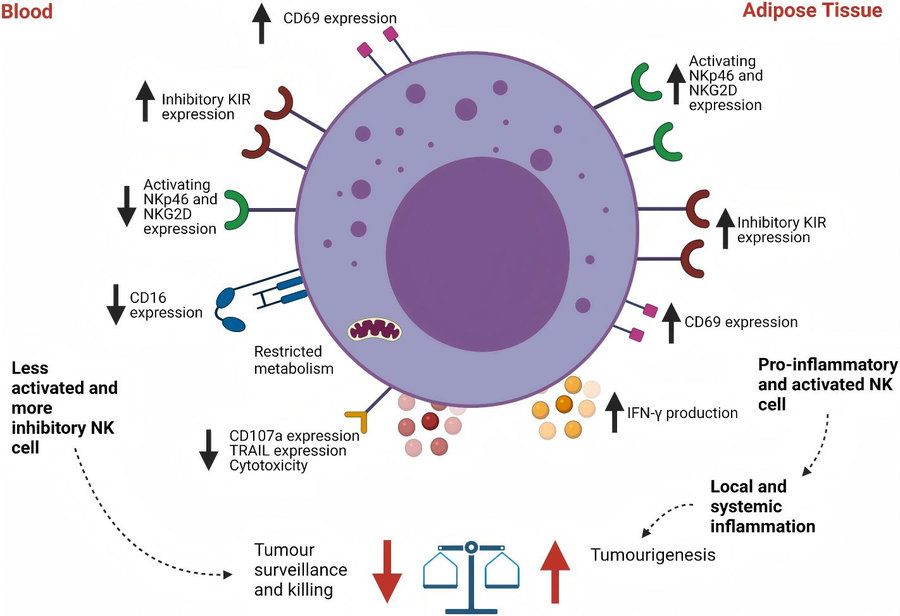 Fig.1 Circulating and adipose NK cell phenotypic defects driving tumour susceptibility in obesity. (Mylod, et al., 2022)
Customer Review
Unlocking Mechanistic Clarity in High-Lipid Environments
"We were struggling to find a contract research partner that truly understood the weird nuances of immune cell behavior under lipotoxic conditions. Protheragen didn't just give us a cookie-cutter cytotoxicity setup; they worked side-by-side with our team to model the specific lipid environments we needed. Their metabolic flux data gave us the exact clarity required to select our lead molecule asset. We are already planning our next ex vivo testing package with them for next quarter."
Dr. E. R., Group Leader
High-Fidelity Visual Data That Builds Stakeholder Confidence
"The automated cell imaging datasets provided by Protheragen were exceptionally clean and gave our investment board a lot of confidence. Their team was highly responsive throughout the whole assay optimization phase, handling our delicate engineered cell lines with extreme care. They have become an integral extension of our preclinical discovery team."
Dr. M. V., Principal Scientific Officer
Frequently Asked Questions
-
Why is NK cell testing relevant to therapies targeting obesity?
Obesity damages NK cell metabolism, blunting their ability to kill target cells and clear senescent adipocytes. Testing reveals if your therapeutic candidate can restore this crucial functional capacity under metabolic stress.
-
Can Protheragen support human clinical trial sample testing?
No, our testing platform is strictly dedicated to preclinical in vitro and ex vivo research studies. We help optimize your candidates long before they reach clinical stages.
-
How do you simulate the immune environment of an obese patient in vitro?
We introduce specific cocktails of free fatty acids, high glucose, and inflammatory cytokines into the cell cultures, effectively mirroring the lipotoxic conditions found inside obese adipose tissues.
-
What specific cytotoxicity endpoints do you typically measure?
We track direct target cell lysis in real time using advanced live-cell imaging, alongside measuring chemical markers of degranulation like CD107a expression and granzyme B release.
-
Can we ship our own proprietary compounds or engineered cells to your facility?
Yes, we routinely receive proprietary molecules, antibodies, and modified cells from sponsors under strict confidentiality agreements to run our validated functional assays.
-
Do you offer metabolic flux analysis specifically for these immune cells?
Yes, we measure mitochondrial respiration and glycolysis kinetics to see if your compound fixes the internal metabolic engine of the NK cell.
-
How do you ensure the data generated will be reliable for regulatory filings?
We use strictly validated instruments, rigorous negative and positive controls, and follow highly detailed standard operating procedures. This ensures our data stands up to deep scientific scrutiny.
-
What is the average turnaround time for a standard testing project?
It mostly depends on the overall size and complexity of the assay panel, but most standard screening projects are fully completed with reports delivered within 4 to 6 weeks.
-
Can your assays distinguish between different sub-populations of NK cells?
Yes, our high-color flow cytometry panels can readily differentiate and analyze specific subsets based on their distinct surface marker expressions.
Contact Us
Protheragen delivers industry-leading, specialized preclinical NK testing services that empower therapeutic developers to validate their candidates within authentic models of metabolic disease. By combining precise lipotoxicity simulations with high-fidelity functional, phenotypic, and metabolic assays, we give you the deep biological insights needed to advance your obesity-focused cell therapies or small molecules with total confidence. Welcome to Contact Protheragen, and our team will get back to you within 24 hours.
Reference
- Mylod, E.; et al. Natural killer cell therapy: A new frontier for obesity-associated cancer. Cancer Letters. 2022, 535, 215620 (CC BY 4.0).
All of our services and products are intended for preclinical research use only and cannot be used to diagnose, treat or manage patients.