
NK Cell Isolation and Amplification Service
InquiryObesity is no longer viewed simply as an energy storage problem. It is a chronic inflammatory condition driven by immune system dysfunction within expanding adipose tissue. Emerging preclinical research highlights that natural killer (NK) cells play a dual role here. They can either worsen insulin resistance through pro-inflammatory cytokine production or help clear senescent, dysfunctional adipocytes to restore metabolic balance.
NK Cell Isolation and Amplification Service for Obesity Therapy Development
At Protheragen, we recognize that exploiting these pathways requires highly specific cell populations. Our specialized NK cell isolation and amplification service is tailor-made for preclinical researchers investigating how targeted NK cell therapies can mitigate metabolic syndrome, decrease low-grade systemic inflammation, and alter fat tissue distribution. We provide the cellular tools needed to transition your therapeutic concepts from theoretical models into validated preclinical data.
Core Technologies
To deliver functional and highly pure NK cell populations, we utilize a suite of proprietary and optimized methodologies designed specifically for challenging metabolic research environments:
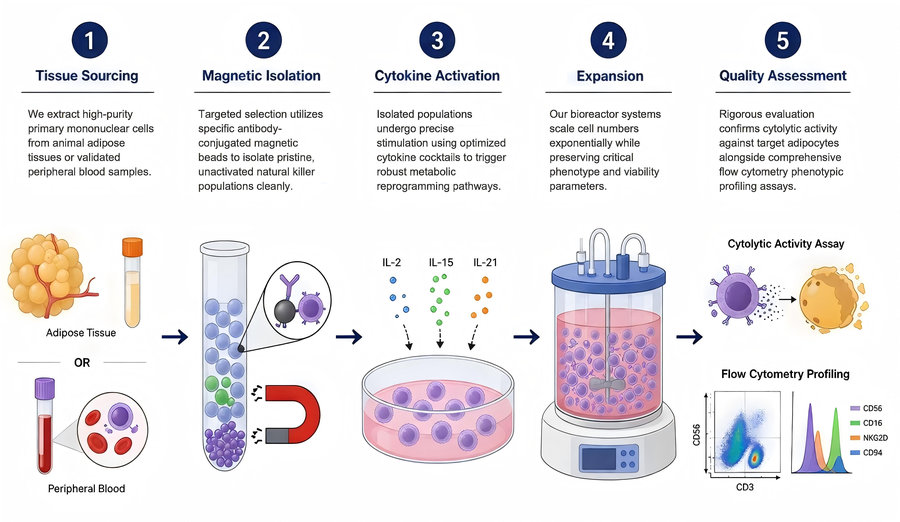
Extracting immune cells from lipid-rich environments presents unique obstacles. Our specialized tissue dissociation enzymes and density-gradient matrices separate stromal vascular fractions (SVF) without damaging delicate surface receptors.
We utilize proprietary combinations of IL-12, IL-15, and IL-18 to induce "trained" or memory-like NK cell phenotypes. This specific priming enhances their homing capabilities and cytotoxic potential against hypertrophic adipocytes.
Our closed-loop bioreactors maintain tight control over oxygen, pH, and nutrient delivery. This prevents the exhaustion often seen in traditional static cell cultures, ensuring exponential growth with stable phenotypes.
Solution Scope
Our preclinical service portfolio supports every phase of your proof-of-concept exploration. We handle everything from initial cell recovery to complex validation assays, ensuring your project has solid foundational data.
- Primary Cell Sourcing and Fractionation
We isolate NK cells from various rodent models (e.g., diet-induced obesity mice, ob/ob, db/db) and healthy or metabolic-compromised human donor tissues. Our customized protocols efficiently handle subcutaneous and visceral adipose depots, yielding high concentrations of tissue-resident NK cells.
- Phenotypic and Functional Tailoring
Depending on your research goals, we can skew NK cell populations toward specific functional states. Whether you need non-inflammatory phenotypes that secrete IL-10 to soothe tissue inflammation, or highly cytotoxic variants targeted at clearing senescent adipocytes, our optimization platform modifies the expansion environment to achieve your desired profile.
- Comprehensive Preclinical Validation Analytics
We do not just expand cells; we verify their functional capacity. Every batch undergoes comprehensive quality control testing:
- Flow Cytometry Profiling: Verification of key surface markers like NKp46, CD56, CD16, NKG2D, and exhaustion markers such as PD-1 or TIM-3.
- Adipocyte Co-culture Cytotoxicity Assays: Real-time assessment of NK-mediated killing of hypertrophic or senescent adipocytes using advanced impedance-based monitoring systems.
- Secretome Analysis: Multiplex quantification of cytokine profiles (IFN-γ, TNF-ɑ, IL-10) to guarantee the expanded cells match your required inflammatory profile.
Reach out to our specialists today to scope your upcoming preclinical study.
Workflow
Our optimized laboratory workflow ensures maximum viability and phenotypic stability at every critical phase of the preclinical development cycle.
Fields of Application
The cell populations generated by our team are perfectly suited for several critical areas of preclinical exploration:
- Adipose Tissue Macrophage Modulation
Investigating how expanded NK cells interact with, and potentially polarize, M1/M2 macrophage populations within visceral fat to reduce systemic insulin resistance. - Senolytic Therapy Development
Using targeted NK cells to selectively eliminate senescent preadipocytes and mature adipocytes, which secrete harmful factors that accelerate tissue aging and metabolic decline. - In Vivo Homing and Biodistribution Studies
Evaluating how effectively systemically or locally injected NK cells migrate into inflamed fat pads in Diet-Induced Obesity Models.
Advantages
Choosing Protheragen gives your preclinical program access to specialized, high-yield methodologies that outperform generic cell isolation kits in complex metabolic environments.
Adipose-Optimized Purity and Viability
Standard separation kits frequently fail when applied to lipid-dense tissue fractions, resulting in low viability. Our specialized protocols consistently achieve over 90% NK cell purity and exceptional post-thaw viability. This ensures your downstream in vivo transfers or in vitro assays are highly reproducible and free from confounding cellular debris. It is demonstrated that our gentle tissue-processing methods preserve fragile homing receptors that traditional methods destroy.
Phenotypic Stability During Mass Expansion
A common issue with massive cellular scale-up is exhaustion or a shift toward a pro-inflammatory phenotype that could worsen metabolic syndrome. Protheragen utilizes a proprietary perfusion methodology that expands cell numbers up to a thousand-fold while maintaining a stable, predictable functional state. It is confirmed that cells expanded via our platform retain high expression of NKG2D and show zero signs of premature senescence.
Tailored Solutions for Metabolic Disease Models
Our team customizes expansion media and cytokine feeds specifically to match the unique physiological realities of high-fat environments, making your experimental outcomes much more reliable. It is indicated that cells optimized through our metabolic protocols exhibit enhanced survival when introduced into inflamed adipose microenvironments.
Connect with our scientific team today to get a customized isolation and amplification plan.
Publication Data
Title: Obesity modulates NK cell activity via LDL and DUSP1 signaling for populations with adverse social determinants
Journal: JCI Insight, 2024
DOI: https://doi.org/10.1172/jci.insight.180606
Summary: This study of socioeconomically disadvantaged Black American women reveals obesity and LDL drive NK cell dysfunction via elevated DUSP1. Poor social health determinants worsen cytotoxic NK subset loss; DUSP1 suppresses lysosome biogenesis through mTOR/TFEB to weaken tumor-killing immune activity.
Key Findings
- Cohort immune profiling: Obese African American women facing adverse social health determinants (aSDoH) had fewer cytotoxic CD56dim/CD16+ NK cells and more regulatory CD56bright/CD16dim NK cells. Higher social isolation, depressive symptoms, and lower socioeconomic status independently correlated with depleted cytotoxic NK populations after adjusting for BMI and cardiovascular risk.
- Functional NK impairment: Obese participants' NK cells showed 71% reduced tumor cell lysis, lower degranulation marker CD107a, and drastically diminished IFN-γ, TNF-α, and granzyme B secretion. Ex vivo and in vitro LDL exposure recapitulated this defective NK phenotype in non-lipid-lowering subjects.
- DUSP1 identified as shared mediator: Unbiased RNA-seq pinpointed DUSP1 as the single gene upregulated by both obesity and LDL. DUSP1 protein levels rose 32.9% with LDL treatment, correlating positively with BMI and negatively with cytotoxic NK proportions.
- Mechanistic lysosomal axis: DUSP1 overexpression lowered lysosomal LAMP1 and disrupted mTOR/TFEB signaling, blocking TFEB nuclear translocation and lysosome production. DUSP1 inhibition restored mTOR expression, TFEB dephosphorylation, lysosome biogenesis, and NK cytotoxicity, without reversing LDL-induced lysophagy.
- Population disparity context: This is the first mechanistic NK study focused on marginalized Black women, linking structural social inequities, lipid dysregulation, and DUSP1-mediated innate immune suppression to elevated cardiovascular and cancer risk disparities.
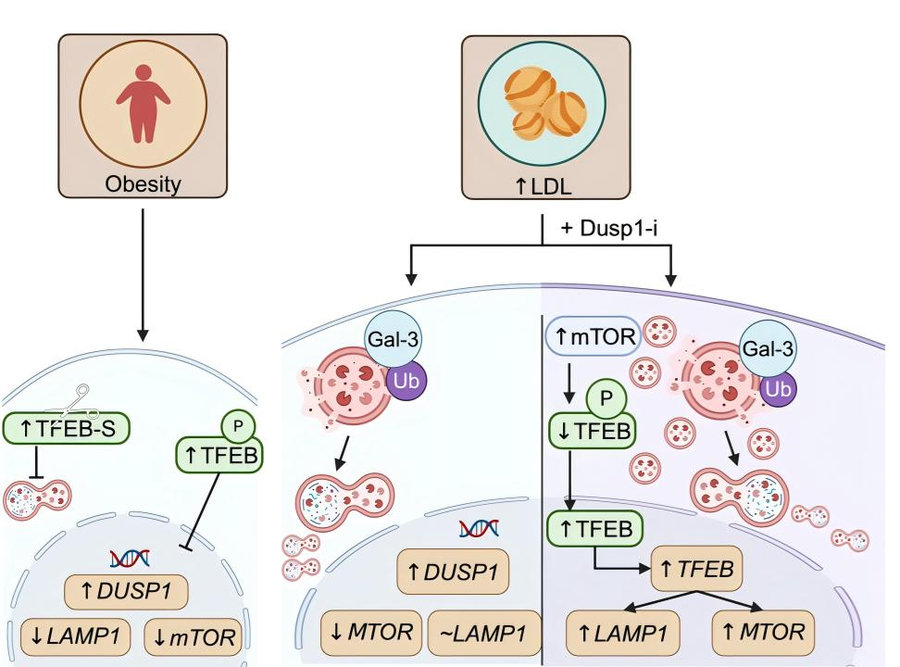 Fig.1 Mechanistic pathway: obesity & LDL induce DUSP1 to suppress mTOR/TFEB-Driven lysosome biogenesis and NK cell cytotoxicity under adverse social health determinants. (Baumer, et al., 2024)
Customer Review
Overcoming Low Yields in Visceral Fat Extraction
We were struggling with terrible cell yields and high mortality rates when trying to isolate resident NK cells from visceral fat pads in our diet-induced obesity mouse cohorts. Partnering with Protheragen completely changed the game for us; their specialized extraction protocols delivered beautiful, highly viable populations that made our adoptive transfer experiments incredibly successful."
Dr. H. V., Lead Immunometabolism Researcher
Preserving Phenotypic Stability for Multi-Dose Studies
"The team at Protheragen didn't just deliver cells; they provided invaluable technical advice on maintaining stable phenotypes in high-lipid environments. Their amplification service gave us the precise cellular volumes we required for our entire multi-dose preclinical study, and we are already planning our next batch with them."
Dr. M. T., Research Project Manager
Frequently Asked Questions
-
Can you isolate NK cells from heavily inflamed, high-fat tissue samples?
Yes, we have optimized our enzymatic digestion and washing steps to cleanly separate stromal vascular fractions from high-lipid supernatants, ensuring high yields even from severely obese animal tissues.
-
What species do you routinely work with for this service?
We regularly process samples from mice (C57BL/6, Balb/c, transgenic models), rats, and human non-clinical tissue donations (like bariatric surgery residues).
-
How do you prevent the NK cells from becoming exhausted during the amplification process?
We use continuous-perfusion bioreactors instead of static wells. This constantly removes metabolic waste and provides fresh nutrients and low-dose cytokines, mimicking a natural physiological environment.
-
Can we choose the specific cytokine cocktail used for amplification?
Absolutely. We can use your exact formulation or recommend one of our proprietary blends designed to generate either highly cytotoxic or immunomodulatory phenotypes.
-
Do you provide validation data with the delivered cells?
Every batch comes with a detailed certificate of analysis. This includes flow cytometry histograms for purity, cell viability scores, and sterility test results.
-
Are these expanded cells suitable for direct injection into animal models?
Yes, they are formulated in appropriate, sterile buffers ready for adoptive transfer experiments in your preclinical animal models.
-
What is the typical turnaround time for an isolation and expansion project?
Most standard projects take between three and five weeks from tissue receipt to final product delivery, depending on the expansion scale you require.
-
How do you ensure the cells don't worsen systemic insulin resistance upon transfer?
We can tailor the cell culture conditions to reduce the production of IFN-γ while enhancing protective cytokines like IL-10, helping you test safer therapeutic strategies.
-
Can you help us design the downstream cytotoxicity assays?
Yes, our scientific team can assist in setting up co-culture experiments with adipocyte cell lines or primary preadipocytes to evaluate therapeutic efficacy.
Contact Us
Developing effective cell therapies for complex metabolic conditions like obesity requires starting with premium, uncompromised cell populations. Protheragen provides the specialized isolation, tailored amplification, and rigorous validation needed to ensure your preclinical programs stand on solid scientific ground. Welcome to Contact Protheragen today to see how we can bring your project requirements to life.
Reference
- Baumer, Y.; et al. Obesity modulates NK cell activity via LDL and DUSP1 signaling for populations with adverse social determinants. JCI Insight. 2024, 10(2), e180606 (CC BY 4.0).
All of our services and products are intended for preclinical research use only and cannot be used to diagnose, treat or manage patients.