
Peripheral NK Cell Therapy Development Service
InquiryObesity is no longer understood as just a metabolic disorder of caloric storage. It is increasingly recognized as a state of chronic, low-grade systemic inflammation that profoundly alters immune system homeostasis. Natural killer (NK) cells, a key lineage of innate lymphocytes, are highly vulnerable to these metabolic shifts. Chronic exposure to high levels of lipid molecules and altered adipokine profiles in obese environments leads to severe metabolic paralysis and phenotypic exhaustion of these cells. This systemic dysfunction impairs their natural cytotoxic capacity, leaving obese individuals far more susceptible to malignancies and infectious diseases.
Peripheral NK Cell Therapy Development Service in NK Cell Therapy Development
At Protheragen, we have built a specialized preclinical development platform dedicated to restoring and optimizing peripheral NK cell therapies specifically tailored to function within these hostile, lipid-dense microenvironments. Our services provide the advanced cell engineering, metabolic reprogramming, and robust in vitro and in vivo validation frameworks required to push promising therapeutic candidates through the preclinical pipeline.
Core Technologies
To overcome the specific challenges of cell therapy in metabolic disease contexts, Protheragen integrates several cutting-edge preclinical technologies:
We utilize targeted molecular tools to modulate crucial metabolic checkpoints in peripheral NK cells, focusing heavily on protecting the mTOR pathway from lipid-induced down-regulation. This modification helps maintain high rates of glycolysis and oxidative phosphorylation, ensuring that the cells preserve their functional vigor and do not experience structural lipid accumulation when introduced into obese microenvironments.
Utilizing advanced genetic modification strategies, we alter expression patterns of key receptors to make engineered NK cells resistant to suppressive adipokines such as leptin and adiponectin. By engineering out these inhibitory signaling pathways, our peripheral NK therapies maintain robust activation profiles even under high systemic lipid pressures.
Our automated system tracks real-time killing kinetics of peripheral NK cells when co-cultured with target cells in specialized, lipid-enriched media that accurately mimic the physiological conditions of obese serum.
Solution Scope
Protheragen offers an end-to-end suite of preclinical services tailored to the specific demands of developing cell therapies for metabolic disorders. Our capabilities cover everything needed to prove your therapeutic concept before entering clinical testing.
- Phenotypic and Functional Profiling in Obesity Models
Obesity radically reshapes the receptor landscape of NK cells. We provide deep immunophenotyping using multi-color flow cytometry to track the expression of activating receptors (like NKG2D and NKp46) and inhibitory checkpoints. We also perform exhaustive cytotoxicity assays using lipid-loaded target cells, measuring granzyme B and perforin release alongside interferon-γ production to map exactly how well your therapeutic candidate performs when surrounded by high fatty acid concentrations.
- Tailored Metabolic Interventions and Media Simulation
Standard cell culture media fail to capture the true metabolic chaos of a patient with severe metabolic syndrome. Our laboratory recreates these precise in vivo conditions by formulating customized, lipid-enriched culture environments. We use these platforms to test how different metabolic modulators can prevent the cellular paralysis typically caused by lipid overexposure. This allows us to fine-tune the metabolic profile of your peripheral NK cells for maximum survival.
- Comprehensive In Vivo Preclinical Evaluation
Moving beyond the cell culture dish, we offer extensive testing in specialized animal models. We utilize diet-induced obesity (DIO) mouse models to evaluate the homing capabilities, systemic persistence, and therapeutic efficacy of engineered peripheral NK cells. Our advanced imaging and tissue-harvesting workflows let us track exactly how well the administered cells infiltrate targeted tissues and resist the suppressive metabolic signals generated by expanded adipose tissue.
Submit Your Project Details to design a customized preclinical evaluation study.
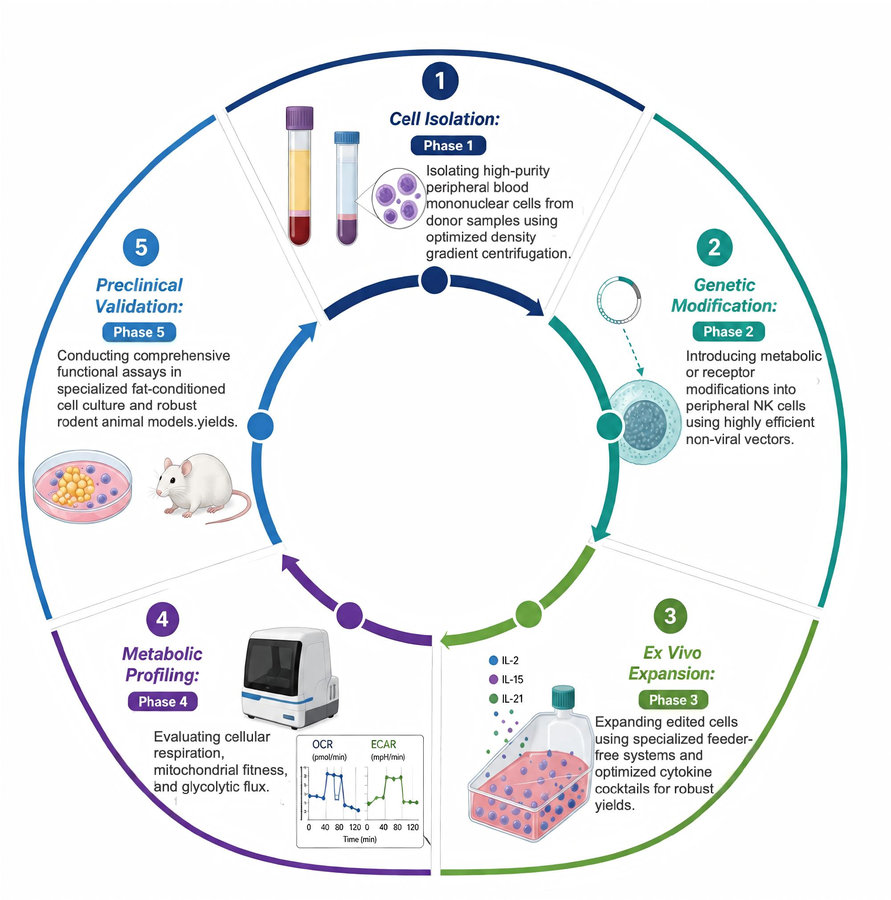
Workflow
Our preclinical workflow ensures a smooth, data-driven journey from initial isolation to complete validation of therapeutic candidates.
Fields of Application
Our specialized cell development services support multiple branches of modern biomedical research focused on the intersection of metabolism and immunity:
- Onco-Immunology in Obesity
Developing peripheral NK therapies that resist metabolic exhaustion to effectively target solid tumors in obese patient profiles. - Metabolic Syndrome Therapeutics
Investigating how optimized innate immune cells can help modulate chronic tissue-level inflammation within expanded visceral adipose tissue. - Infectious Disease Defense
Engineering resilient NK cells capable of maintaining robust viral clearance and interferon secretion despite high systemic lipid exposure.
Advantages
Partnering with Protheragen gives your discovery program access to unmatched technical specialization and validated assay systems built for metabolic immunology.
Hostile Microenvironment Simulation
We do not just test your cells in standard incubator conditions; instead, we challenge them against specialized, lipid-saturated environments that perfectly mirror chronic metabolic disease states. This deep physiological relevance gives you a much clearer, highly reliable picture of true therapeutic potential early in development, saving significant time and downstream costs.
Decades of Immunology Expertise
Our scientific leadership brings years of hands-on experience in metabolic immunology and cell processing workflows directly to your project. This deep institutional knowledge means we don't just generate raw numbers; we deliver profound, highly actionable biological insights that can actively save struggling drug discovery programs. We know exactly how to troubleshoot delicate cell lines.
Tailored Preclinical Assay Design
We recognize that every engineered peripheral NK cell line has its own unique modifications and requirements, so we refuse to use rigid, one-size-fits-all testing templates. Our team collaborates closely with your scientists to build completely customized screening matrices that highlight the specific strengths of your unique therapeutic design. This custom approach ensures no valuable therapeutic mechanism goes unnoticed during evaluation.
Contact us to receive a detailed technical consultation.
Publication Data
Title: Effects of obesity on NK cells in a mouse model of postmenopausal breast cancer
Journal: Scientific Reports, 2020
DOI: https://doi.org/10.1038/s41598-020-76906-5
Summary: This ovariectomized obese BALB/c mouse study shows high-fat diet elevates leptin/IL-6, suppresses NKp46 on NK cells, upregulates adipose MULT1, and accelerates 4T1 breast tumor growth. Impaired NK cell anti-tumor function links obesity to higher postmenopausal breast cancer risk.
Key Findings
- This diet-induced obese (DIO) ovariectomized BALB/c mouse model recapitulates postmenopausal triple-negative breast cancer using orthotopic 4T1 cells engineered with codon‑optimized firefly luciferase reporter, split into short (20 h) and long-term (4-week) assays. DIO mice had greater body/visceral fat mass, plus elevated plasma leptin and IL-6 marking chronic low-grade inflammation. Bioluminescence and caliper tracking confirmed faster early tumor progression in obese mice despite matching end-stage tumor weight, driven by tumor necrosis in obese lesions.
- Peripheral immune profiling revealed reduced circulating lymphocytes, lowered anti-inflammatory Ly6Clow monocytes, and expanded granulocytes in DIO groups. While total NK cell frequency rose long-term in tumor-bearing obese mice, surface NKp46 (CD335) expression per NK cell was significantly diminished at both protein and splenic mRNA levels, crippling NK cytotoxic capacity. Visceral adipose tissue from DIO mice overexpressed the NKG2D activating ligand MULT1; excess MULT1 sequesters NK cells in fat depots, depleting tumor-reactive NK pools. Tumor-bearing obese mice also displayed shifted T-cell subsets: fewer CD4+ helper T cells and more cytotoxic CD8+ T cells, plus reduced peripheral B cells. Splenic NK ESR1 estrogen receptor mRNA dropped in obese/tumor mice, suggesting postmenopausal adipose estrogen further blunts NK anti-tumor immunity. Collectively, obesity disrupts NK receptor-ligand balance to fuel postmenopausal breast cancer progression.
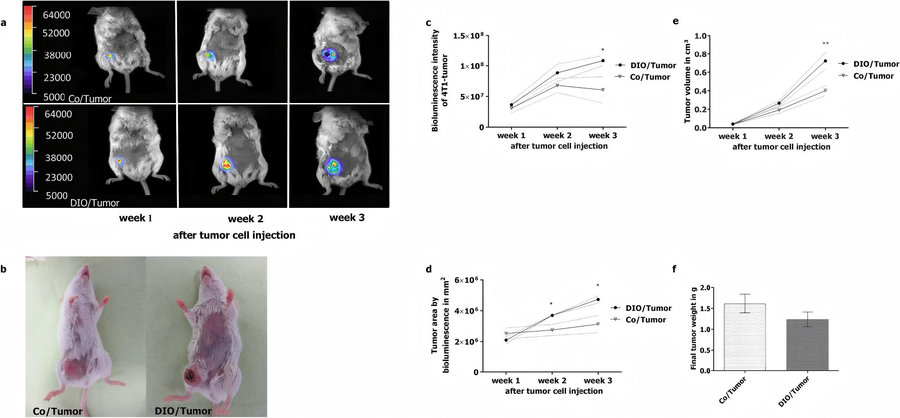 Fig.1 Bioluminescence imaging and caliper measurement of tumor progression in orthotopic 4T1 tumor-bearing ovariectomized mice under normal-chow versus high-fat-diet induced obese conditions. (Spielmann, et al., 2020)
Customer Review
Overcoming Lipid-Induced Suppression in ADCC Discovery Programs
"Our therapeutic antibody-dependent cellular cytotoxicity program was stalling because our NK candidates kept losing functional vigor in lipid-dense environments. Protheragen stepped in and completely revitalized our preclinical approach. Their customized fat-conditioned screening platforms gave us the exact physiological data we needed to optimize our engineering strategy. We are already mapping out our next round of in vivo evaluation with their team."
Dr. A. T., Research Scientist of Immunotherapy Discovery
Unlocking Mitochondrial Insights via Specialized Diet-Induced Disease Models
"The level of scientific depth the team brought to our metabolic immunology project was truly impressive. They didn't just hand over raw screening data; they worked alongside us to interpret how lipid accumulation was impacting mitochondrial polarization in our cells. Having access to their specialized diet-induced obesity models saved our project months of trial and error."
Dr. E. R., Lead Principal Scientist
Frequently Asked Questions
-
Why do peripheral NK cells need specific development services for obesity?
Obesity creates an incredibly hostile systemic environment filled with suppressive adipokines and free fatty acids that physically paralyze normal NK cell metabolism. Standard NK cell therapies often fail rapidly when introduced to these conditions. Our services specifically engineer and validate cells to resist this metabolic exhaustion, ensuring they remain active and dangerous to targets.
-
Can you help us modify our existing peripheral NK cells to make them lipid-resistant?
Yes, absolutely. Our core technologies include metabolic reprogramming and receptor engineering platforms specifically designed to insert into your existing cell lines. We can alter metabolic checkpoints or knock down specific adipokine receptors to shield your cells from lipid-induced suppression.
-
What kind of in vitro models do you use to simulate an obese environment?
We utilize specialized, custom-formulated media profiles rich in specific free fatty acids like palmitate and oleate, alongside altered ratios of leptin and adiponectin. This closely recreates the exact metabolic stress and lipid-induced signaling pathways that cells encounter inside an obese patient.
-
Do you provide clinical-grade cell manufacturing or human trials?
No, Protheragen focuses entirely on the preclinical stages of discovery and validation. We provide the essential in vitro profiling, metabolic engineering, and animal model data required to support your regulatory filings before you move into clinical trial phases.
-
How do you measure the metabolic health of the engineered NK cells?
We run comprehensive extracellular flux analyses to track real-time oxygen consumption rates and extracellular acidification rates. This tells us exactly how much energy the cells are producing via oxidative phosphorylation and glycolysis, giving us a direct look at their mitochondrial fitness under lipid stress.
-
What animal models are available for in vivo validation?
We primarily utilize well-characterized diet-induced obesity (DIO) rodent models. These animals are maintained on high-fat diets to develop the exact systemic low-grade inflammation and metabolic shifts needed to rigorously test your cell therapy's homing and persistence.
-
What is the typical turnaround time for a full preclinical testing validation cycle?
Timeline depth depends heavily on the specific scope of the in vivo studies, but a standard in vitro metabolic profiling and cytotoxicity screening package typically takes between 6 and 8 weeks from cell receipt to final data delivery.
-
How do you ensure the purity of the peripheral NK cells during isolation?
We utilize highly optimized negative selection magnetic beads or advanced fluorescence-activated cell sorting workflows. This keeps the cells untouched by activating antibodies during isolation, ensuring their baseline state remains completely uncompromised before testing begins.
-
Can your platforms evaluate chimeric antigen receptor (CAR-NK) cells?
Yes, our cytotoxicity and metabolic profiling systems are perfectly suited for evaluating both standard peripheral NK cells and heavily engineered variants, including CAR-NK architectures facing metabolic suppression.
Contact Us
Developing effective cell therapies for patients facing complex metabolic conditions requires moving past simplified, traditional cell culture models. Protheragen provides the deep specialized expertise, customized lipid-stressed assay designs, and validated preclinical disease models necessary to prove your therapeutic candidate's resilience and efficacy. From initial phenotypic characterization to advanced metabolic engineering and deep in vivo tracking, we provide the clear, high-quality data packages required to move your program confidently toward regulatory success. Welcome to Contact Protheragen, and our team will get back to you within 24 hours.
Reference
- Spielmann, J.; et al. Effects of obesity on NK cells in a mouse model of postmenopausal breast cancer. Scientific Reports. 2020, 10(1), 20606 (CC BY 4.0).
All of our services and products are intended for preclinical research use only and cannot be used to diagnose, treat or manage patients.