
Obesity-related Proteins
InquiryObesity is a multifactorial metabolic disorder characterized by dysregulated energy homeostasis, altered lipid storage, and chronic low-grade systemic inflammation. Obesity involves interconnected signaling networks that link peptide hormones, adipose-derived factors, neural mediators, and metabolic receptors in the brain and peripheral organs. Key regulators such as leptin (LEP), adiponectin (ADPN), ghrelin (GHRL), glucagon-like peptide 1 (GLP-1), fibroblast growth factor 21 (FGF21), and melanocortin receptors (MCRs) control appetite signaling, insulin sensitivity, and lipid oxidation.
Advancing preclinical research, high-throughput drug screening, and biomarker development requires reliable, biophysically intact proteins that reflect native human biology. Inconsistent protein folding, variable glycosylation patterns, or trace endotoxin contamination can introduce experimental artifacts, confounding binding kinetics, cell-based signaling assays, and in vivo studies. This portfolio of recombinant obesity-related proteins is manufactured under strict quality standards to provide dependable research tools for structural biology, assay development, and metabolic drug discovery.
High-Purity Recombinant Proteins for Obesity & Metabolic Research
The obesity-related protein portfolio at Protheragen includes a broad range of target classes involved in metabolic regulation, energy balance, and endocrine signaling. To support multi-target metabolic drug discovery and translational research, we provide recombinant proteins categorized across major physiological pathways:

- Incretin and Appetite-Regulating Peptides: Research targets involved in postprandial signaling and satiety, including GLP-1, glucose-dependent insulinotropic polypeptide (GIP), peptide YY (PYY), ghrelin (GHRL), islet amyloid polypeptide (IAPP), and multi-receptor incretin co-agonists.
- Adipokines & Myokines: Endocrine signaling factors such as ADPN, LEP, resistin (RETN), chemerin (RARRES2), retinol-binding protein 4 (RBP4), and irisin (FNDC5) that regulate peripheral insulin sensitivity and fat storage.
- Fibroblast Growth Factor Axis: Endocrine growth factors and co-receptors, including FGF21, fibroblast growth factor 19 (FGF19), and beta-klotho (KLB), critical for lipid oxidation and energy expenditure studies.
- Receptors & Signaling Domains: Soluble receptor extracellular domains and functional receptors, including glucagon-like peptide 1 receptor (GLP-1R), leptin receptor (LEPR), melanocortin 4 receptor (MC4R), and growth hormone secretagogue receptor (GHSR).
- Metabolic Enzymes and Lipid-Binding Proteins: Molecules such as dipeptidyl peptidase 4 (DPP4) and fatty acid-binding protein 4 (FABP4), which contribute to peptide processing and intracellular fatty acid handling.
Each protein is produced in optimized host platforms, including HEK293, CHO, Escherichia coli, and insect cells, ensuring proper disulfide bonds, native tertiary structure, and functional cross-reactivity across human, rodent, and non-human primate orthologs.
Applications
- Adipocyte Differentiation and Signaling
Active adipokines, including ADPN, RETN, and RARRES2, facilitate in vitro studies on pre-adipocyte differentiation, glucose uptake, AMPK pathway activation, and lipolysis regulation.
- Immunoassay Standard Calibration
High-purity proteins serve as reference standards for ELISA, Western Blotting, multiplex Luminex assays, and mass spectrometry quantification across clinical biomarker panels.
- In Vivo Metabolic Profiling
Carrier-free, low-endotoxin preparations are suitable for acute and chronic dosing in rodent models (e.g., ob/ob, db/db) to assess food intake, body weight changes, energy expenditure, and glucose tolerance.
- Structural Biology Studies
Monodisperse, non-aggregated protein preparations provide stable material for X-ray crystallography, cryo-Electron Microscopy (cryo-EM), and NMR structural analysis to support structure-guided drug design.
Advantages
Bioassay-Verified Biological Activity
Biological activity is evaluated using appropriate functional assays, such as cell proliferation and ligand-receptor binding. Available activity data and assay details are provided according to product-specific specifications.
Low Endotoxin Levels
Proteins are processed with specialized endotoxin removal techniques to prevent non-specific immune responses in sensitive primary cells and animal models. Endotoxin content is confirmed by LAL testing to remain strictly below 1.0 EU/µg.
Lot-to-Lot Reproducibility
Standardized purification protocols and process monitoring maintain consistent purity, molecular weight, and biological activity across lots, eliminating experimental drift in long-term screening programs.
Publication Data
Title: Understanding the Role of Adipokines in Cardiometabolic Dysfunction: A Review of Current Knowledge
Journal: Biomolecules, 2025
DOI: https://doi.org/10.3390/biom15050612
Summary: This review examines the roles of adipokines in cardiometabolic dysfunction, focusing on their pro-inflammatory and anti-inflammatory activities and the molecular signaling pathways involved in disease development and progression. It discusses how these adipocyte-derived signaling proteins contribute to conditions associated with obesity and cardiovascular and metabolic disorders, while highlighting the complexity of their effects across different physiological contexts. The review also evaluates the current potential of adipokines as diagnostic biomarkers and therapeutic targets, identifying gaps in understanding their mechanisms and clinical applicability. These insights may help clarify the links between adipose tissue dysfunction and cardiometabolic disease, support the identification of biomarkers for earlier disease detection, and guide future research into targeted therapeutic strategies.
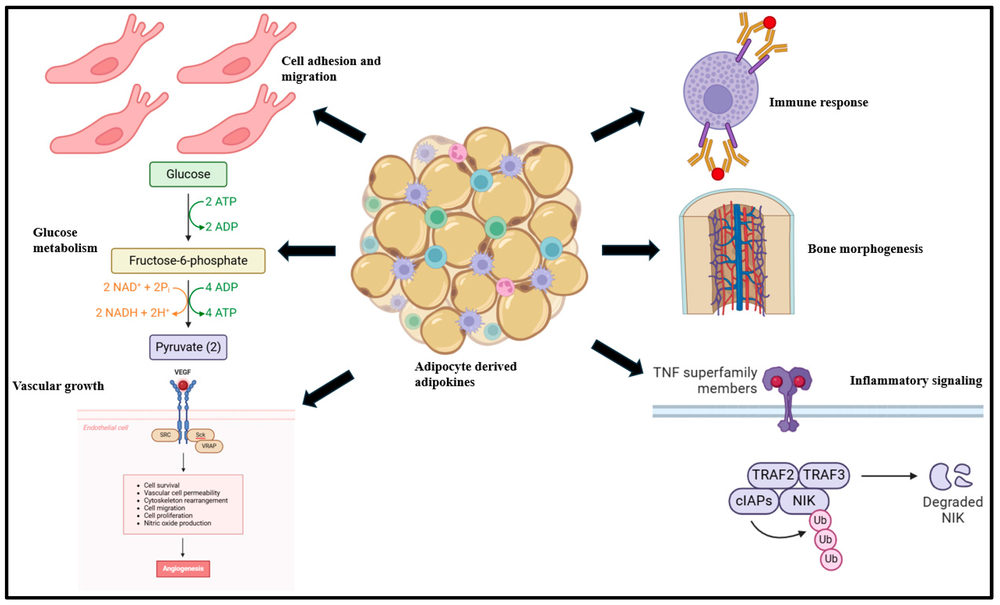 Fig.1 Adipokines regulate inflammation, immune responses, glucose metabolism, and vascular development. (Datta, et al., 2025)
Customer Review
Resolution of False-Positive Inflammatory Background in Adipocyte Assays
"Endotoxin-related interference had complicated our inflammatory response assays in adipocyte cultures. Using adipokine preparations with low endotoxin levels helped reduce nonspecific background signals and improve assay consistency."
A. T., Lipid Research Assistant
Reliable Reference Standards for Immunoassay Calibration
"Recombinant ADPN and FGF21 serve as calibration materials in our ELISA assay development. Their quality and storage performance have been suitable for our laboratory's analytical requirements."
M. V., Assay Scientist
Frequently Asked Questions
-
Which expression platform should I select for my research?
Mammalian systems (HEK293, CHO) are recommended when complex post-translational modifications like N-glycosylation are required for receptor binding. E. coli is ideal for non-glycosylated proteins and small peptide hormones.
-
Are carrier-free formulations available?
Yes. All proteins are formulated without BSA or exogenous carrier proteins. They are lyophilized from sterile buffers with trehalose or mannitol to prevent analytical interference.
-
How should reconstituted proteins be stored?
Reconstituted solutions remain stable at 2°C to 8°C for up to one week. For long-term storage, prepare single-use aliquots and store at -20°C or -80°C to avoid freeze-thaw cycles.
-
Can these proteins be used as calibration standards in ELISA?
Yes. Purified proteins undergo strict identity and purity testing, making them reliable reference standards for sandwich ELISA, Western Blotting, and multiplex immunoassays.
Successful metabolic drug discovery relies on structurally intact, biologically active target proteins. Protheragen provides recombinant proteins associated with obesity research, including signaling ligands, receptor domains, adipokines, and metabolic enzymes. These products are intended for a variety of laboratory applications, with product-specific quality information and analytical data available to support studies of metabolic pathways and therapeutic candidate development. To learn more about our obesity-related products, contact us today.
Reference
- Datta, S.; et al. Understanding the role of adipokines in cardiometabolic dysfunction: A review of current knowledge. Biomolecules. 2025, 15(5): 612. (CC BY 4.0)
Obesity-related Proteins
- Species: Rat
- Origin: Recombinant
- Conjugation: Unconjugate

- Species: Mouse
- Origin: Recombinant
- Conjugation: Unconjugate
- Species: Human
- Origin: Recombinant
- Conjugation: Unconjugate
- Species: Human
- Origin: Recombinant
- Conjugation: Unconjugate
- Species: Human
- Origin: Recombinant
- Conjugation: Unconjugate
- Species: Human
- Origin: Recombinant
- Conjugation: Unconjugate
- Species: Mouse
- Origin: Recombinant
- Conjugation: Unconjugate
- Species: Human
- Origin: Recombinant
- Conjugation: Unconjugate
- Species: Human
- Origin: Recombinant
- Conjugation: Unconjugate
- Species: Mouse
- Origin: Recombinant
- Conjugation: Unconjugate
