
Lipid Labeling & Detection Reagents
InquiryLipids function as crucial structural components, metabolic energy substrates, and vital intracellular signaling molecules. In weight loss therapy development, tracking how potential drug candidates influence lipid uptake, droplet biogenesis, lipolysis, and intracellular transport is essential. Protheragen provides an advanced suite of lipid labeling & detection reagents specifically engineered to empower researchers and pharmaceutical developers in visualizing and quantifying complex lipid dynamics.
Illuminating Lipid Dynamics: Advanced Labeling and Detection Tools to Accelerate Obesity Research
Our state-of-the-art bioorthogonal probes, fluorescent fatty acid analogs, and solvatochromic lipid droplet indicators allow real-time monitoring of lipid flux across in vitro, ex vivo, and in vivo experimental models. By providing high signal-to-noise ratios, exceptional biocompatibility, and minimal structural perturbation, we enable actionable insights that accelerate lead optimization for antiobesity drug pipelines.
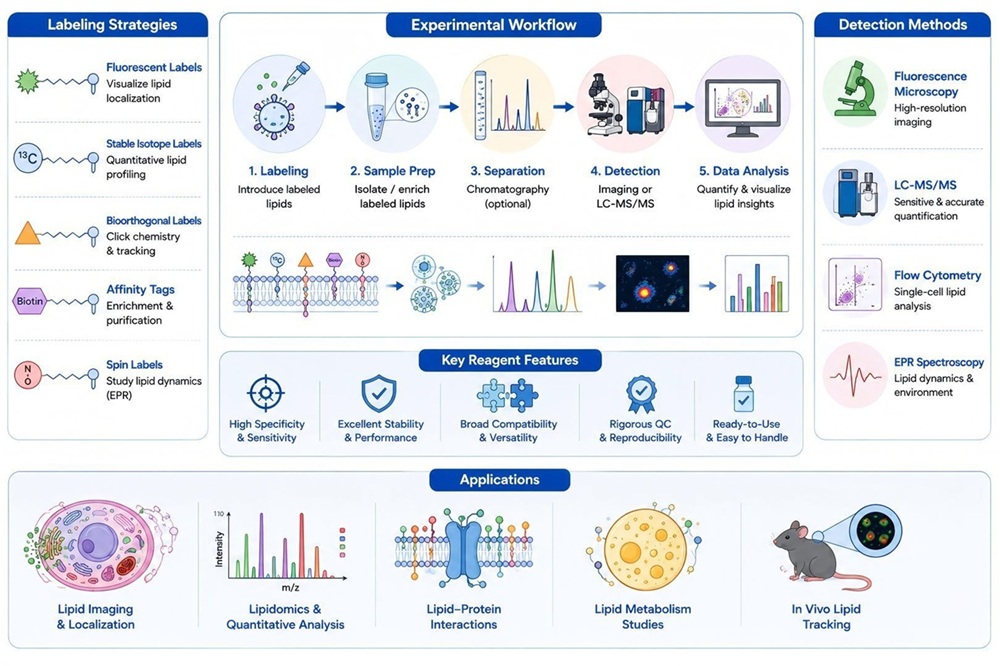
Core Characteristics
Bioorthogonal Click Chemistry Probes
Our platform uses alkynyl- and azido-modified lipids that enter natural metabolic pathways without disturbing native processes. A rapid bioorthogonal click reaction with fluorophore-tagged reagents enables high-resolution spatial localization and quantitative detection via fluorescence microscopy or flow cytometry.
Solvatochromic Environment-Sensitive Fluorophores
These fluorophores shift emission spectra based on local lipid polarity and viscosity. Selectively accumulating in hydrophobic lipid droplets or membrane domains, they emit fluorescence only in nonpolar cores. This eliminates background signal from unreacted probe in aqueous media, enabling wash-free live cell imaging during lipolysis or adipogenesis.
Photostable Near-Infrared Fluorescent Lipid Conjugates
For deep tissue visualization and whole animal imaging, Protheragen provides near-infrared lipid conjugates. Operating within the tissue optical window, these probes minimize autofluorescence and scattering to track adipose tissue remodeling, hepatic lipid accumulation, and systemic lipid clearance.
Applications
- Adipocyte Differentiation and Lipolysis Profiling
Quantifying preadipocyte maturation into adipocytes is fundamental to understanding fat storage. Our reagents enable continuous tracking of lipid droplet growth, structural remodeling, and hormone-stimulated lipolysis to measure drug effects on fat breakdown.
- Mitochondrial Lipid Oxidation and Thermogenesis
Activating brown and beige adipose tissue thermogenesis is a leading weight loss strategy. Our organelle-selective probes enable simultaneous monitoring of lipid transport into mitochondria and mitochondrial membrane potential changes to identify thermogenic compounds.
- Intestinal Lipid Absorption and Enterocyte Transport
Reducing dietary lipid absorption provides an established weight management pathway. Our fluorescent fatty acid and triglyceride mimics enable high-throughput screening of enterocyte lipid uptake inhibitors and digestive lipase modulators.
- Systemic Lipid Redistribution and Tissue Profiling
Understanding how therapeutics alter systemic lipid partitioning across muscle, heart, liver, and adipose depots is critical. Our near-infrared lipid tracers track systemic lipid clearance and tissue uptake dynamics in animal models.
Advantages
Minimal Structural Perturbation
Ultracompact chemical tags retain native lipid sterics, preserving authentic membrane partitioning, subcellular localization, transport kinetics, and enzymatic turnover.
High Signal-to-Background Ratio
Optimized fluorophore and functional group chemistry minimizes non-specific binding, enabling crisp visualization, accurate quantitative analysis, and clear signal detection in complex biological samples.
Versatile Bioorthogonal Compatibility
Designed with versatile click-chemistry handles (e.g., azides, alkynes) for flexible late-stage functionalization, multiplex imaging, and seamless live-cell or fixed-sample workflows.
Publication Data
Title: [18F]BODIPY-triglyceride-containing chylomicron-like particles as an imaging agent for brown adipose tissue in vivo
Journal: Scientific reports, 2019
DOI: https://doi.org/10.1038/s41598-019-39561-z
Summary: In this study, researchers developed a novel dual-modal fluorescent/PET radiotracer, [18F]BODIPY-C16-triglyceride, incorporated into pre-synthesized chylomicron-like particles to image and quantify brown adipose tissue (BAT) in vivo. The tracer was successfully synthesized with high yields and passed rigorous quality control, effectively visualizing BAT in mouse models with significantly enhanced uptake observed upon cold exposure. This approach offers a reliable method for tracking triglyceride-derived fatty acid uptake by BAT, providing a valuable alternative imaging strategy to overcome the limitations of conventional [18F]FDG PET-CT, particularly under insulin-resistant conditions like type 2 diabetes.
Customer Review
Reliable Quality Probes for Adipocyte Signaling
"Bioorthogonal lipid probes from Protheragen enabled us to visualize fatty acid uptake and lipid droplet remodeling in primary human adipocytes with clear, high-contrast imaging. The low background signal and strong photostability allowed our team to generate consistent quantitative data across our primary compound library."Dr. A. T., Bioanalytical Scientist
High Sensitivity in Lipid Screening Assays
"The solvatochromic fluorophores from Protheragen delivered excellent signal contrast in live-cell assays, helping us streamline our assay development timeline. Their product specifications held in our validation runs, demonstrating consistent lot-to-lot reproducibility across multiple compound series." Dr. J. V., Medicinal Chemistry Scientist
Frequently Asked Questions
-
How do bioorthogonal lipid probes maintain native enzymatic recognition?
Our probes feature minimal modifications like small terminal alkynyl or azido groups. Adding minimal steric bulk, cellular enzymes process labeled substrates virtually identically to endogenous lipids.
-
What fluorophore wavelengths are available for multiplexing experiments?
We offer probes spanning blue, green, orange, red, and near-infrared wavelengths, enabling seamless multiplexing with immunofluorescence markers, organelle stains, and viability dyes.
-
How do your products support drug discovery targeting brown adipose tissue activation?
Our organelle target probes allow simultaneous live cell tracking of fatty acid trafficking into mitochondria and thermogenic uncoupling protein activity to identify brown fat activators.
-
Are custom lipid synthesis and tailored labeling services available for novel targets?
Yes, Protheragen provides custom chemical synthesis tailored to your research requirements, including specialized modifications, custom fluorophores, or isotope tags.
Protheragen is committed to advancing therapeutic discovery through innovative lipid technology, superior analytical tools, and dedicated scientific support. Whether you require off-the-shelf lipid detection kits, high-throughput assay development, or custom probe synthesis, our team of Ph.D. scientists is ready to accelerate your weight loss therapy pipeline. Contact us today to explore how Protheragen can support your metabolic research goals.
Reference
- Paulus, A.; et al. [18F] BODIPY-triglyceride-containing chylomicron-like particles as an imaging agent for brown adipose tissue in vivo. Scientific Reports. 2019, 9(1): 2706. (CC BY 4.0)
Lipid Labeling & Detection Reagents
- Appearance: Liquid
- Purity: ≥99% (deuterated forms, d1-d11)
- Identity: Confirmed by TLC and HPLC.

- Appearance: Liquid
- Purity: ≥99% (deuterated forms, d1-d5).”
- Identity: Confirmed by TLC and HPLC.

- Appearance: Crystalline solid
- Purity: ≥95%
- Identity: Confirmed by NMR, TLC, and HPLC.

- Appearance: Liquid
- Purity: ≥99% (deuterated forms, d1-d5)
- Identity: Confirmed by TLC and HPLC.
- Appearance: Solid
- Purity: ≥99% (deuterated forms, d1-d3)
- Identity: Confirmed by NMR, TLC, and HPLC.
- Appearance: Liquid
- Purity: ≥99% (deuterated forms, d1-d11)
- Identity: Confirmed by TLC and HPLC.
- Appearance: Solid
- Purity: ≥99% (deuterated forms, d1-d3)
- Identity: Confirmed by NMR, TLC, and HPLC.
- Appearance: Crystalline solid
- Purity: ≥99% (deuterated forms, d1-d3)
- Identity: Confirmed by NMR and TLC.
- Appearance: Crystalline solid
- Purity: ≥95%
- Identity: Confirmed by NMR and TLC.
- Appearance: Liquid
- Purity: ≥95%
- Identity: Confirmed by NMR, TLC, and HPLC.