
Dendritic Cell Isolation and Culture Service
InquiryObesity is no longer understood as just a simple calorie imbalance. Over the last decade, we have come to recognize it as a state of chronic, low-grade systemic inflammation rooted deeply within the adipose tissue (fat tissue). Within this microenvironment, immune cell infiltration plays a massive role in metabolic dysfunction. While macrophages usually get a lot of the spotlight, dendritic cells (DCs) are actually critical upstream regulators. They act as the primary antigen-presenting cells that dictate whether the local immune environment leans toward a tolerant, anti-inflammatory state or a highly destructive, insulin-resistant inflammatory cascade.
Dendritic Cell Isolation and Culture Service in Dendritic Cell Therapy Development Service
At Protheragen, we recognize that targeting metabolic disorders through immunomodulation requires highly specialized tools. Our dendritic cell isolation and culture service is built specifically to support preclinical researchers exploring how DC subsets influence metabolic pathways, adipocyte hypertrophy (fat cell enlargement), and systemic insulin sensitivity. By providing exceptionally pure, functionally intact primary dendritic cells isolated from specific tissue types or differentiated from precursors, we empower your discovery pipeline. Whether your goal is to map the phenotypic shift of conventional DCs in obese mouse models or to engineer tolerogenic human DCs to damp down adipose tissue inflammation, our platform delivers the exact cellular foundation you need.
Core Technologies
Isolating and culturing dendritic cells from fragile, lipid-rich metabolic tissues presents unique technical challenges. Over years of optimization, Protheragen has established a proprietary suite of core technologies designed to protect cell viability and preserve natural functional phenotypes.
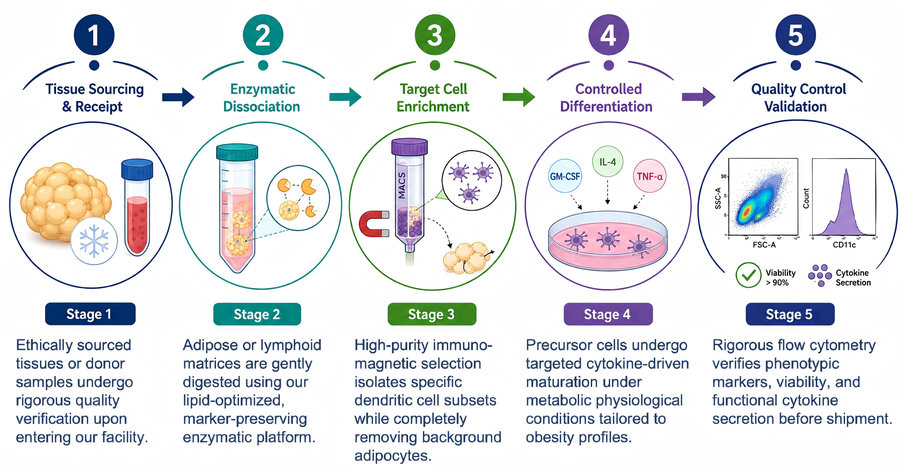
Standard enzymatic digestion can destroy delicate cell surface markers or trigger premature activation due to mechanical stress. Our proprietary, temperature-controlled enzymatic blends gently break down adipose matrices while safely isolating stromal vascular fraction (SVF) mononuclear cells without lipid contamination.
We deploy customized, negative and positive multi-parameter magnetic-activated selection protocols. This approach allows for the clean separation of rare conventional DC subsets (cDC1 and cDC2) and plasmacytoid DCs (pDCs) directly from high-fat diet (HFD) animal models or human donor samples, avoiding the activation artifacts common with standard sorting.
Standard commercial culture media often contain nutrient and insulin levels that inadvertently alter the metabolic programming of the DCs. Our specialized formulation mimics the physiological lipid and glucose gradients found in specific in vivo states, ensuring your cultured cells retain their true-to-life metabolic responses during in vitro assays.
Solution Scope
Our preclinical services cover every angle of dendritic cell isolation, differentiation, and validation, giving you a complete toolkit for metabolic immunology research.
- Primary Tissue Isolation Services
We extract primary dendritic cells directly from complex tissue microenvironments. This includes isolating adipose tissue-resident DCs from the stromal vascular fraction of white adipose tissue (WAT) and brown adipose tissue (BAT), as well as conventional isolation from spleen, lymph nodes, and peripheral blood. We support both healthy control and high-fat Diet Induced Obesity (DIO) Animal Models.
- In Vitro Culture and Differentiation
For projects requiring large cell numbers or controlled environmental priming, we offer full-scale differentiation services. We generate bone marrow-derived dendritic cells (BMDCs) from murine models or monocyte-derived dendritic cells (moDCs) from human peripheral blood mononuclear cells. These cells can be cultured under specialized conditions to drive them toward mature, immature, or specifically tolerogenic states using precisely calibrated cytokine cocktails.
- Co-Culture and Functional Profiling
To help you understand how your therapeutics work, we set up advanced in vitro assays that mimic the body's internal environment. We offer adipocyte-DC co-culture systems to measure how immune cells alter fat storage and lipolysis (the breakdown of fats). Additionally, we provide full T-cell proliferation assays and detailed cytokine and chemokine profiling (such as TNF-ɑ, IL-6, and IL-10) via multiplex assays to map exactly how your compounds modulate the immune response.
Connect with a Protheragen Specialist to Custom-Tailor Your Isolation Protocol.
Workflow
Navigating the complexities of tissue-resident cell isolation requires an exact, highly coordinated sequence of steps designed to maintain maximum cellular integrity from extraction to delivery.
Fields of Application
Our specialized dendritic cell platforms bridge the gap between basic immunology and metabolic disease, opening up critical new pathways for therapeutic exploration and discovery.
- Screening Immunomodulatory Obesity Drugs
Evaluate how novel small molecules, biologics, or natural compounds alter dendritic cell activation and cytokine output within inflamed fat tissue.
- Investigating Insulin Resistance Pathways
Explore the precise cellular mechanics behind how dendritic cell-driven T-cell activation promotes systemic insulin resistance and metabolic dysfunction.
- Developing Tolerogenic DC Therapies
Optimize methods for generating tolerogenic dendritic cells capable of calming chronic adipose tissue inflammation and restoring metabolic balance.
- Discovering Biomarkers
Map phenotypic changes and surface marker variations on tissue-resident dendritic cells across different stages of obesity progression to identify novel therapeutic targets.
Advantages
Navigating the delicate immune-metabolic interface demands high-performance cellular tools, and our platforms are engineered to overcome the chronic technical bottlenecks that typically stall obesity research.
Unparalleled Purity in Adipose Isolations
Isolating immune cells from fat tissue is notoriously difficult because lipids frequently contaminate the sample and cause high cell mortality. Our specialized processing protocols consistently yield a dendritic cell purity of greater than 90% from adipose fractions, a metric validated by rigorous multi-color flow cytometry. This means your downstream assays generate clean, highly reproducible data free from distracting background noise.
Preserved Metabolic Identity
Many isolation methods accidentally trigger or stress dendritic cells, ruining their native metabolic state before your experiments even begin. The cells we deliver preserve their exact in vivo activation state, giving you an accurate picture of how they behave in metabolic disease.
Extensive Preclinical Model Experience
We have spent years optimizing procedures across a wide variety of obesity models, including diet-induced obesity (DIO) rodents and complex genetic models like ob/ob and db/db mice. We understand the physiological differences in these tissues, allowing us to rapidly adapt our isolation parameters to match the unique characteristics of your chosen animal model.
Comprehensive Customization Options
We do not believe in a one-size-fits-all approach to science. We custom-tailor everything from the specific tissue source to the exact maturation state or cytokine cocktail used in culture to align perfectly with your experimental design. Every project is assigned a dedicated immunologist who works directly with you to optimize every parameter.
Request a Detailed Preclinical Project Quote Today!
Publication Data
Title: Conventional type 1 dendritic cells protect against age-related adipose tissue dysfunction and obesity
Journal: Cellular & Molecular Immunology, 2022
DOI: https://doi.org/10.1038/s41423-021-00812-7
Summary: This study identifies Batf3-dependent cDC1s as adipose-protective immune cells. cDC1 loss drives age-related obesity, insulin resistance and liver steatosis via depleted NK1.1⁺ iNKT cells. sFLT3L expands cDC1s to reverse diet-induced metabolic damage, relying on the cDC1–iNKT immune axis.
Key Findings
- cDC1 deficiency accelerates age-associated metabolic disease
Batf3 knockout mice lacking cDC1s on standard chow gain excess fat mass, lower energy expenditure, shift fuel metabolism toward carbohydrate lipogenesis, and develop insulin resistance, dyslipidemia and hepatic steatosis with age. Bone marrow chimera experiments confirm protective effects stem from Batf3-expressing hematopoietic cDC1s, not adipocyte-intrinsic Batf3. - cDC1s sustain metabolically protective NK1.1⁺ iNKT populations
Young cDC1-deficient mice lack visceral adipose NK1.1⁺ iNKT cells before obesity onset. cDC1s uniquely trigger iNKT IFN-γ secretion; IFN-γ licenses NK cells to clear pro-inflammatory M1 macrophages, preventing white adipose tissue low-grade inflammation. Loss of this axis elevates TNF-α, leptin and reduces protective adiponectin. - sFLT3L therapy relies on cDC1-iNKT signaling to treat obesity
Systemic soluble FLT3L selectively expands cDC1s over cDC2s in fat tissue, boosting energy expenditure and lowering serum triglycerides, cholesterol and liver lipid buildup in high-fat diet mice. This therapeutic benefit vanishes in Batf3-knockout or NK1.1-depleted animals, and partially restores in Rag1-deficient mice receiving iNKT adoptive transfer, proving cDC1 and NK1.1⁺ iNKT cells as mandatory mediators. - Nutrition modulates adipose cDC1 abundance
Fasting elevates visceral cDC1 counts, while chronic high-fat feeding depletes them; gene profiling links higher cDC1 signature scores to milder weight gain on obesogenic diets.
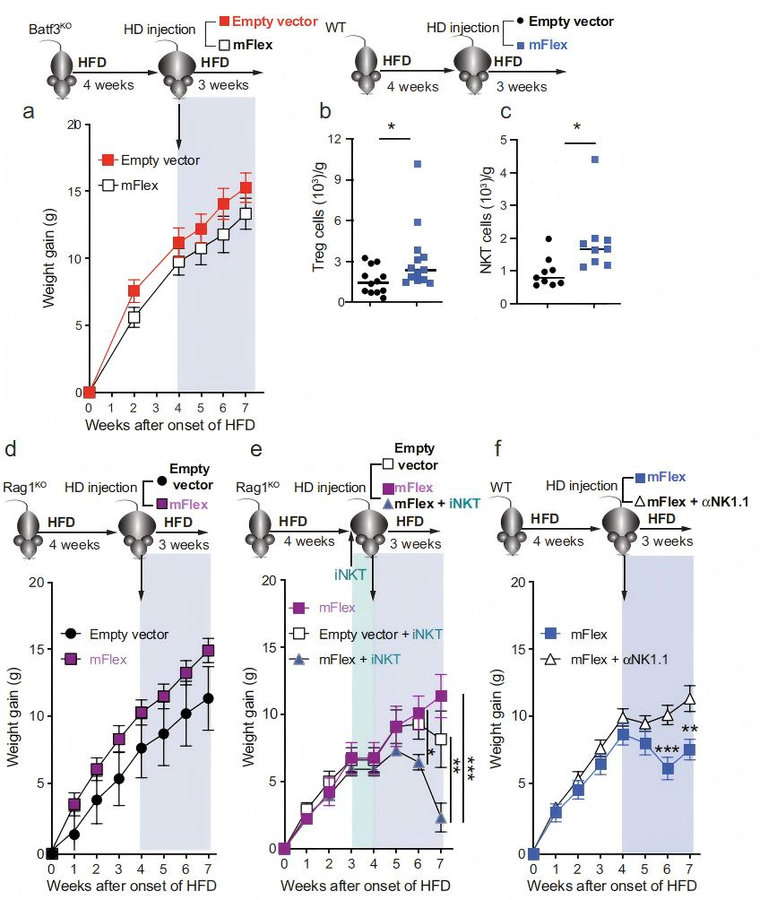 Fig.1 FLT3L targets cDC1-iNKT immune axis to reverse age and diet-driven obesity and fatty liver dysfunction. (Hernández-García, et al., 2022)
Customer Review
Overcoming Lipid Contamination Obstacles in High-Fat Diet Murine Models
"We were struggling to get clean, reproducible dendritic cell extractions from our high-fat diet mouse cohorts; lipid contamination was constantly ruining our downstream PCR and flow assays. Protheragen stepped in and completely optimized the isolation workflow. The purity and viability of the adipose-resident DCs they delivered allowed us to identify key upstream signaling mechanisms that we had been missing for months. We are already planning our next series of co-culture studies with their team."
Dr. A. T., Lead Immunometabolism Researcher
Accelerating Human In Vitro Discovery Pipelines via Tailored Fatty Acid Co-Cultures
"Our laboratory needed a reliable partner to differentiate human monocyte-derived DCs under specific fatty acid conditions to support our discovery pipeline. Protheragen didn't just deliver high-quality cells; their scientific team provided invaluable feedback on media formulation and physiological relevance. Their custom culture services saved us substantial assay validation time, and the data reproducibility has been outstanding. They have become an essential extension of our preclinical discovery team."
Dr. G. G., Research Associate
Frequently Asked Questions
-
What typical cell yields can I expect from the adipose tissue of diet-induced obese (DIO) mice?
Yields depend heavily on how long the animals have been on the high-fat diet and the specific fat pad targeted (e.g., epididymal vs. subcutaneous). Generally, obese adipose tissue yields significantly more stromal vascular fraction cells, but dendritic cells remain a rare population. We optimize our isolation scales based on your needed cell counts. Contact us to discuss your design.
-
Can you isolate specific conventional dendritic cell subsets like cDC1 and cDC2 from metabolic tissues?
Yes, our immunomagnetic and fluorescence-activated selection protocols can separate conventional type 1 (cDC1) and type 2 (cDC2) dendritic cells. This allows you to study the distinct roles these specific subsets play in driving or resolving adipose tissue inflammation.
-
How do you ensure that isolated dendritic cells do not become spontaneously activated during isolation?
We use low-temperature processing, gentle enzymatic dissociation, and customized anti-clumping formulas. We also strictly avoid harsh density gradient centrifugation steps whenever possible. This keeps the cells in their native, baseline activation state.
-
Can we supply our own tissues or animal models for your isolation services?
Absolutely. We can receive validated tissue samples shipped via optimized cold-chain transport networks, or we can source and house specific obesity models within our partner facilities to handle the entire process from start to finish.
-
Do you offer human primary dendritic cell isolation services tailored to obesity research?
Yes, we isolate monocyte-derived dendritic cells (moDCs) or primary circulating DCs from qualified human donor samples, including disease-state donors with high BMI or type 2 diabetes profiles. Reach out to discuss donor availability.
-
What quality control metrics do you provide with each delivered batch of cultured cells?
Each batch comes with a comprehensive certificate of analysis (CoA) detailing cell viability (typically greater than 85%), purity percentages via flow cytometry, and confirmation of correct morphology. We can also include functional cytokine secretion profiles upon request.
-
Can you induce specific metabolic states in the cultured DCs, such as loading them with fatty acids?
Yes, we can supplement our optimized culture media with specific fatty acids (like palmitate or oleate) or inflammatory mediators to mimic the lipotoxic environment of obese adipose tissue. Let us know your exact requirements.
-
What is the standard turnaround time for a custom isolation and culture project?
Standard projects typically take 2 to 4 weeks depending on the complexity of the tissue sourcing, the specific animal models requested, and the duration of the in vitro culture phases. We always provide a clear, detailed timeline during our initial consultation.
Contact Us
Targeting the immune system to treat metabolic diseases holds incredible therapeutic potential, but success depends on the quality of your cellular models. Protheragen provides the deep biological expertise, specialized tissue-dissociation technologies, and customized culture environments required to deliver pristine, functionally intact dendritic cell populations tailored precisely to your obesity research goals. From primary adipose tissue isolations to complex in vitro co-culture modeling, we handle the technical complexities so you can focus on breakthrough discoveries. Welcome to Contact Protheragen to discuss your specific requirements and explore potential collaboration opportunities.
Reference
- Hernández-García, E.; et al. Conventional type 1 dendritic cells protect against age-related adipose tissue dysfunction and obesity. Cellular & Molecular Immunology. 2022, 19(2), 260–275 (CC BY 4.0).
All of our services and products are intended for preclinical research use only and cannot be used to diagnose, treat or manage patients.