

Energy Metabolism Quantitative Analysis Service
InquiryObesity is no longer viewed merely as a lifestyle condition but as a complex, multi-systemic metabolic disorder driven by a fundamental imbalance between energy intake and energy expenditure. At Protheragen, we recognize that the path to breakthrough anti-obesity therapeutics requires more than just tracking weight loss; it demands a deep, quantitative understanding of the underlying metabolic shifts.
Energy Metabolism Quantitative Analysis Service for Anti-Obesity Therapeutics
By integrating advanced indirect calorimetry, body composition profiling, and cellular energetic assays, Protheragen offers a comprehensive toolkit for characterizing the efficacy and metabolic impact of novel compounds. We focus exclusively on the preclinical phase, ensuring that your lead candidates—whether they are GLP-1/GIP receptor agonists, thermogenic activators, or lipid metabolism modulators—are backed by robust, statistically powered evidence before advancing to clinical stages.
Core Technologies
Protheragen leverages a suite of high-precision technologies to provide a multi-dimensional view of energy homeostasis:
- High-Resolution Indirect Calorimetry
Utilizing state-of-the-art metabolic caging systems, we measure oxygen consumption (VO2), carbon dioxide production (VCO2), and the respiratory exchange ratio (RER). This allows for the precise calculation of energy expenditure and the determination of substrate preference (carbohydrate vs. lipid oxidation) in real-time.
- Dual-Energy X-ray Absorptiometry (DEXA) & NMR
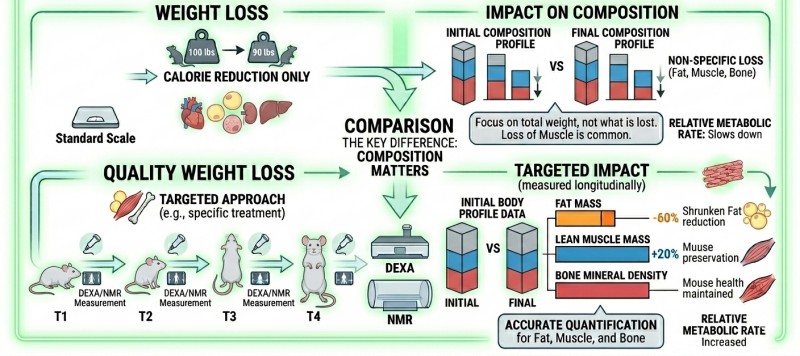
To distinguish between "weight loss" and "quality weight loss," we use non-invasive longitudinal imaging to quantify changes in fat mass, lean muscle mass, and bone mineral density.
- Bioluminescent Metabolic Pathway Assays
At the cellular level, we employ sensitive, plate-reader-based chemistries to measure glucose uptake, triglyceride accumulation, and fatty acid oxidation (FAO) in primary adipocytes or myocytes.
- Automated Behavioral & Intake Tracking
Our systems integrate high-frequency food and water intake scales with infrared beam-break sensors to correlate metabolic rate with physical activity and circadian rhythms.
Service Scope
Protheragen provides a flexible range of preclinical services tailored to the diverse landscape of metabolic research:
- Whole-Body Energy Balance
Quantitative assessment of energy expenditure (EE), basal metabolic rate, and the thermic effect of food/drugs.
- Substrate Utilization Profiling
Real-time monitoring of metabolic flexibility and the transition between glucose and lipid burning.
- Body Composition Analysis
Precise tracking of adiposity changes and the preservation of lean tissue.
- Lipid & Glucose Dynamics
Cellular assays for lipolysis, lipogenesis, and insulin-stimulated glucose uptake.
- Mitochondrial Bioenergetics
Analysis of mitochondrial mass, membrane potential, and oxidative stress markers.
Partner with Our Experts to Design Your Next Study.
Workflow
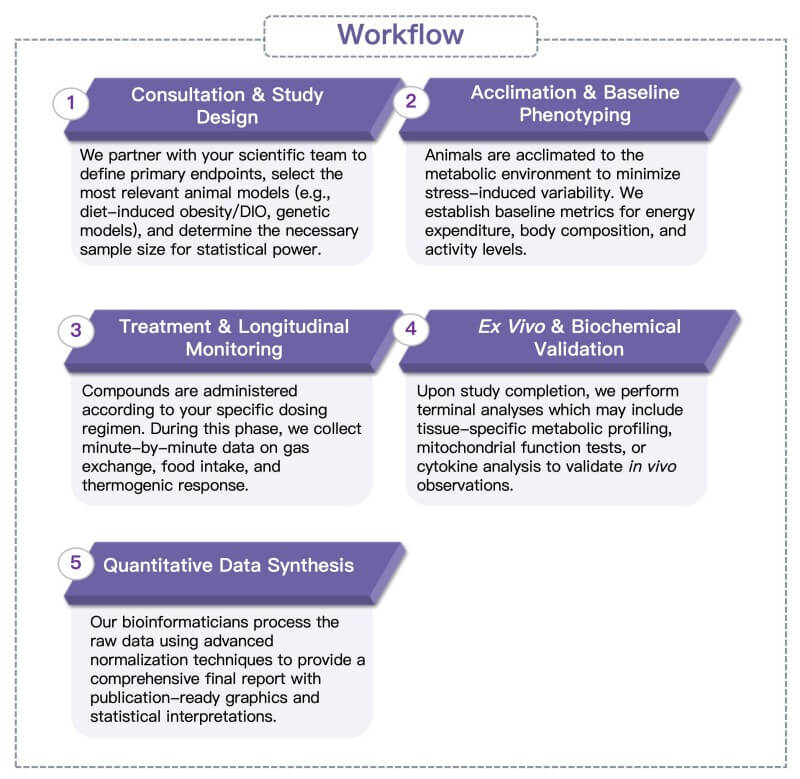
Our service process is engineered for scientific rigor and rapid turnaround, ensuring that your project moves from hypothesis to data-driven insight efficiently.
Fields of Application
Our services support a wide range of therapeutic development areas:
- Incretin Mimetics: Evaluating the metabolic effects of GLP-1, GIP, and Glucagon Receptor co-agonists.
- Brown Adipose Tissue (BAT) Activators: Quantifying the thermogenic potential and energy "drain" of UCP1-targeting compounds.
- Lipid Metabolism Modulators: Assessing the impact of ACC inhibitors or FASN inhibitors on whole-body fat oxidation.
- Appetite Suppressants: Distinguishing between weight loss driven by reduced caloric intake versus increased metabolic rate.
- Nutraceuticals: Providing rigorous scientific validation for metabolic-boosting functional ingredients.
Advantages
Choosing Protheragen means partnering with a specialist who prioritizes translational accuracy and data integrity.
- High-Resolution Data Integrity
Our systems capture data points every minute, allowing for the detection of subtle, transient metabolic shifts that traditional daily measurements miss.
- Standardized Normalization
We utilize the latest industry Consensus Models for data normalization, ensuring that energy expenditure results are not confounded by changes in body weight or composition.
- Optimized Statistical Power
Our protocols are designed based on quantitative analysis of variability, ensuring your study has the necessary N-size to reach significant conclusions.
- End-to-End Preclinical Focus
By specializing solely in preclinical research, we have refined our models to provide the most predictive data for human translation.
Customer Review
Uncovering Hidden Therapeutic Windows through High-Resolution Kinetic Data
"Protheragen has been an essential partner in our lead optimization phase. Their ability to provide minute-by-minute metabolic data allowed us to identify a specific thermogenic window for our candidate that we had previously missed. The depth of their final report was instrumental in our recent funding round."
Ms. Z. X., Emerging Biotech
Validating Mechanisms of Action with Precise Substrate Utilization Profiling
"The transition from in vitro success to in vivo validation is always a hurdle. Protheragen's expertise in indirect calorimetry gave us the confidence that our compound was truly increasing lipid oxidation rather than just suppressing appetite. We look forward to our next collaboration on our secondary scaffold."
Dr. M. J., Cardiovascular & Metabolic Diseases
Frequently Asked Questions
-
Why is indirect calorimetry better than just measuring body weight?
Body weight is a lagging indicator. Indirect calorimetry provides real-time "mechanistic" data, showing how a drug works—whether it increases energy burn or switches the body to burn more fat.
-
How do you handle the impact of body weight on energy expenditure calculations?
We use ANCOVA (analysis of covariance), which is the gold standard for metabolic data. This ensures that a decrease in energy expenditure isn't simply a result of the animal getting smaller, but a true metabolic change.
-
Can you differentiate between fat loss and muscle loss?
Yes. Our DEXA and NMR technologies allow us to track lean mass and fat mass separately, which is critical for assessing the "quality" of the weight loss.
-
What animal models do you typically use?
We most commonly work with C57BL/6J mice on high-fat diets (DIO), but we also support genetic models like ob/ob or db/db mice depending on your target.
-
How long does a typical metabolic cage study take?
A standard longitudinal study usually lasts 4 to 8 weeks, but we can perform acute 24-hour "thermogenic" screens for rapid candidate selection.
-
Do you provide cellular-level data?
Absolutely. We complement our in vivo work with in vitro assays for glucose uptake, lipolysis, and mitochondrial function to provide a full "molecule-to-organism" picture.
-
Can you measure physical activity?
Yes, our cages include XY and Z infrared beams to track total locomotion and rearing, allowing us to factor activity into the energy expenditure equation.
-
How do you minimize animal stress during the study?
We use a comprehensive acclimation period and specialized "red-light" systems that allow animals to feel secure in their environment while being monitored.
Contact Us
Protheragen provides the critical missing link in anti-obesity drug development. By harnessing the power of precision glycan precursor flux & functional metabolism analysis, we empower your preclinical programs with the resolution required to master the metabolic complexities of obesity. From mechanism validation to biomarker discovery, our platform is your partner in metabolic innovation.
Contact Protheragen for More Information and to Discuss Your Project
All of our services and products are intended for preclinical research use only and cannot be used to diagnose, treat or manage patients.