

Cellular Redox and Energy Homeostasis Analysis
InquiryObesity is increasingly recognized as a complex "redox disease," where the disruption of energy balance is inextricably linked to mitochondrial dysfunction and oxidative stress. In the quest for next-generation anti-obesity medications (AOMs), such as GLP-1/GIP multi-agonists and mitochondrial uncouplers, the ability to maintain cellular redox and energy homeostasis is a critical determinant of therapeutic efficacy and safety. Protheragen provides a specialized preclinical platform dedicated to the high-resolution analysis of these metabolic pillars.
Cellular Redox and Energy Homeostasis Analysis for Anti-Obesity Therapeutics
Our service focuses on the delicate interplay between reactive oxygen species (ROS) production, antioxidant defense systems (e.g., GSH/GSSG ratios), and mitochondrial bioenergetics. By evaluating how candidate compounds modulate the metabolic "switch" between energy storage and expenditure, Protheragen helps biopharmaceutical partners identify leads that not only promote weight loss but also restore systemic metabolic health. We bridge the gap between initial drug discovery and IND-enabling studies through rigorous, data-driven preclinical assessments.
Core Technologies
To provide a holistic view of metabolic health, Protheragen leverages a suite of high-sensitivity analytical technologies:
- High-Resolution Respirometry
We utilize advanced oxygen consumption rate (OCR) and extracellular acidification rate (ECAR) monitoring to assess mitochondrial health and glycolytic flux in real-time.
- Redox Proteomics & Metabolomics
Employing liquid chromatography tandem mass spectrometry (LC-MS/MS) and high-performance liquid chromatography (HPLC)-based quantification of biomarkers such as malondialdehyde (MDA), reduced/oxidized glutathione (GSH/GSSG), and nitric oxide metabolites (nitrite/nitrate).
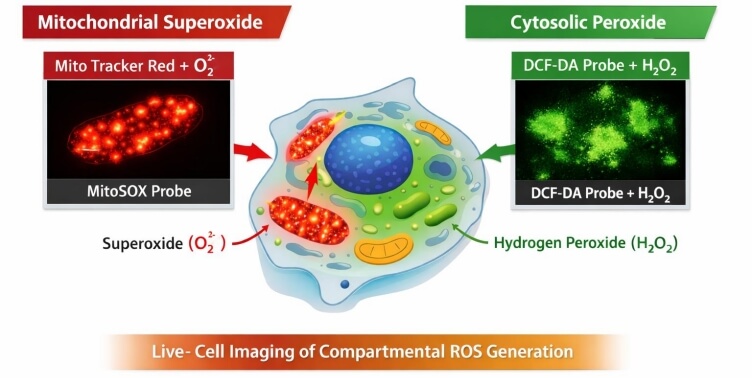
- Subcellular Redox Imaging
Live-cell imaging using redox-sensitive fluorescent probes to track compartment-specific ROS generation (e.g., mitochondrial superoxide vs. cytosolic peroxide).
- Enzymatic Activity Profiling
Quantitative assays for key metabolic regulators, including AMPK, Sirtuins, and NADPH-generating enzymes like G6PD, which are essential for maintaining the cellular reducing environment.
Service Scope
Our cellular redox and energy homeostasis analysis is vital for:
- Metabolic Reprogramming Agents
Testing Sirt1 and AMPK activators for their ability to restore mitochondrial biogenesis.
- Nutraceutical & Lipid Research
Assessing bioactive lipids like oleoylethanolamide (OEA) and their modulation of hepatic mitochondrial function.
Screening for mitochondrial toxicity or "reductive stress" early in the development cycle.
Contact Our Team for More Information and to Discuss Your Project
Workflow
Protheragen follows a streamlined, consultative workflow designed to integrate seamlessly into your drug development program:
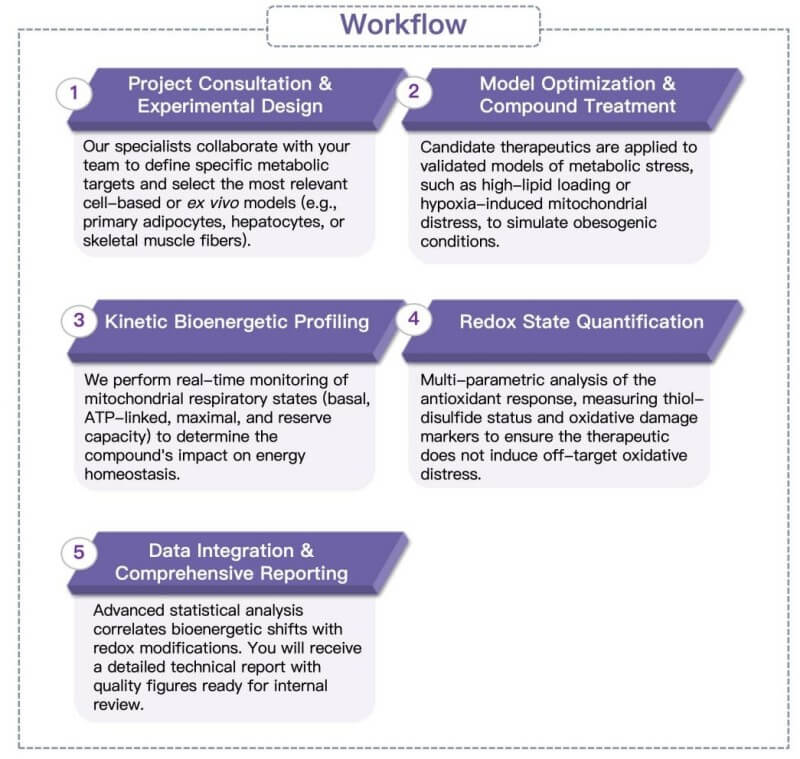
Contact Protheragen to Discuss How Our Workflow Can Validate Your Anti-obesity Therapeutic Leads.
Fields of Application
Our cellular redox and energy homeostasis analysis is vital for:
- Next-Gen Incretin Mimetics: Evaluating the bioenergetic impact of dual and triple agonists (GLP-1R/GIPR/GCGR).
- Metabolic Reprogramming Agents: Testing Sirt1 and AMPK activators for their ability to restore mitochondrial biogenesis.
- Nutraceutical & Lipid Research: Assessing bioactive lipids like oleoylethanolamide (OEA) and their modulation of hepatic mitochondrial function.
- Safety & Toxicology: Screening for mitochondrial toxicity or "reductive stress" early in the development cycle.
Advantages
Partnering with Protheragen offers unique strategic benefits:
- Mechanistic Depth
We go beyond simple weight-loss metrics to uncover the "how" behind your compound's efficacy, focusing on the cellular energy-redox interface.
- Unrivaled Precision
Our HPLC and mass spectrometry platforms provide the sensitivity required to detect subtle shifts in redox biomarkers that standard assays often miss.
- Specialized Expertise
With over 20 years in biology, our team understands the nuances of metabolic disease, from mitochondrial dynamics to the role of the endocannabinoidome in energy balance.
- Rapid Turnaround
We prioritize efficiency without compromising scientific rigor, ensuring your lead optimization moves forward at pace.
Publication Data
Title: Zinc homeostasis and redox alterations in obesity
Journal: Front. Endocrinol., 2024
DOI: https://doi.org/10.3389/fendo.2023.1273177
Summary: This review explores the bidirectional link between zinc homeostasis, redox metabolism, and obesity. Zinc—an essential micronutrient with pro-antioxidant, metabolic, and anti-inflammatory roles—interacts closely with reactive oxygen/nitrogen species (RO(N)S) to regulate cellular function. Obesity disrupts this balance via oxidative stress, altered zinc transporter expression (ZnT/ZIP families), and impaired zinc distribution, exacerbating insulin resistance, hyperleptinemia, and chronic inflammation. The review highlights how zinc transporters and metallothioneins (MTs) control zinc buffering/muffling, and how targeting these systems could improve obesity-related metabolic abnormalities.
Key Findings
- Zinc-Redox Crosstalk in Obesity: Zinc regulates redox homeostasis by inhibiting oxidative reactions and supporting antioxidant enzymes (e.g., Cu/Zn SOD), while redox status controls zinc release from MTs and binding to proteins—disruption of this crosstalk amplifies obesity-induced oxidative stress.
- Zinc Deficiency in Obesity: Obese individuals commonly exhibit hypozincemia (low serum zinc) and hyperzincuria (increased urinary zinc excretion), linked to higher BMI, insulin resistance, and leptin levels—weight loss reverses these zinc abnormalities.
- Metabolic Roles of Zinc: Zinc mimics insulin action, enhances glucose uptake, and modulates leptin-NPY signaling (appetite regulation); deficiency worsens insulin resistance and hyperleptinemia, key drivers of obesity.
- Zinc Transporters in Adipose & Liver Metabolism:
- ZIP14 downregulation in obesity impairs adipocyte differentiation and promotes inflammation via NF-κB/STAT3 pathways.
- ZnT7 deficiency reduces body fat by inhibiting triglyceride synthesis in subcutaneous adipose tissue.
- Global ZnT8 knockout exacerbates obesity, while pancreatic β-cell-specific ZnT8 deletion protects against insulin resistance.
- Anti-Inflammatory & Pro-Antioxidant Zinc Effects: Zinc suppresses pro-inflammatory cytokines (IL-6, TNF-α) and activates Nrf2-mediated antioxidant defenses—supplementation improves inflammatory markers and insulin sensitivity in obese individuals.
- Zinc Buffering/Muffling: MTs and ZnT/ZIP transporters maintain zinc homeostasis by regulating "zinc transients"; their dysfunction in obesity disrupts cellular zinc availability and redox balance.
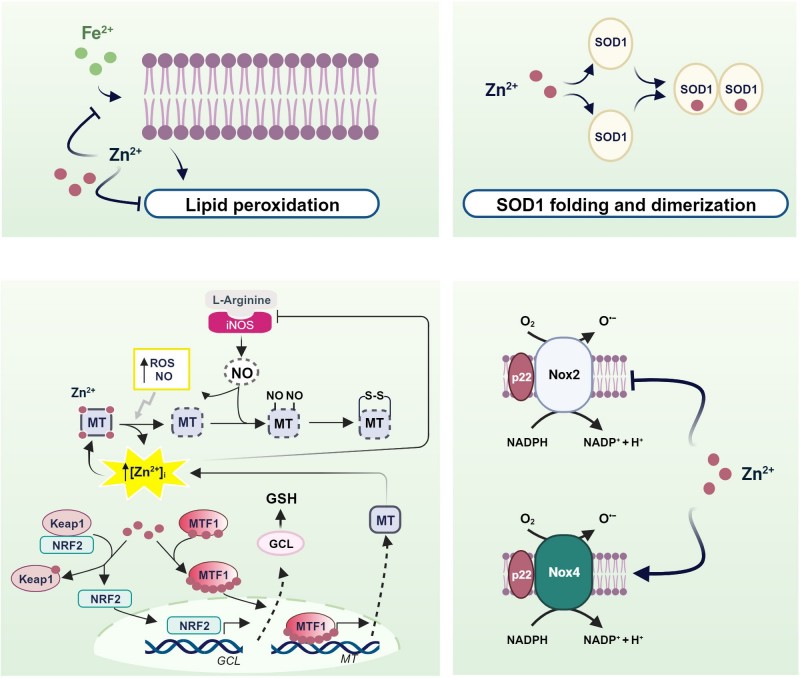 Fig.1 Pro-antioxidant pathways of zinc: safeguarding living organisms from oxidative damage (Franco & Canzoniero, 2025).
Customer Review
Bridging the Gap Between Data and Mechanism
"The team at Protheragen provided us with more than just raw data; they gave us a clear mechanistic narrative for our lead GLP-1 conjugate. By mapping the shifts in the GSH/GSSG ratio alongside mitochondrial respiration, we were able to demonstrate a significant reduction in metabolic stress that we hadn't been able to capture previously. We plan to utilize their platform for all our upcoming preclinical lead optimizations."
Mr. M. J., Biopharma Lead Discovery
A Strategic Extension of Our R&D Infrastructure
"Protheragen's expertise in redox biology is truly world-class. Their ability to conduct high-resolution respirometry on our novel mitochondrial uncouplers was instrumental in our recent funding round. Their reports are detailed, accurate, and ready for regulatory scrutiny. They have become an essential extension of our R&D department."
Dr. X. L., Metabolic Therapeutics Startup
Frequently Asked Questions
-
Why is redox homeostasis a critical endpoint in anti-obesity drug development?
Obesity often involves a "vicious cycle" of oxidative stress and mitochondrial failure. A drug that reduces weight but ignores these factors may lead to poor metabolic outcomes or long-term safety issues.
-
Can you analyze both primary cells and immortalized cell lines?
Yes. While we often use cell lines for initial screening, we highly recommend primary adipocytes or hepatocytes for physiologically relevant homeostasis data.
-
How does Protheragen measure mitochondrial "reserve capacity"?
We use a stress test protocol (e.g., using FCCP and rotenone/antimycin A) to determine the bioenergetic limit of the cells under therapeutic treatment.
-
Can you detect the difference between cytosolic and mitochondrial ROS?
Absolutely. We utilize compartment-specific probes and isolated mitochondria fractions to pinpoint exactly where oxidative shifts are occurring.
-
How do you quantify the GSH/GSSG ratio?
We use a high-sensitivity HPLC method with diode array detection to ensure accurate quantification of both reduced and oxidized forms without artifacts from sample handling.
-
Does your service include assessment of "browning" markers?
Yes, we measure the functional bioenergetic consequences of browning, such as increased uncoupled respiration and UCP1-mediated proton leak.
-
Is the analysis limited to adipose tissue?
No, we frequently perform analyses on liver (NAFLD/NASH models), skeletal muscle, and even neuronal models involved in central energy regulation.
-
What is the typical sample size required for an ex vivo study?
This depends on the tissue type, but our high-resolution platforms are optimized for small tissue biopsies to maximize data from every sample.
-
How do you ensure the reproducibility of redox measurements?
We maintain strict anaerobic handling protocols where necessary and utilize standardized internal controls to account for any variations in sample processing.
Contact Us
Protheragen provides an elite preclinical service for cellular redox and energy homeostasis analysis, specifically tailored for the development of anti-obesity therapeutics. By combining state-of-the-art bioenergetic monitoring with deep redox proteomics, we empower researchers to identify compounds that truly restore metabolic equilibrium.
Contact Protheragen for More Information and to Discuss Your Project
Reference
- Franco, C.; Canzoniero, L.M.T. Zinc homeostasis and redox alterations in obesity. Front. Endocrinol. 2024, 14:1273177. (CC BY 4.0)
All of our services and products are intended for preclinical research use only and cannot be used to diagnose, treat or manage patients.