

Anti-Obesity Drug PK-PD Modeling Service
InquiryAnti-obesity drug development faces distinct PK-PD complexities: lipophilic molecules that distribute widely into adipose compartments, incretin-based peptides with long half-lives, multi-agonist biologics exhibiting delayed metabolic readouts, and small molecules subjected to extensive enterohepatic recycling. Modern pharmacology now depends on advanced model-informed methodologies to understand how exposure patterns translate to metabolic effects, body-weight trajectories, and biomarker modulation.
Optimizing Anti-Obesity Therapies: Strategic PK-PD Analysis
Protheragen delivers a fully integrated preclinical PK-PD modeling service tailored for metabolic and obesity-focused pipelines. By merging high-resolution concentration–time datasets with mechanistic modeling frameworks, we help sponsors quantify drug performance, optimize candidate selection, and design data-driven dose strategies for first-in-animal and early development decision-making.
Core Technologies: Precision Platforms for Bioanalysis and Prediction
Robust PK-PD modeling is reliant on highly accurate bioanalytical quantification and sophisticated computational tools. Protheragen leverages cutting-edge technology platforms that are purpose-built for the unique challenges of metabolic drug candidates in preclinical species.
- Nonlinear Mixed-Effects (NLME) Modeling
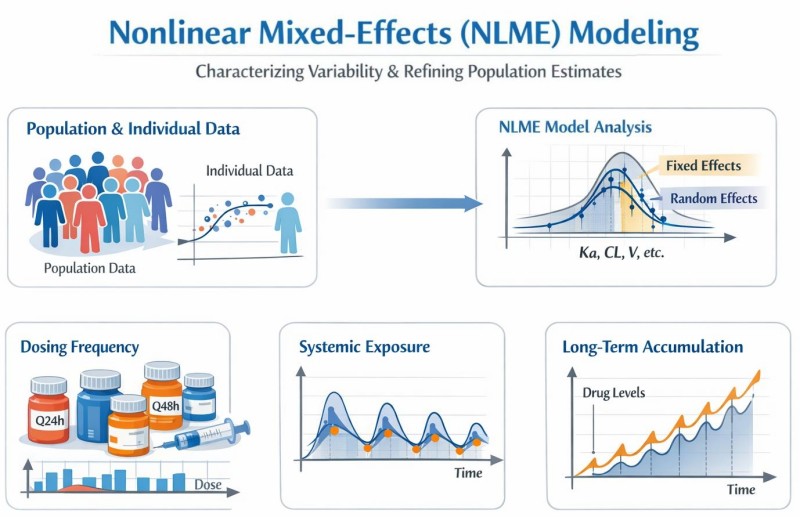
We apply industry-standard NLME frameworks to characterize variability, refine population estimates, and generate robust projections for dosing frequency, systemic exposure, and long-term accumulation.
- Mechanistic Compartmental Modeling
Customized structures account for adipose distribution, delayed gastric emptying, peripheral clearance, and enterohepatic dynamics—common features of anti-obesity compounds.
- Indirect Response and Turnover Models
Integrated to reflect slow-evolving PD endpoints such as appetite modulation, energy expenditure, adipocyte turnover, and hormone/peptide kinetics.
- Exposure–Response & Biomarker Modeling
Incorporates metabolic indicators including insulin, GLP-1, leptin, triglycerides, and liver enzymes, enabling a multidimensional view of pharmacodynamic performance.
- Simulation Platforms for Candidate Differentiation
We conduct simulation-based comparisons to support MoA validation, dose-finding, and candidate ranking, reducing uncertainty in early development.
Have a specific project in mind? Contact our technical specialists for personalized support.
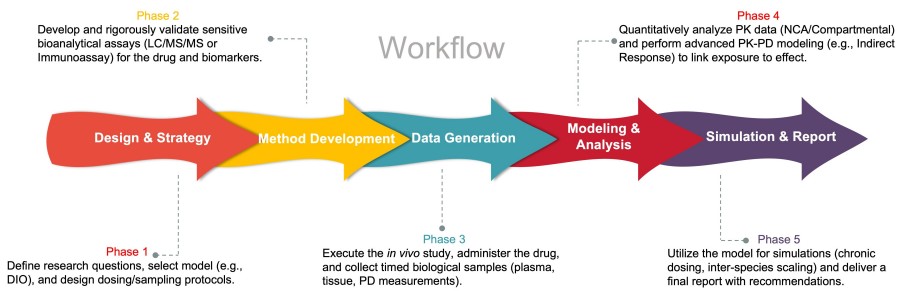
Workflow
Our comprehensive service is structured to maximize data quality and interpretability, ensuring seamless progress through the research phase.
Fields of Application
Our specialized PK-PD services are applicable across the entire spectrum of emerging anti-obesity and cardiometabolic therapeutics:
Incretin-Based Therapies: PK-PD modeling for novel GLP-1, GIP, and glucagon single, dual, or tri-agonists, focusing on receptor occupancy correlation with glucose homeostasis and satiety markers.
Appetite and Satiety Modulators: Characterizing therapeutics that target CNS pathways to suppress appetite or increase energy expenditure (e.g., NPY, AgRP, MC4R agonists).
Adipose Tissue Remodeling Agents: Assessing the relationship between drug exposure and markers of brown fat activation, adipogenesis, and lipolysis.
Combination Therapies: Developing sophisticated PK-PD models to evaluate drug-drug interactions and synergistic effects of multi-target agents aimed at obesity, diabetes, and associated conditions like non-alcoholic steatohepatitis (NASH).
Advantages: Unmatched Expertise in Obesity PK
Choosing Protheragen for your anti-obesity drug PK-PD modeling service provides a significant competitive edge:
Integrated Metabolic Expertise
Our specialized team includes bioanalysts, pharmacologists, and modeling scientists with decades of collective experience focused specifically on metabolic disorders and obesity. We do not just run assays; we interpret data within the context of complex metabolic pathways.
Proprietary Disease Models
We utilize highly characterized, fit-for-purpose preclinical obesity models, ensuring the relevance of your PK-PD data for predicting human outcomes. This reduces translational risk.
Model-Informed Drug Development (MIDD) Focus
Precise PK data allows for rapid winnowing of candidates and informed optimization of chemical structure early in the discovery phase, saving time and resources.
Proven Track Record
Our successful partnerships are built on delivering clear, actionable PK-PD data that accelerates milestones. For example, our modeling efforts successfully guided the selection of a highly potent dual-agonist lead compound, establishing an optimal once-weekly preclinical dosing regimen that minimized exposure variability and maximized weight loss effects.
Contact Our Specialized Team to Discuss PK-PD Strategies for Your Anti-Obesity Candidate.
Service ScopeProtheragen provides full-spectrum PK-PD support dedicated to Preclinical Anti-Obesity Drug Development.
Diet-induced obesity (DIO) rodents, genetically modified obesity/diabetes models, and relevant non-human primates (NHP).
Absorption, distribution, clearance (half-life), bioavailability (F), volume of distribution (Vd), and tissue distribution analysis.
- PD Endpoints (Obesity/Metabolism)
Body weight change and rate, food intake, body composition (lean mass, fat mass), glucose tolerance tests (GTT), insulin sensitivity index, lipid panel analysis, and key hormone measurements (e.g., leptin, ghrelin).
- Immunogenicity Assessment
Non-clinical anti-drug antibody (ADA) screening, a critical safety element for peptide and antibody-based obesity therapies.
Publication Data
Title: Pharmacokinetics (PK), Pharmacodynamics (PD) and Integrated PK/PD Modeling of a Novel Long Acting FGF21 Clinical Candidate PF-05231023 in Diet-Induced Obese and Leptin-Deficient Obese Mice
Journal: PLoS ONE, 2015
DOI: https://doi.org/10.1371/journal.pone.0119104
Summary: PF-05231023 is a long-acting FGF21 analog (a promising therapy for obesity and type 2 diabetes) made by linking modified FGF21 to an antibody scaffold. FGF21 works by binding to KLB/FGFR1c complexes—its C-terminus (CT) attaches to KLB, and N-terminus (NT) to FGFR1c. This study found PF-05231023 has very different pharmacokinetics (PK) for its two termini: the NT lasts 10x longer (22 vs. 2 hours) and is far better absorbed via injection (44–59% vs. 4–7.7% for CT). In tests on obese mice (diet-induced or leptin-deficient), PF-05231023 lowered blood sugar (via glucose tolerance tests) and reduced weight effectively—whether given intravenously (IV) or under the skin (SC). Models showed the NT alone is enough to drive these benefits (even if less potent than full FGF21), while the CT just speeds up results. These findings help make better FGF21-based drugs for metabolic diseases.
Key Findings
- PF-05231023's two ends act differently: Its N-terminus (NT) lasts 22 hours and is well-absorbed (44–59% via injection), while the C-terminus (CT) clears fast (2 hours, 4–7.7% absorption). NT becomes the main working form.
- Lowers blood sugar and weight: Works in obese mice—cuts blood sugar (effective at ≥0.1 mg/kg) for 3–6 days per dose, and causes strong weight loss (peak at 15–22 days) with weekly doses.
- NT alone drives benefits: You do not need the CT—NT by itself lowers blood sugar and weight (just needs higher levels than full FGF21).
- CT only speeds things up: It makes effects start faster but isn't required for results.
- Injection routes work equally: Whether given intravenously (IV) or under the skin (SC), it works just as well (thanks to NT's good SC absorption).
- Helps make better drugs: Future FGF21 therapies should stabilize CT (for strength) and keep NT active longer (for lasting effects) to treat obesity and type 2 diabetes.
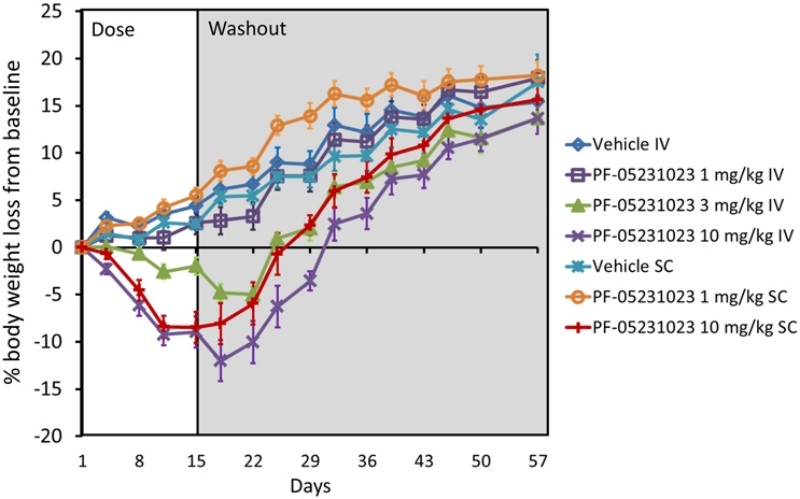 Fig.1 Percentage BW loss in DIO mice following IV and SC administration of PF-05231023. (Weng, et al., 2015)
Customer Review
Strategic PK-PD Modeling Secures Optimal Chronic Dosing Regimen
"Protheragen was a true extension of our team. We were facing challenges characterizing the half-life and sustained effect of our novel peptide analog in our DIO mouse model. The Protheragen team not only designed an innovative sparse-sampling PK study to reduce animal usage, but their subsequent PopPK modeling precisely predicted the chronic dose required for maximum weight loss effect. The data was clear, the communication was excellent, and the predictive power of their modeling saved us an entire round of costly dose-ranging studies. We are already collaborating with them on our next-generation dual agonist program."
Dr. A. S., Head of Preclinical R&D
Translational Confidence: PBPK Modeling for Complex Metabolites Confirms Target Tissue Concentration
"We approached Protheragen with a first-in-class small molecule and very aggressive timelines. They quickly proposed a staged biliary excretion program, coordinated analytics, and delivered a report that our board and investors could understand at a glance. The integration of experimental data with modeling was especially valuable. Based on this experience, we have already engaged them for transporter studies and PBPK support on our next candidate, and we expect this collaboration to continue as our pipeline grows."
Mr. K. T., Director of Discovery Pharmacology
Frequently Asked Questions
-
Why is PK-PD modeling essential for obesity drugs compared to standard PK studies?
Standard PK only measures drug concentration. PK-PD modeling is essential because obesity drugs require linking drug exposure to a time-dependent pharmacological effect (e.g., sustained weight loss, long-term glucose control). This correlation provides the quantitative basis for dose optimization and predicting chronic efficacy.
-
Which preclinical animal models do you recommend for anti-obesity PK-PD?
We primarily utilize diet-induced obesity (DIO) rodent models, which accurately reflect key aspects of human metabolic disease, alongside normal rodents for initial safety/tolerability. For advanced biologics, non-human primates (NHP) are often recommended for closer translational prediction.
-
Can Protheragen handle my novel peptide or oligonucleotide-based therapeutic?
Absolutely. our core technologies section details our expertise with both large and small molecules. We utilize high-sensitivity techniques like MSD-ECL and Gyrolab, which are ideally suited for quantifying peptide and biologic concentrations in plasma with minimal sample volume.
-
How do you address the delayed PD effect often seen with chronic anti-obesity drugs?
We use advanced modeling techniques, such as indirect response models, which mathematically account for the temporal lag between maximum drug concentration (Cmax) and maximum effect (Emax, such as peak weight loss). This allows for accurate estimation of critical parameters like drug potency.
-
What is the typical turnaround time for a standard preclinical PK-PD study?
While timelines vary based on the complexity of the drug modality and the chronic nature of the PD endpoint, our efficient workflow and dedicated platform access minimize time-to-data.
-
How do you use the PK-PD data to predict a safe and effective human starting dose?
We employ physiologically-based pharmacokinetic (PBPK) modeling combined with interspecies scaling of the established PK-PD relationship. This approach integrates preclinical data with physiological parameters to mechanistically predict the First-in-Human (FIH) dose range, minimizing risk and uncertainty.
-
Can you develop custom PD assays for non-traditional metabolic biomarkers?
Yes, our core technologies include flow cytometry and multiplexed platforms which are perfect for developing custom assays for unique PD biomarkers, such as tissue-specific receptor occupancy or novel inflammatory cytokine panels related to metabolic dysfunction.
-
Do I need to provide the analytical method for my compound?
While we can accept validated methods, a key strength of Protheragen is our ability to provide full assay development and validation from scratch for novel compounds, saving you time and ensuring the method is optimized for the selected preclinical species.
How to Contact Us
The anti-obesity drug PK-PD modeling service by Protheragen is designed to transform complex preclinical data into actionable insights. Leveraging over 20 years of expert biological specialization and high-end analytical technologies, we provide the strategic foundation necessary to efficiently advance your anti-obesity candidate from discovery to research success. We are committed to quantitative excellence, translational predictability, and accelerating your time to therapeutic success.
Online Inquiry Form: Contact Protheragen
Email: info@obesityscientific.com (Please include a short description of your compound class, current data, and key project questions)
Phone: 1-631-506-1393
Reference
- Weng Y.; et al. Pharmacokinetics (PK), Pharmacodynamics (PD) and Integrated PK/PD Modeling of a Novel Long Acting FGF21 Clinical Candidate PF-05231023 in Diet-Induced Obese and Leptin-Deficient Obese Mice. PLoS ONE. 2015, 10(3): e0119104. (CC BY 4.0)
All of our services and products are intended for preclinical research use only and cannot be used to diagnose, treat or manage patients.