

Anti-Obesity Drug Biliary Excretion Study Service
InquiryFor modern anti-obesity candidates, understanding biliary excretion is no longer a “nice-to-have” PK parameter – it is a key determinant of exposure, safety, and formulation strategy. Lipophilic small molecules and conjugated biologics are frequently cleared via bile, where they may be eliminated in feces or reabsorbed through enterohepatic circulation, extending half-life and creating secondary peaks in plasma concentration.
Biliary Excretion Assessment Service for Anti-Obesity Drugs
Protheragen provides a dedicated anti-obesity drug biliary excretion study service focused on preclinical discovery and non-clinical development. We do not run human or clinical trials. Instead, we generate high-resolution biliary excretion data in animals and in vitro systems to:
- Quantify the fraction of dose eliminated via bile vs. urine and feces
- Characterize enterohepatic recirculation and secondary exposure peaks
- Identify biliary metabolites and conjugates relevant to safety and drug-induced liver injury (DILI) risk
- Support PBPK modeling, dose selection, and formulation design for anti-obesity programs
If you are evaluating first-in-class small molecules, next-generation incretin analogues, or novel thermogenesis modulators, robust biliary excretion data can de-risk your PK Strategy early.
Core Technologies for Biliary Excretion Profiling
Protheragen integrates state-of-the-art in vivo, in vitro, and in silico platforms to generate a quantitative, mechanism-aware picture of biliary excretion for anti-obesity drug candidates.
- In Vivo Bile-Collection Models
Published data and decades of pharmacology experience show that bile-duct cannulated (BDC) rodents remain the gold standard for quantitative biliary excretion profiling. Protheragen offers:
- Rat and mouse BDC models for single-dose and repeat-dose studies
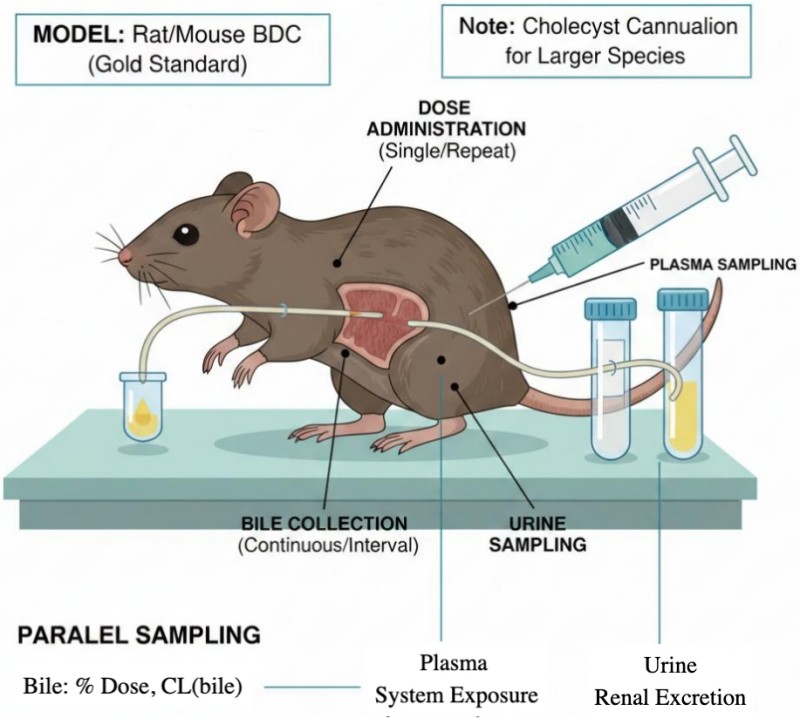
- Cholecyst-cannulated models in larger species where appropriate
- Continuous or interval bile collection with parallel plasma and urine sampling
These models allow direct calculation of the percentage of dose excreted in bile, the time course of biliary clearance, and the contribution of enterohepatic recycling to systemic exposure.
- Advanced Liquid Chromatography–Tandem Mass Spectrometry (LC–MS/MS) and HRMS Analytics
Sensitive and selective analytical methods are essential to capture parent drug and multiple metabolites in complex bile matrices. We deploy:
- Fit-for-purpose LC–MS/MS panels for parent and known metabolites
- High-resolution mass spectrometry (HRMS) to identify novel biliary conjugates (e.g., glucuronides, sulfates, glutathione adducts)
- Stable isotope–labeled internal standards for accurate recovery and mass balance
For many anti-obesity drugs, including highly lipophilic agents or prodrugs, these data clarify whether major clearance pathways are hepatic–biliary or renal.
- Hepatocyte and Sandwich-Culture Systems
To dissect mechanisms upstream of in vivo excretion, Protheragen leverages primary hepatocytes and sandwich-culture hepatocyte systems that preserve canalicular networks:
- In vitro biliary clearance assays to estimate biliary excretion index and intrinsic clearance
- Assessment of transporter-mediated efflux into canalicular compartments (BSEP, MRP2, P-gp, BCRP)
- Early detection of cholestasis risk and transporter inhibition that may translate into DILI risk.
- Transporter Interaction and Uptake Assays
Biliary excretion often depends on coordinated uptake and efflux across hepatocytes. We provide:
- Uptake assays in transporter-overexpressing systems (e.g., OATP families)
- Efflux assays for canalicular transporters implicated in biliary excretion and cholestatic liability
Inhibition and induction panels to assess DDIs among anti-obesity co-medications, relevant as multiple weight-management agents are often combined in practice.
- PBPK and Enterohepatic Recirculation Modeling
Using the experimental data above, our modeling team builds preclinical PBPK models that explicitly incorporate biliary excretion and enterohepatic cycling:
- Simulation of different dosing regimens and formulations
- Sensitivity analyses on biliary clearance vs. other routes
- Scenario testing for obesity-related changes in hepatic function and bile flow
Leaning on published pharmacokinetic principles and bile-excretion rules (e.g., MW thresholds, polarity), these models help convert data into actionable design decisions.
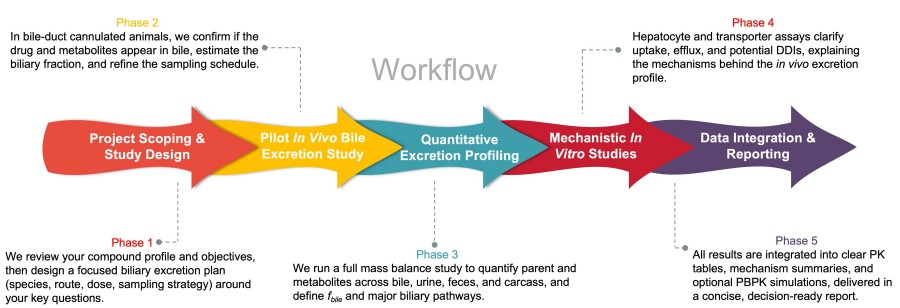
Workflow
Our anti-obesity biliary excretion studies are designed as modular, decision-oriented workflows.
Fields of Application: Where Biliary Excretion Data Matter Most
Biliary excretion insights are especially critical in anti-obesity R&D, where clearance pathways, enterohepatic recycling, and metabolite profiles directly influence dosing strategy, safety margins, and the success of diverse molecule and formulation types.
- First-in-Class Small-Molecule Anti-Obesity Agents
For novel neurometabolic or thermogenic small molecules, biliary excretion studies:
-Clarify whether long half-life is driven by genuine target engagement or recycling through the bile
-Inform dose frequency and accumulation risk
-Support risk mitigation for metabolites with potential off-target or hepatic effects
- Long-Acting Peptides and Incretin-Based Agents
Several modern anti-obesity peptides rely on structural modifications and conjugation to prolong half-life. Biliary excretion profiling helps to:
-Determine how much of the conjugated or unconjugated species is cleared via the bile
-Understand the differences between lean and obese preclinical models
-Support PBPK models used for first-in-human planning (even though Protheragen itself does not conduct clinical trials)
- Gut-Targeted or Minimally Systemic Agents
For drugs designed to act within the gut:
-Biliary excretion can recirculate the drug back into the intestinal lumen, augmenting local exposure
-Studies can distinguish true non-absorption from rapid biliary elimination after systemic uptake
- Formulation and Prodrug Optimization
Bile-driven clearance often interacts with formulation decisions. Biliary excretion data can:
-Show whether new formulations alter the balance between renal and biliary pathways
-Reveal whether higher bioavailability also increases biliary load and potential hepatic burden
- Safety, DILI, and Transporter-Mediated Liabilities
Phase II-conjugated metabolites excreted in bile can contribute to cholestasis and liver injury. Early identification of such pathways allows:
-Structurally guided mitigation strategies
-Prioritization of backup compounds with more favorable excretion profiles
Advantages: Why Partner with Protheragen
Partnering with Protheragen means working with a preclinical team that lives and breathes hepatobiliary pharmacokinetics, transforming complex biliary excretion data into clear, development-ready decisions for your anti-obesity pipeline.
Deep Biliary Excretion Expertise Anchored in Pharmacology
Classic reviews have emphasized that biliary excretion is governed by species-dependent molecular weight thresholds, polarity, and transporter expression, and that lower animals and humans may differ significantly. Our team integrates these principles with contemporary transporter biology and PBPK modeling to design studies that are both mechanistic and development-focused.
Preclinical-Only Focus for Early-Stage Obesity Programs
Protheragen operates exclusively in preclinical and non-clinical R&D:
- No clinical or human studies
- Study designs optimized for discovery, hit-to-lead, and lead optimization decisions
- Fast iteration between chemistry, formulation, and PK readouts
Integrated ADME Perspective on Anti-Obesity Agents
Recent overviews of anti-obesity medications highlight how obesity changes drug distribution, hepatic metabolism, and clearance, reinforcing the need for tailored pharmacokinetic programs. We combine biliary excretion data with systemic PK, metabolite profiling, and transporter assessments to provide a coherent, end-to-end view of compound disposition.
Experience Across Mechanistic Classes
Published data on emerging anti-obesity targets, from incretin pathways to adrenergic modulation of thermogenic adipose tissue, underscore the diversity of mechanisms and PK behaviors in this space. Our experience spans gut-restricted compounds, systemically active injectables, and agents with mixed clearance pathways, giving us a broad benchmark for interpreting your data.
Decision-Ready, Investor-Friendly Deliverables
Reports focus on what development teams and investors actually need to see:
- Clear quantification of biliary vs. non-biliary clearance
- Visual depiction of enterohepatic recirculation risk
- Mechanistic narratives that support partnering discussions
Published data from bile-duct cannulated models and hepatocyte systems show that early identification of predominant clearance routes can prevent late-stage failures and dosing surprises; our project histories align with these trends, helping clients avoid costly reformulations and suboptimal dose selections.
Contact Protheragen to discuss a customized biliary excretion study.
Service ScopeProtheragen’s anti-obesity drug biliary excretion study service covers a broad range of compounds and modality types, while remaining strictly preclinical:
Small-Molecule Anti-Obesity Agents
- Appetite suppressants and neurometabolic modulators
- Peripheral lipase inhibitors and gut-targeted agents
- Thermogenesis- and β3-adrenergic pathway modulators, where pharmacology in adipose tissue must be balanced against hepatic clearance.
Peptide and Peptide-Mimetic Agents
- Incretin-based analogues and co-agonists
- Long-acting conjugates and depot formulations
Novel Delivery Formats
- Prodrugs designed to modulate intestinal absorption and first-pass metabolism
- Nanocarriers and conjugates that may shift elimination from renal to hepatobiliary routes
Study Types
- Single-dose and repeat-dose biliary excretion studies
- Radiolabeled mass balance (in collaboration with suitable isotope partners)
- Metabolite Identification in bile with emphasis on safety-relevant species
- Mechanistic transporter and hepatocyte-based characterization
Publication Data
Title: Anti-Obesity and Hypocholesterolemic Actions of Protamine-Derived Peptide RPR (Arg-Pro-Arg) and Protamine in High-Fat Diet-Induced C57BL/6J Mice
Journal: Nutrients, 2021
DOI: https://doi.org/10.3390/nu13082501
Summary: This article integrates preclinical findings on the metabolic pathways of protamine-derived peptide RPR (Arg-Pro-Arg) and the advancement of drug delivery systems (DDSs) for anti-obesity therapy. It reveals that RPR, a novel tripeptide from salmon protamine, exerts anti-obesity and hypocholesterolemic effects by regulating lipid metabolism genes and enhancing fecal steroid excretion. Additionally, it outlines how advanced DDSs—such as microneedles, nanoparticles, and hydrogels—overcome limitations of conventional therapies, improving bioavailability and targeted delivery of anti-obesity agents in preclinical models.
Key Findings
- Novel active peptide: RPR (Arg-Pro-Arg) is identified as a unique tripeptide with dual anti-obesity and hypocholesterolemic functions, derived from protamine via tryptic hydrolysis.
- Metabolic regulation: Protamine and RPR modulate lipid metabolism by upregulating PPARα (liver) and PPARγ1 (adipocytes), and downregulating SREBP1, SCD1, and FAS, reducing white adipose tissue (WAT) accumulation.
- Cholesterol-lowering mechanism: Both agents enhance fecal cholesterol and bile acid excretion, and activate LDLR expression, inhibiting intestinal cholesterol absorption.
- Advanced DDS efficacy: Microneedle patches, polymeric nanoparticles, and hydrogels improve the delivery of anti-obesity agents (e.g., RPR, CL316243, caffeine), achieving targeted WAT browning, reduced systemic side effects, and superior weight loss in preclinical models.
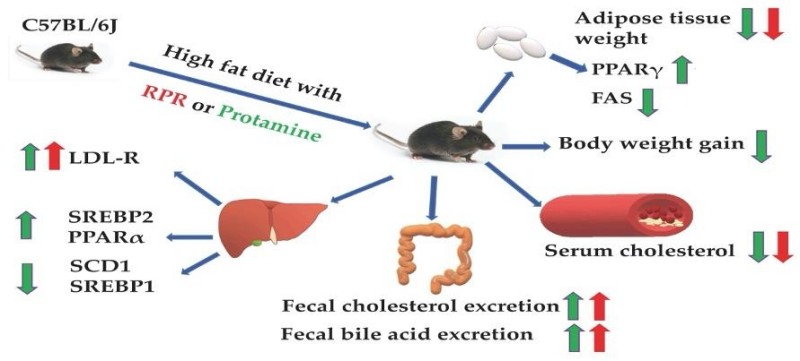 Fig.1 Mechanism of the anti-obesity and hypocholesterolemic actions of RPR and protamine. (Mijiti, et al., 2021)
Customer Review
Metabolism
“Our lead anti-obesity candidate had a complex PK profile with unexplained secondary peaks. Protheragen designed a bile-duct cannulated rat study and complementary hepatocyte work that clearly demonstrated enterohepatic recirculation and identified key biliary metabolites. The clarity of their data gave our internal team the confidence to refine our dosing strategy before moving into larger preclinical safety studies. We now view biliary excretion work as a standard component of our portfolio evaluation.”
Dr. R. R., Mid-Sized Biotech (Europe)
Early-Stage Obesity Startup
“We approached Protheragen with a first-in-class small molecule and very aggressive timelines. They quickly proposed a staged biliary excretion program, coordinated analytics, and delivered a report that our board and investors could understand at a glance. The integration of experimental data with modeling was especially valuable. Based on this experience, we have already engaged them for transporter studies and PBPK support on our next candidate, and we expect this collaboration to continue as our pipeline grows.”
Prof. D. C. R., Director of Preclinical Development
Frequently Asked Questions
-
Do I really need biliary excretion studies for every anti-obesity candidate?
Not always. Biliary excretion studies are most critical when your compound is lipophilic, highly bound, extensively metabolized, or shows secondary PK peaks suggesting enterohepatic recirculation. If your compound is highly polar and renally cleared, bile may be less relevant. We routinely review early ADME data to advise if a biliary module will add decision-making value.
-
Which species do you recommend for biliary excretion work?
Rats and mice are commonly used, with bile-duct cannulation enabling quantitative collection. Species selection depends on your broader toxicology and efficacy plans, physicochemical properties, and metabolism profile. We design studies that align with your main pharmacology species whenever feasible, while acknowledging known species differences in biliary thresholds and transporters.
-
Can you study enterohepatic recirculation in preclinical models?
Yes. By combining time-resolved bile collection, plasma sampling, and, when appropriate, bile diversion or re-infusion experiments, we can identify and quantify enterohepatic cycling. Integration with PK modeling clarifies how much recirculation contributes to overall exposure.
-
How do biliary excretion data support dose selection?
Biliary clearance influences half-life, accumulation, and exposure variability. When bile is a major route, changes in hepatic function or transporter activity may significantly alter systemic levels. Our data and models help you understand how robust your dosing strategy is to such variability and guide the choice of starting and target exposures for later stages.
-
We are concerned about drug-induced liver injury. Can this service help?
Yes, indirectly. While biliary excretion studies cannot “prove” the absence of liver injury, they identify high biliary loads, reactive or cholestatic metabolites, and transporter interactions associated with cholestasis. Combined with standard toxicology, this information strengthens your DILI risk assessment and mitigation strategies.
-
Do you evaluate metabolite profiles in bile as well as plasma?
Absolutely. Our analytical methods are configured to detect parent and metabolites in bile, plasma, urine, and feces. Comparing metabolic patterns across matrices reveals which species are uniquely cleared via bile and whether any bile-specific metabolites require follow-up.
-
How early in development should we run biliary excretion studies?
For high-priority programs, we recommend a focused biliary excretion pilot once you have a lead candidate with basic PK and safety data. This timing allows you to adjust chemistry or formulation if biliary liabilities are identified, before committing to large-scale toxicology.
-
Can you support transporters and mechanistic studies if our internal team lacks this capability?
Yes. Protheragen offers a full panel of uptake and efflux transporter assays and hepatocyte-based systems. We can run these as standalone projects or integrate them with your biliary excretion study to provide a unified mechanistic picture.
-
How are your reports structured for internal and external stakeholders?
Reports include detailed methods and raw data appendices for scientific review, alongside concise executive summaries and figures for management and partners. Many clients use our visualizations directly in internal governance, board decks, and investor materials.
-
How do we get started, and what information do you need from us?
Reach out with a brief overview of your compound (structure or class), available ADME/PK data, and key questions you hope to answer. Our team will propose a stepwise study plan, budget, and timeline. You retain control over scope and sequencing, and we iterate with you until the design fits your objectives and constraints.
Contact Our Team for More Information and to Discuss Your Project
At Protheragen, we are committed to turning preclinical challenges into opportunities for progress. Our anti-obesity drug biliary excretion study service is not just a research offering—it is a strategic partner in your mission to address the global obesity epidemic. With scalable, reliable, and decision-focused biliary excretion insights, we help you cut through dead ends, accelerate timelines, and bring life-changing therapies to patients faster.
To initiate a discussion or request a proposal:
- Use our online inquiry hotline: Contact Protheragen
- Or reach out via email: info@obesityscientific.com (Please include a short description of your compound class, current data, and key project questions)
Our scientists will respond with a tailored, stepwise plan for biliary excretion studies aligned with your anti-obesity R&D goals.
Reference
- Mijiti M.; et al. Anti-Obesity and Hypocholesterolemic Actions of Protamine-Derived Peptide RPR (Arg-Pro-Arg) and Protamine in High-Fat Diet-Induced C57BL/6J Mice. Nutrients. 2021; 13(8): 2501. (CC BY 4.0)
All of our services and products are intended for preclinical research use only and cannot be used to diagnose, treat or manage patients.