

Anti-Obesity Drug Bioavailability Study Service
InquiryOral and systemic bioavailability determine whether a promising anti-obesity candidate translates into meaningful and durable weight loss in patients. Even with the advent of highly effective incretin-based agents, many molecules still fail because they are poorly absorbed, extensively metabolized, or behave unpredictably in people living with obesity, whose physiology differs markedly from that of lean subjects. Published data on approved and emerging agents highlight how optimization of exposure, food effects, formulation, and delivery route is now as critical as target selection itself.
Anti-Obesity Drug Absorption and Exposure Analysis Service
Protheragen's anti-obesity drug bioavailability study service is designed to de-risk development at an early stage by integrating advanced ADME, PK, and formulation science with Obesity-Relevant Preclinical Models. We focus on how much drug actually reaches the systemic circulation and target tissues, for how long, and under what conditions, providing decision-ready insights that support indication selection, dose regimen design, and regulatory strategy.
Core Technologies for Drug Bioavailability in Obesity
At the heart of our service is a suite of cutting-edge technologies engineered to uncover how anti-obesity candidates absorb, distribute, and perform under real-world physiological conditions.
- Advanced Formulation & Solubility-Enhancement Platforms
Many anti-obesity candidates suffer from low aqueous solubility or instability in the GI tract. Multiple published studies have shown that nanoemulsions, lipid-based systems, and deep eutectic solvents can dramatically improve oral exposure and amplify anti-obesity efficacy compared with conventional formulations. At Protheragen, we support:
- Nanoemulsions and self-emulsifying systems
-To improve dissolution rate, intestinal absorption, and lymphatic uptake. - Natural deep eutectic solvent-like approaches
-To enhance solubility, modify mucus penetration, and alter intestinal permeability for polar or phenolic compounds. - Solid dispersion and amorphous systems
-For small molecules vulnerable to crystallization or poor wetting.
These platforms are fully integrated with in vitro and in vivo bioavailability testing, allowing rapid iteration between formulation ideas and exposure outcomes.
- Route-of-Administration Optimization (Oral, Transdermal, Injectable)
Obesity pharmacotherapy increasingly uses long-acting injectables, but there is growing interest in oral and transdermal alternatives to reduce healthcare burden. Reviews of transdermal systems emphasize their potential to bypass first-pass metabolism, provide smooth exposure, and reduce GI side effects for chronic obesity management. We evaluate:
- Oral dosing (solution, capsule, tablet, modified-release forms)
- Transdermal and topical approaches (patches, microemulsions, microneedle-assisted delivery)
- Subcutaneous and intramuscular injections for peptides, dual/triple agonists, and depot formulations
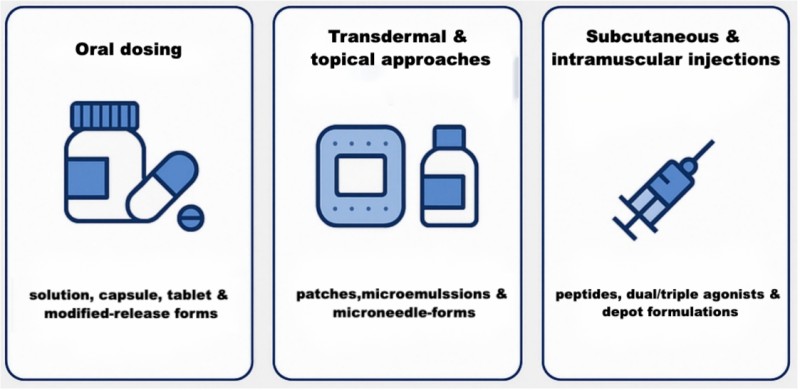
For each route, we investigate absorption kinetics, bioavailability, and variability across obesity-relevant models.
- Microbiome-Interacting and Nutrient-Sensitive Bioavailability
Emerging mechanistic work shows that gut microbiota and dietary context can profoundly modulate the bioavailability and bioactivation of dietary polyphenols and small molecules, thereby influencing weight loss and metabolic outcomes. Preclinical data on compounds such as rutin, especially when combined with tailored probiotic strains, demonstrate synergistic anti-obesity effects linked to microbial hydrolysis and metabolite generation. Protheragen offers:
- Microbiome-informed in vitro models (anaerobic incubations, fecal slurry systems)
- Food-effect and diet-composition studies in vivo (high-fat vs balanced diet)
Obesity-Specific PK & Food-Effect Assessment
Obesity alters gastric emptying, liver blood flow, tissue perfusion, and body composition, leading to distinct PK and bioavailability profiles compared with lean individuals. Clinical investigations of newer small-molecule anti-obesity agents illustrate how meal composition and obesity status can change exposure, Cmax, and t½, with implications for dose and timing recommendations.
Protheragen integrates obesity-specific physiological conditions into preclinical study designs to make your bioavailability package truly indication-relevant.
- High-Sensitivity Bioanalytical and ADME Profiling
Building on industry-standard ADME best practices, we deploy a suite of in vitro assays and liquid chromatography-tandem mass spectrometry (LC–MS/MS)–based bioanalysis to characterize:
- Solubility, logD, and stability in biorelevant media
- Permeability (Caco-2 / MDCK-like systems, PAMPA-type models)
- Metabolic stability (microsomes, hepatocytes), plasma protein binding
- Reactive metabolite and drug–drug interaction risks, including CYP inhibition
These data provide the mechanistic context behind exposure findings and feed into translational PK/PD Modeling.
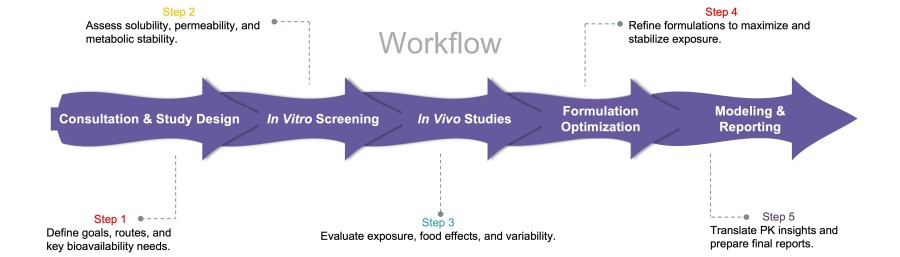
Development Workflow
Our workflow is structured yet flexible, allowing you to enter at any stage depending on your program's maturity.
Fields of Application
Protheragen's anti-obesity drug bioavailability study service supports a wide range of R&D strategies:
- First-in-Class Small Molecules
Seeking oral or transdermal delivery as alternatives to injectables.
- Next-Generation Incretin and Gut-Hormone Analogues
Requiring long-acting exposure with controlled peaks.
- Combination Therapies
Leveraging synergy between metabolic targets and microbiome modulators, with Protheragen providing integrated bioavailability and PK support to optimize multi-agent therapeutic strategies.
- Natural Product and Botanical-Derived Programs
Which have long faced development challenges due to low solubility and inconsistent systemic exposure.
- Life-Cycle Management of Existing Anti-Obesity Assets
Including formulation upgrades or new routes of administration to extend market value.
- Precision-Medicine Approaches
Where bioavailability and exposure may differ across subgroups (e.g., sex, degree of obesity, comorbidities).
Advantages
Obesity-Focused Bioavailability Expertise
Our team combines deep pharmacology, ADME, and formulation expertise with hands-on experience in obesity and metabolic disease models, allowing us to anticipate challenges that generic PK providers may miss. We design studies around real-world clinical questions such as adherence, meal timing, and comorbidities rather than purely academic endpoints.
Integration of Cutting-Edge Delivery and Formulation Concepts
Drawing on published data in nanoemulsions, lipid systems, and eutectic formulations that have successfully enhanced exposure and anti-obesity efficacy, we prioritize development paths most likely to deliver clinically meaningful outcomes rather than marginal improvements.
Obesity- and Diet-Specific Study Design
We specifically factor in:
- Altered physiology in obesity
- High-fat vs balanced diets
- Microbiome composition and function
This alignment increases the translatability of your early-phase data to the eventual patient population.
Fully Integrated ADME–PK–Bioanalysis Platform
Protheragen offers in-house in vitro ADME, bioanalytical assay development, and in vivo PK, enabling you to work with one coordinated team rather than multiple vendors. This shortens timelines, reduces handover risk, and ensures data consistency from first screening through advanced modeling.
Protheragen provides a comprehensive Anti-Obesity Drug Bioavailability Study Service that covers:
★ Molecule Types Supported by Our Platform
- Small Molecules (lipophilic, polar, ionizable, prodrugs)
- Peptides and peptidomimetics (e.g., gut hormone analogues, dual/triple agonists)
- Natural products and complex mixtures (polyphenols, plant-derived actives)
- Microbiome-interacting compounds and microbial-derived metabolites
★ Delivery Routes & Formulation Options
- Oral: Solutions, suspensions, capsules, tablets (immediate- or modified-release), gastro-retentive or enteric designs
- Parenteral: SC/IM injections, long-acting depots
- Transdermal: Patches, microemulsions, microneedle-enhanced systems
- Enabling formulations: Nanoemulsions, lipid-based carriers, deep eutectic–like systems, amorphous solid dispersions
★ Preclinical Study Designs Offered
- Absolute and relative bioavailability studies in preclinical models
- Food-effect and meal-composition studies
- Obesity vs lean comparative PK evaluation
- Multiple-dose steady-state evaluations
- Bioavailability in disease-relevant comorbidity models (e.g., NAFLD, T2D)
- Early microdose / exploratory studies to inform go / no-go decisions
★ Integrated Data Outputs
- High-sensitivity plasma and tissue concentration measurements
- Exposure–response analyses (linking PK to weight and metabolic biomarkers)
- Safety-relevant PK signals (Cmax spikes, accumulation, variability)
Publication Data
Title: Anti-Obesity Drug Delivery Systems: Recent Progress and Challenges
Journal: Pharmaceutics, 2023
DOI: https://doi.org/10.3390/pharmaceutics15112635
Summary: This article reviews recent advances in drug delivery and formulation strategies designed to improve the bioavailability, stability, and therapeutic performance of anti-obesity agents. It highlights how poor solubility, rapid metabolism, limited permeability, and unfavorable gastrointestinal conditions hinder the effectiveness of many promising compounds, and outlines modern delivery platforms—such as nanoemulsions, lipid carriers, polymeric nanoparticles, and microneedle systems—that can overcome these limitations.
Key Findings
- Bioavailability Challenges: Many anti-obesity compounds show low solubility, limited permeability, and rapid metabolism, resulting in poor systemic exposure.
- Enhanced Delivery Systems: Lipid carriers, nanoemulsions, and polymeric nanoparticles significantly improve solubility, protect unstable molecules, and promote better intestinal uptake.
- Alternative Administration Routes: Transdermal systems—particularly microneedle patches—bypass the GI tract and avoid first-pass metabolism, delivering more reliable exposure.
- Strong Preclinical Improvements: Advanced formulations consistently demonstrate superior pharmacokinetics and enhanced anti-obesity effects in animal studies compared to conventional forms.
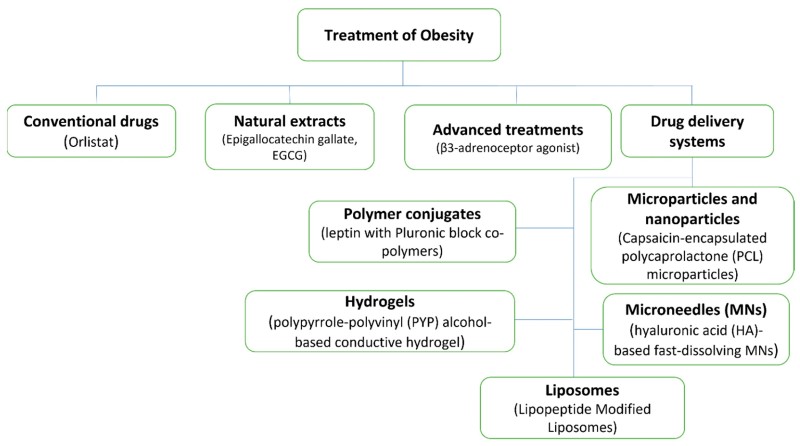 Fig.1 Obesity treatment approaches. (Ashour, et al., 2023)
Customer Review
Pre-Clinical Stage, Small-Molecule Obesity Program
"We came to Protheragen after seeing inconsistent exposure and only modest weight loss in our diet-induced obesity model. Their team quickly identified solubility and food-effect issues and proposed an enabling formulation, along with a refined dosing schedule. Within one study cycle, we saw a clear increase in systemic exposure, reduced variability, and a much stronger link between exposure and weight reduction. The reports and modeling gave us the confidence to advance our research efforts and proceed with subsequent planning."
Prof. E. E., Biotech Program Director
Peptide-Based Dual Agonist Program
"Partnering with Protheragen transformed the trajectory of our early-stage program. We initially struggled with inconsistent exposure and unpredictable bioavailability across formulations. Their team quickly identified the underlying ADME and solubility challenges, proposed a more suitable formulation strategy, and delivered clear, data-driven PK insights from obesity-relevant models. The improvement in exposure consistency was dramatic. Their reports were precise, actionable, and perfectly aligned with what our internal decision-makers needed. We have now expanded our collaboration to include tissue distribution and PK modeling, confident in their technical depth and reliability."
Dr. D. C. R., Mid-Size Pharma
Frequently Asked Questions
-
At what stage should we consider a dedicated bioavailability study for our anti-obesity candidate?
It is ideal to start quantitative bioavailability work once you have basic PK and efficacy data in at least one animal model. Early evaluation allows you to refine route, formulation, and dosing strategy before expensive toxicology or clinical trials. We routinely design stage-appropriate packages for both discovery and preclinical development.
-
Can you help if our compound already shows some efficacy, but highly variable exposure?
Yes. Variability is often linked to solubility, food effects, microbiome interactions, or formulation issues. We use a combination of in vitro and in vivo tools to identify root causes and recommend practical solutions.
-
Do you support both small molecules and peptide-based anti-obesity drugs?
Absolutely. Our platforms cover small molecules, peptides, and hybrid modalities. We tailor study design to the specific stability, permeability, and distribution properties of each modality, including depot or controlled-release systems for injectable peptides.
-
Can you assess the impact of high-fat diets on bioavailability?
Yes. We routinely run food-effect studies contrasting low- vs high-fat conditions in preclinical models. This helps you anticipate real-world use patterns in people with obesity.
Have more questions?
Share your project brief with Protheragen, and our scientific team will review your objectives, clarify technical considerations, and prepare a custom Q&A package alongside a tailored study outline. Whether you need help comparing formulations, troubleshooting low bioavailability, selecting appropriate models, or planning a full preclinical program, our experts will provide clear, data-driven guidance to support your decision-making and accelerate development.
Submit your inquiry anytime — we will follow up with actionable recommendations and next-step options tailored to your molecule and strategy.
Reference
- Ashour, M. M.; et al. Anti-Obesity Drug Delivery Systems: Recent Progress and Challenges. Pharmaceutics. 2023, 15(11): 2635. (CC BY 4.0)
All of our services and products are intended for preclinical research use only and cannot be used to diagnose, treat or manage patients.