

Intestinal Organoid Modeling Service for Obesity Research
InquiryObesity is no longer viewed simply as a disorder of adipose tissue; it is a systemic metabolic crisis where the gastrointestinal tract plays a central, driving role. The intestinal epithelium acts as the primary interface for nutrient sensing, hormone secretion, and barrier integrity—all of which are significantly altered in obese phenotypes. Traditional 2D cell cultures fail to capture the complex 3D architecture and multicellular diversity of the gut, while animal models often exhibit metabolic pathways that diverge from human physiology.
Precision Obesity Research: Advanced Intestinal Organoid Modeling Solutions
Protheragen provides a cutting-edge intestinal organoid modeling service for obesity research, utilizing patient-derived and high-fat-challenged 3D "mini-guts." Our platform allows researchers to bridge the gap between preclinical discovery and human relevance. By recapitulating the specialized cell types—including enterocytes, goblet cells, and enteroendocrine cells—within a physiologically accurate 3D scaffold, we empower our clients to study the molecular mechanisms of nutrient hyperabsorption, gut-brain axis signaling, and chronic low-grade inflammation in a controlled, human-centric environment.
Core Technologies
To provide high-fidelity models for obesity research, Protheragen leverages a suite of proprietary and advanced technologies:
- Patient-Derived Organoid (PDO) Biobanking
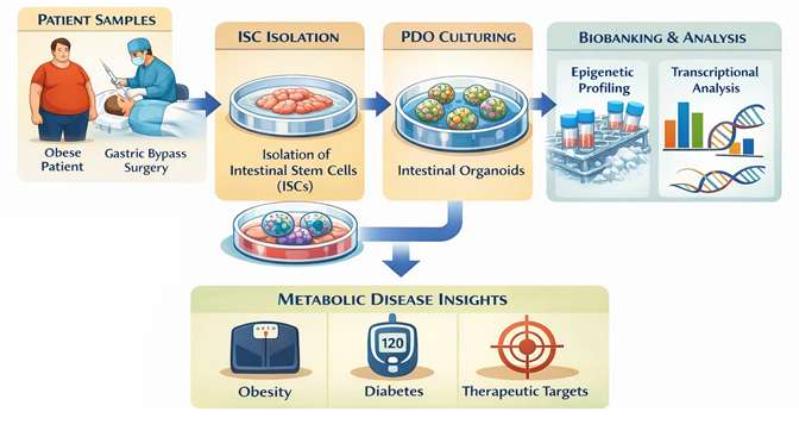
To capture the unique epigenetic and transcriptional characteristics associated with metabolic diseases, intestinal stem cells (ISCs) are harvested from surgical resections or biopsies, including samples from patients with obesity and those undergoing gastric bypass surgery.
- Induced High-Fat/Hyperglycemic Environment Modeling
For studies requiring the induction of an "obese-like" state in healthy tissue, we utilize specialized culture media enriched with lipids and glucose to simulate metabolic stress and lipid droplet formation.
- Multi-Lineage Differentiation Protocols
Our optimized growth factor cocktails ensure the presence of enteroendocrine cells (secreting GLP-1, PYY) and goblet cells, both of which are critical for studying appetite regulation and barrier function in obesity.
- Precision Bio-Imaging & Analysis
We employ high-content screening and 3D confocal imaging to quantify morphological changes, such as crypt depth, villus-like expansion, and lipid accumulation (e.g., Oil Red O and boron-dipyrromethene 581/591 staining).
Solution Scope
Protheragen offers a wide range of specialized modules within our intestinal organoid platform:
- Nutrient Absorption Profiling
Quantitative assessment of glucose, fatty acid, and amino acid transport across the epithelial layer.
- Barrier Integrity & Inflammation
Evaluation of tight junction proteins and cytokine production (e.g., TNF-α, IL-6) under metabolic stress.
- Microbiome-Metabolite Interaction
Testing the impact of short-chain fatty acids (SCFAs) or specific microbial metabolites on "obese" organoid homeostasis.
- Preclinical Drug Toxicity & Efficacy
Screening of novel anti-obesity compounds or metabolic modulators to determine their impact on human-derived epithelial tissue.
Contact Our Team for a Custom Project Quote and Technical Consultation.
Workflow
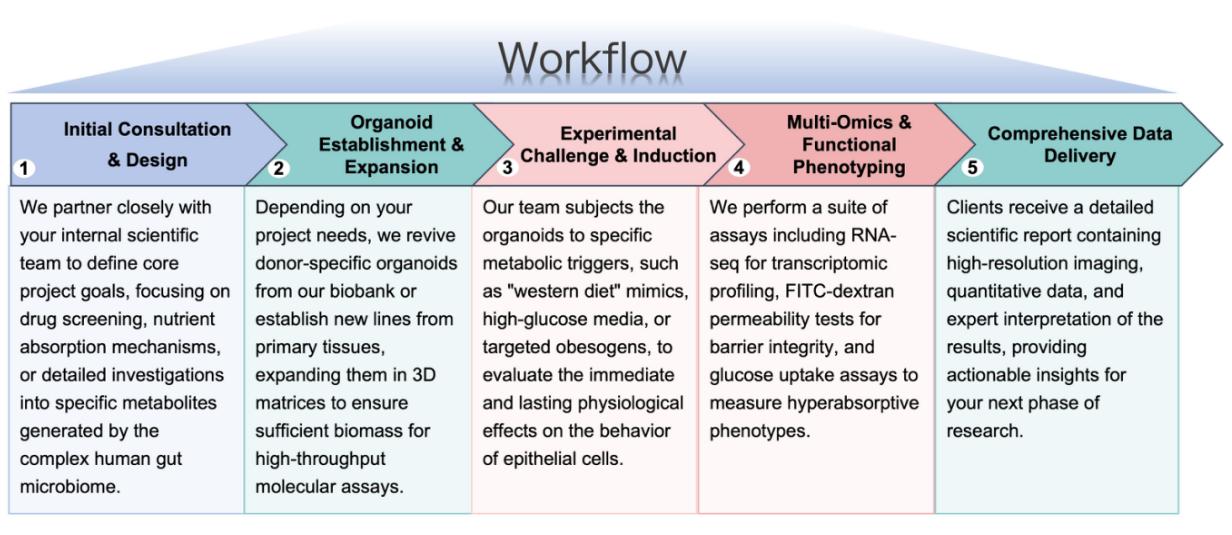
Our service is designed to be a turn-key solution for preclinical metabolic research, following a rigorous five-stage process:
Fields of Application
The versatility of the Protheragen organoid platform extends across the entire spectrum of metabolic science, providing a high-fidelity human interface for diverse research objectives ranging from novel drug discovery to the exploration of the gut-microbiome axis.
Identification of novel targets for appetite suppression and metabolic regulation.
- Nutritional Science
Investigating how specific dietary ingredients or functional foods modulate gut health in the context of weight management.
- Endocrinology
Studying the role of the intestinal clock and circadian misalignment in metabolic syndrome.
Assessing the potential "obesogenic" effects of environmental chemicals on the human gut barrier.
Advantages
Choosing Protheragen means accessing a platform that combines scientific rigor with industrial-scale efficiency.
Human Physiological Relevance
Unlike murine models, our human-derived organoids retain the epigenetic "memory" of the donor's metabolic state, allowing for the study of persistent obesity-driven phenotypes.
Scalability & Reproducibility
We have overcome the traditional "high-cost/low-yield" barrier of organoid research. Our standardized protocols allow for large-scale compound screening with minimal inter-batch variation.
Precision Phenotyping and Advanced Imaging Capabilities
Our ability to "tease apart" the effects of diet versus the state of obesity itself provides a level of mechanistic clarity that is unattainable in vivo. We provide quantitative data on lipid peroxide levels and ferroptosis markers, which are emerging as critical factors in obesity-related intestinal damage.
Publication Data
Title: Human intestinal organoids: Modeling gastrointestinal physiology and immunopathology — current applications and limitations
Journal: European Journal of Immunology, 2023
DOI: https://doi.org/10.1002/eji.202250248
Summary: This review explores human intestinal organoids as a powerful in vitro model for studying gastrointestinal (GI) physiology and immunopathology. Derived from patient tissues (adult Lgr5+ crypt base columnar stem cells), these 3D/2D models recapitulate key features of native intestinal epithelium, including cell heterogeneity, tissue architecture, and functional responses. The paper details their applications in investigating epithelial functions (absorption, barrier function, secretion, cell death/regeneration, cell-cell/microbe interactions) across GI conditions like inflammatory bowel disease (IBD), coeliac disease, irritable bowel syndrome (IBS), obesity, and colorectal cancer (CRC). It also highlights associated techniques, current limitations, and future directions, such as organ-on-a-chip technology.
Key Findings
- Organoid Model Advantages
- Retain tissue-specific morphology and cell subsets (enterocytes, goblet cells, Paneth cells) and respond to physiological stimuli (diet, bacteria, drugs, cytokines).
- Recapitulate disease phenotypes from patient tissues, enabling personalized medicine and drug discovery.
- Support diverse assays (TEER for barrier function, fluorescent probes for absorption, gene editing for mechanism studies) to analyze epithelial functions.
- Applications in GI Disease Research
- Absorption: Obese patient organoids show elevated glucose absorption; coeliac disease organoids exhibit villous atrophy and impaired nutrient uptake; organoids aid tissue regeneration for short bowel syndrome.
- Barrier Function: IBD/coeliac organoids have reduced tight junction proteins (ZO-1, occludin) and increased permeability; drugs like tofacitinib and Aquamin restore barrier integrity.
- Secretion: UC organoids have defective mucin secretion; IL-17 and nerve growth factor alter secretory cell differentiation in IBD/IBS.
- Cell Death & Regeneration: Chronic inflammation impairs ISC function; JAK inhibitors rescue cytokine-induced cell death in IBD organoids.
- Cell-Cell/Microbe Interactions: Co-cultures with immune cells/microbes reveal T cell-driven epithelial damage in Crohn's disease; pathogens like Klebsiella pneumoniae trigger inflammatory cascades.
- CRC: Tumor-derived organoids model cancer progression and predict therapy responses.
- Limitations & Future Directions
- Technical challenges: ECM interference, batch variability in culture media, and lack of non-epithelial cells/mechanical stimuli.
- Reproducibility issues: Donor variability and incomplete reporting of experimental details.
- Future advancements: Organ-on-a-chip systems integrating microfluidics, co-cultures, and mechanical stimuli to enhance physiological relevance.
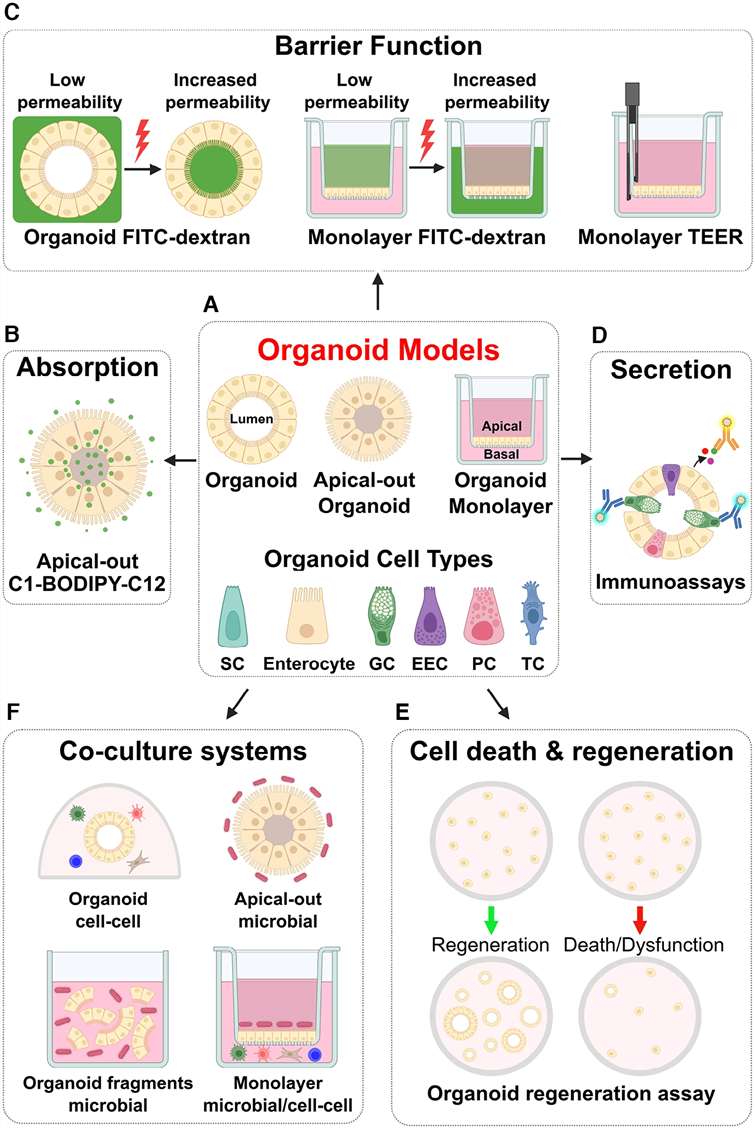 Fig. 1 Human intestinal organoid models and functional assays for gastrointestinal epithelial research. (Flood, et al., 2023)
Customer Review
Validation of Lead Compounds: Bridging the Gap Between Benchtop and Human Metabolism
"Working with Protheragen has been transformative for our metabolic pipeline. Their ability to provide organoids from donors with specific BMI profiles allowed us to validate our lead compound's effect on glucose transport in a human system before moving to further stages. The data were robust, and the insights into lipid droplet formation were exactly what we needed to differentiate our product. We look forward to our next collaboration on gut-hormone signaling."
Dr. S. M., Global Biotech
Mechanistic Clarity: Unlocking Deep Insights into Nutrient Interaction and Barrier Function
"Protheragen provided the high-resolution imaging and quantitative barrier function data we lacked. Their expertise in obesity-specific intestinal modeling is unparalleled, helping us understand how our functional ingredients interact with the 'obese' epithelium. They are more than a service provider; they are a true scientific partner."
Mr. J. L., Specialized Nutrition Firm
Frequently Asked Questions
-
How do your models compare to Caco-2 cell lines?
While Caco-2 is a standard 2D model, it is a cancer-derived line that lacks the cellular diversity (like goblet or enteroendocrine cells) and 3D structure found in our organoids, which more accurately represent healthy or diseased human physiology.
-
Is it possible to study the gut-brain axis with these organoids?
While we focus on the preclinical epithelial component, our models are excellent for measuring the secretion of gut hormones (GLP-1, PYY) that are the primary signalers to the brain's appetite centers.
-
Do you offer co-culture services with immune cells?
Yes, we can integrate immune-epithelial crosstalk modules to study how chronic inflammation in obesity affects the intestinal barrier.
-
Can you measure glucose hyperabsorption specifically?
Absolutely. We utilize specialized glucose transport assays (e.g., using 2-DG or fluorescent glucose analogs) to quantify the hyperabsorptive state common in obesity.
-
What is the typical turnaround time for a drug screening project?
Timeline varies by scale, but typically ranges from 6 to 10 weeks from project initiation to final report delivery.
-
Do you use animal-derived matrices?
We primarily use high-standard basement membrane extracts, but we also offer synthetic scaffold options for clients requiring chemically defined environments.
-
Are the "obese" traits maintained over multiple passages?
Research indicates that certain epigenetic and transcriptomic signatures of obesity are maintained in organoid culture, though we monitor passage-dependent changes closely.
How to Contact Us
The intestinal epithelium is the frontier of obesity research. Protheragen offers the specialized tools and expertise needed to explore this complex landscape through high-fidelity, human-derived intestinal organoids. Our preclinical services provide the mechanistic depth and human relevance required to drive innovation in metabolic health.
Contact Protheragen for More Information and to Discuss Your Project
Reference
- Flood, P.; et al. Human intestinal organoids: Modeling gastrointestinal physiology and immunopathology — current applications and limitations. Eur J Immunol. 2023, 00: 11111. (CC BY 4.0)
All of our services and products are intended for preclinical research use only and cannot be used to diagnose, treat or manage patients.