Products
Online Inquiry

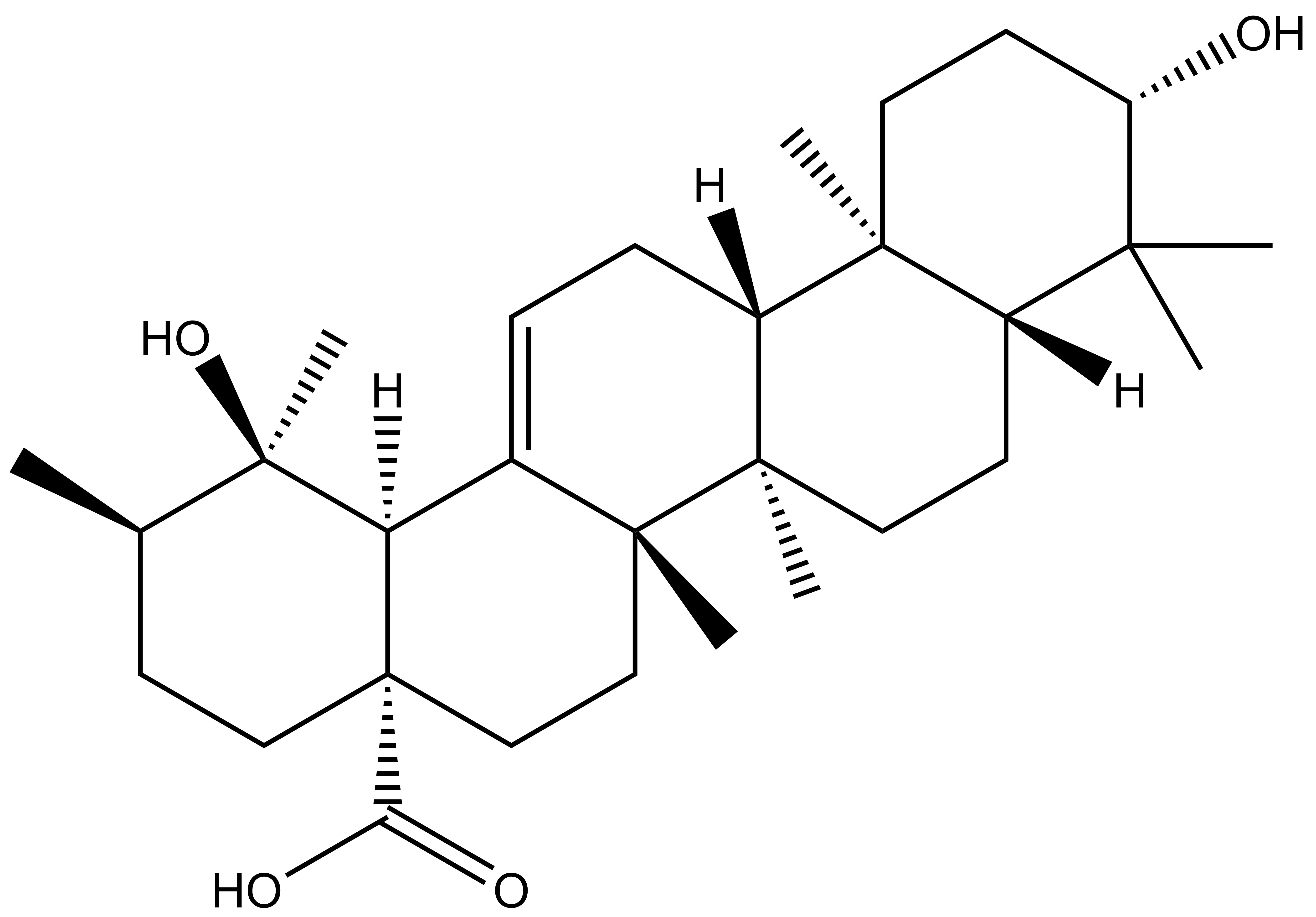
Pomolic acid
Cat. No.:
0225LY-1011
Appearance:
Solid
Purity:
≥96%
Identity:
Confirmed by NMR, and LC-MS.
Size:
Add to basket
Product Overview
Description:
Pomolic acid induces apoptosis in SK-OV-3 cells through both intrinsic mitochondrial and extrinsic death receptor pathways, exhibiting significant anti-inflammatory and anti-cancer traits.
Synonym:
13849-91-7; Randialic acid A; Benthamic acid; (1R,2R,4aS,6aR,6aS,6bR,8aR,10S,12aR,14bS)-1,10-dihydroxy-1,2,6a,6b,9,9,12a-heptamethyl-2,3,4,5,6,6a,7,8,8a,10,11,12,13,14b-tetradecahydropicene-4a-carboxylic acid; Urs-12-en-28-oic acid, 3,19-dihydroxy-, (3beta)-; Urs-12-en-28-oic acid, 3,19-dihydroxy-, (3.beta.)-; 19alpha-Hydroxyursolic acid; 1,10-dihydroxy-1,2,6a,6b,9,9,12a-heptamethyl-2,3,4,5,6,6a,7,8,8a,10,11,12,13,14b-tetradecahydropicene-4a-carboxylic acid
CAS No.:
13849-91-7
Compound CID:
382831
Formula:
C30H48O4
Formula Weight:
472.7
Specification
Relative Density:
1.14 g/cm3
Stability:
3 years in powder form.
Storage:
Storage at -20°C.
Applications:
Pomolic acid can be used in oncology research to study the induction of apoptosis and inhibition of cell migration in malignant cells.
Library Information
Target:
Caspase; AMPK
Receptor:
Caspase; AMPK
Pathways:
Microbiology/Virology; Apoptosis; PI3K/Akt/mTOR signaling; Chromatin/Epigenetic; Proteases/Proteasome
Plate Number:
AOCL-14
Plate Location:
a4
Empty Location:
a1-h1; a12-h12
Container:
96-well plate
Formulation:
10mM DMSO
DMSO Max Solubility:
60 mg/mL; 126.93 mM