Products
- Anti-Obesity Compound Library
- GPCR/G Protein-Targeted Compounds
- Immunology/Inflammation-Targeted Compounds
- JAK/STAT-Targeted Compounds
- MAPK-Targeted Compounds
- Membrane Transporter/Ion Channel-Targeted Compounds
- Metabolism-Targeted Compounds
- NF-κB-Targeted Compounds
- Microbiology/Virology-Targeted Compounds
- Neuronal Signaling-Targeted Compounds
- PI3K/Akt/mTOR-Targeted Compounds
- Oxidation-reduction-Targeted Compounds
- Proteases/Proteasome-Targeted Compounds
- Stem Cells/Wnt-Targeted Compounds
- Tyrosine Kinase/Adaptors-Targeted Compounds
- Ubiquitin-Targeted Compounds
Online Inquiry
Human pro-opiomelanocortin (POMC) ELISA kit (0.156-10 ng/mL)
Cat. No.:
0126WXX-1430
Assay Type:
Quantitative sandwich ELISA
Target Species:
Human
Assay Target:
POMC
Size:
Add to basket
Product Overview
Description:
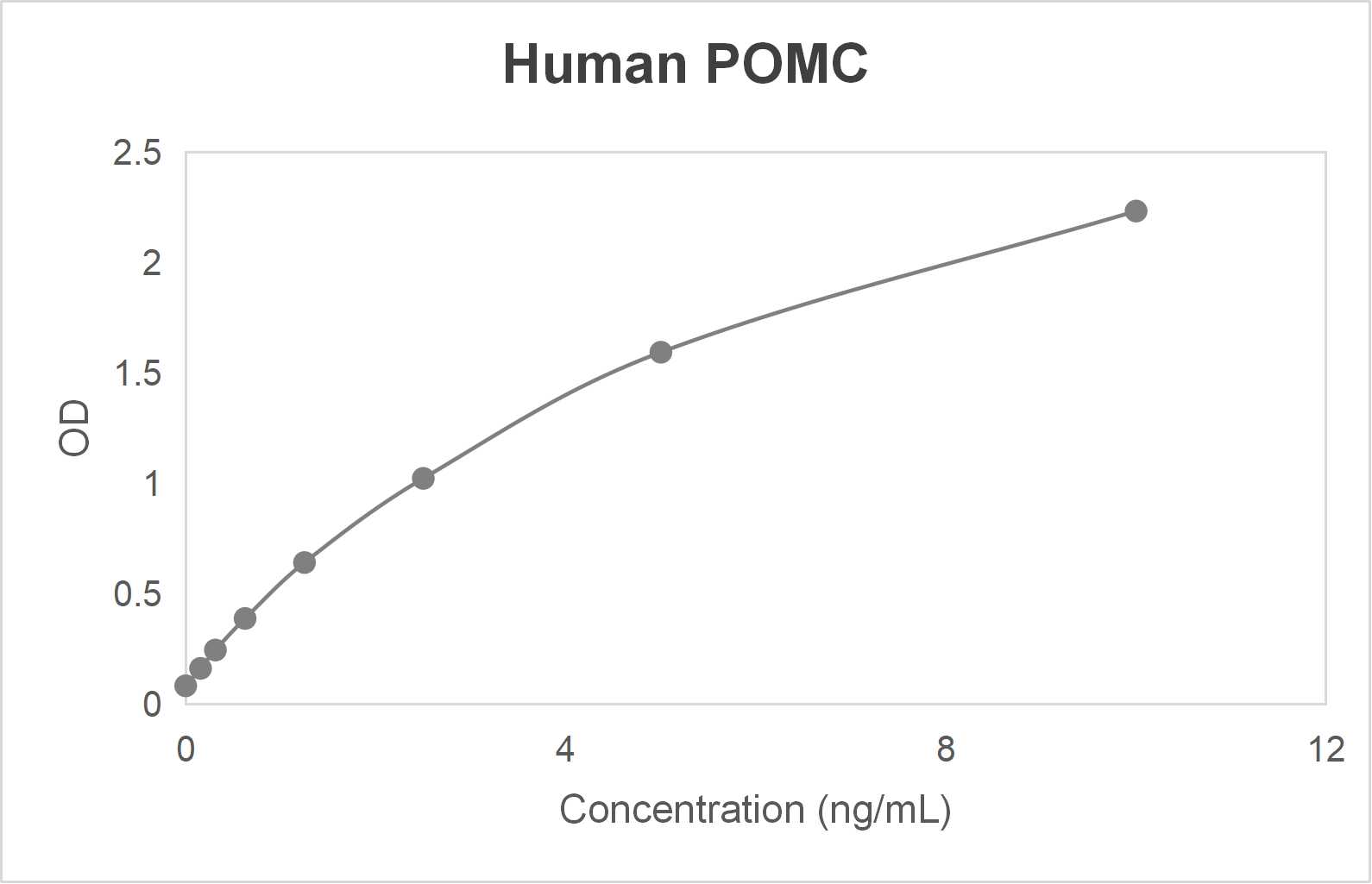
Human pro-opiomelanocortin (POMC) ELISA kit (0.156-10 ng/mL) is an ELISA-based in vitro research tool designed specifically for the quantitative detection of POMC in human samples with a range of 0.156-10 ng/mL and a minimum detectable dose (sensitivity) of 0.05 ng/mL. The kit is highly sensitive and easy to use.
Assay Principle:
This kit utilizes the double-antibody sandwich ELISA technique. The microplate is pre-coated with an anti-human POMC monoclonal antibody, while the detection antibody is a biotinylated polyclonal antibody. Samples and biotinylated antibodies are added to the wells and washed with PBS or TBS. Subsequently, avidin-peroxidase conjugates are introduced. Following a thorough wash to remove unbound reagents, a TMB substrate is used for coloration. TMB reacts to form a blue product through peroxidase activity, which turns yellow upon the addition of the stop solution (color reagent C). The color intensity is positively correlated with the concentration of the target analyte in the sample.
Background:
POMC, a highly complex precursor polypeptide belonging to the POMC family and encoded at chromosomal location 2p23.3, serves as a central hub in the endocrine regulation of energy homeostasis and systemic metabolism. Synthesized as a secreted protein that undergoes extensive peptide hormone processing, POMC is vital for the neuropeptide signaling pathways that govern appetite regulation, glucose homeostasis, and blood pressure. Its biological significance is underscored by its role in producing ACTH to stimulate adrenal cortisol release, as well as its essential binding activities at melanocortin receptors (MC3R and MC4R) to modulate feeding behavior. Crucially, genetic defects in POMC are directly linked to Pro-opiomelanocortin Deficiency (POMCD) and a heightened susceptibility to early-onset obesity—a condition defined by the excessive accumulation of body fat beyond physiological requirements. Beyond its primary metabolic functions, POMC influences diverse processes ranging from cellular pigmentation and neuropeptide transduction to the negative regulation of tumor necrosis factor production, highlighting its status as a pivotal molecular driver in the complex pathology of metabolic disorders.
Synonyms:
POC; NPP; ProOMC; ACTH; Pro-OMC; Pro opiomelanocortin; Corticotropin-lipotropin; Corticotropin; Adrenocorticotropic hormone; Proopiomelanocortin
Applications:
Human pro-opiomelanocortin (POMC) ELISA kit (0.156-10 ng/mL) is used to quantify POMC in human serum, plasma, cell culture supernatant, and organizations, providing data to support research in a wide range of areas, including endocrinology, obesity, and others.
Research Area:
Endocrinology; Obesity
Specification
Sample Type:
Human serum; Plasma; Cell culture supernatant; Organizations
Detection Range:
0.156-10 ng/mL
Sensitivity:
0.05 ng/mL
Precision (Intra-assay):
CV≤8%
Precision (Inter-assay):
CV≤12%
Cross-reactivity:
No significant cross-reactivity or interference was observed.
Recovery:
70-110%
Storage:
Store at 2-8°C.


