Products
- Anti-Obesity Compound Library
- GPCR/G Protein-Targeted Compounds
- Immunology/Inflammation-Targeted Compounds
- JAK/STAT-Targeted Compounds
- MAPK-Targeted Compounds
- Membrane Transporter/Ion Channel-Targeted Compounds
- Metabolism-Targeted Compounds
- NF-κB-Targeted Compounds
- Microbiology/Virology-Targeted Compounds
- Neuronal Signaling-Targeted Compounds
- PI3K/Akt/mTOR-Targeted Compounds
- Oxidation-reduction-Targeted Compounds
- Proteases/Proteasome-Targeted Compounds
- Stem Cells/Wnt-Targeted Compounds
- Tyrosine Kinase/Adaptors-Targeted Compounds
- Ubiquitin-Targeted Compounds
Online Inquiry
Mouse uncoupling protein-1 (UCP1) ELISA kit (78-5000 pg/mL)
Cat. No.:
0126WXX-2042
Assay Type:
Quantitative sandwich ELISA
Target Species:
Mouse
Assay Target:
UCP1
Size:
Add to basket
Product Overview
Description:
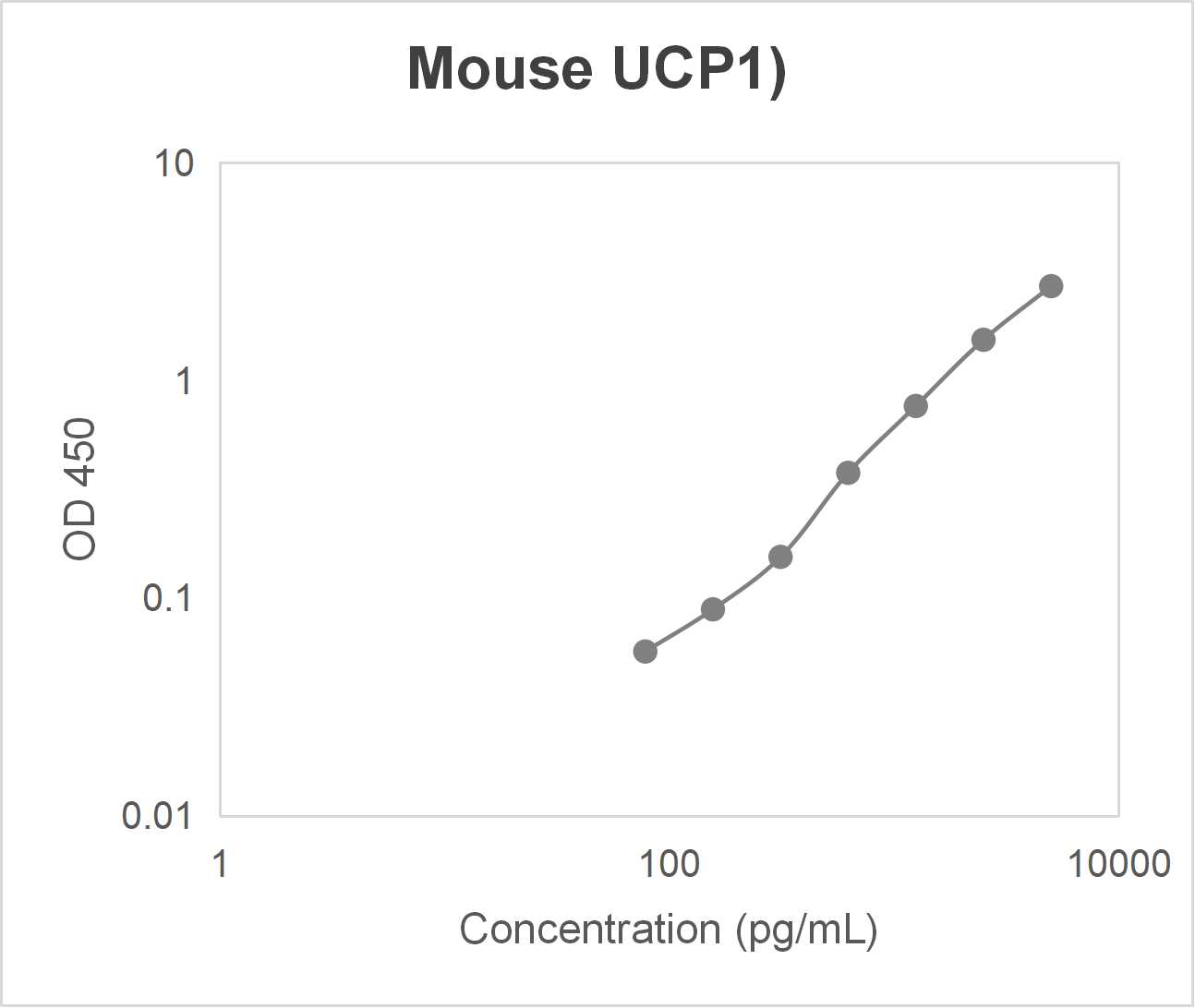
Mouse uncoupling protein-1 (UCP1) ELISA kit (78-5000 pg/mL) is an ELISA-based in vitro research tool designed specifically for the quantitative detection of UCP1 in mouse samples with a range of 78-5000 pg/mL and a minimum detectable dose (sensitivity) of <38 pg/mL. The kit is highly sensitive and easy to use.
Assay Principle:
The microtiter plate provided in this kit has been pre-coated with an antibody specific to the target antigen. Standards or samples are then added to the appropriate microtiter plate wells along with a biotin-conjugated antibody preparation specific for the target antigen. Subsequently, avidin conjugated to HRP is added to each microplate well and incubated. A TMB substrate solution is then added to each well. Only those wells containing the target antigen, biotin-conjugated antibody, and enzyme-conjugated Avidin will exhibit a change in color. The enzyme-substrate reaction is terminated by the addition of a sulphuric acid solution, and the color change is measured spectrophotometrically at a wavelength of 450 nm ± 2 nm. The concentration of the target antigen is determined by comparing the O.D. of the samples to the standard curve.
Background:
Uncoupling protein 1 (UCP1) is a mitochondrial transporter that mediates proton leakage across the inner mitochondrial membrane, uncoupling oxidative phosphorylation from ATP synthesis and dissipating energy as heat. UCP1 plays a key role in brown adipose tissue thermogenesis and energy expenditure, contributing to the regulation of whole-body metabolism. Impaired UCP1 function can reduce thermogenic capacity and promote energy storage, linking it to obesity and related metabolic disorders.
Synonyms:
SLC25A7; UCP; Thermogenin; Solute carrier family 25 member 7; Uncoupling Protein 1; Mitochondrial; Mitochondrial brown fat uncoupling protein 1
Applications:
Mouse uncoupling protein-1 (UCP1) ELISA kit (78-5000 pg/mL) is used to quantify UCP1 in serum, plasma, tissue homogenates, cell culture supernatant, and other biological fluids of mice, providing data to support research in a wide range of areas, including signal transduction, obesity, and others.
Research Area:
Signal transduction; Obesity
Specification
Sample Type:
Serum; Plasma; Tissue homogenates; Cell culture supernatants; Other biological fluids
Detection Range:
78-5000 pg/mL
Sensitivity:
<38 pg/mL
Precision (Intra-assay):
CV≤4.7%
Precision (Inter-assay):
CV≤8.6%
Cross-reactivity:
No significant cross-reactivity or interference was observed.
Storage:
Store at -20°C.