Products
- Anti-Obesity Compound Library
- GPCR/G Protein-Targeted Compounds
- Immunology/Inflammation-Targeted Compounds
- JAK/STAT-Targeted Compounds
- MAPK-Targeted Compounds
- Membrane Transporter/Ion Channel-Targeted Compounds
- Metabolism-Targeted Compounds
- NF-κB-Targeted Compounds
- Microbiology/Virology-Targeted Compounds
- Neuronal Signaling-Targeted Compounds
- PI3K/Akt/mTOR-Targeted Compounds
- Oxidation-reduction-Targeted Compounds
- Proteases/Proteasome-Targeted Compounds
- Stem Cells/Wnt-Targeted Compounds
- Tyrosine Kinase/Adaptors-Targeted Compounds
- Ubiquitin-Targeted Compounds
Online Inquiry
Mouse glucagon (GCG) ELISA kit (1.0 pg/mL)
Cat. No.:
0126WXX-90
Assay Type:
Quantitative competitive ELISA
Target Species:
Mouse
Assay Target:
GCG
Size:
Add to basket
Product Overview
Description:
Mouse glucagon (GCG) ELISA kit (1.0 pg/mL) is an ELISA-based in vitro research tool designed specifically for the quantitative detection of GCG in mouse samples with a minimum detectable dose (sensitivity) of 1.0 pg/mL. The kit is highly sensitive and easy to use.
Assay Principle:
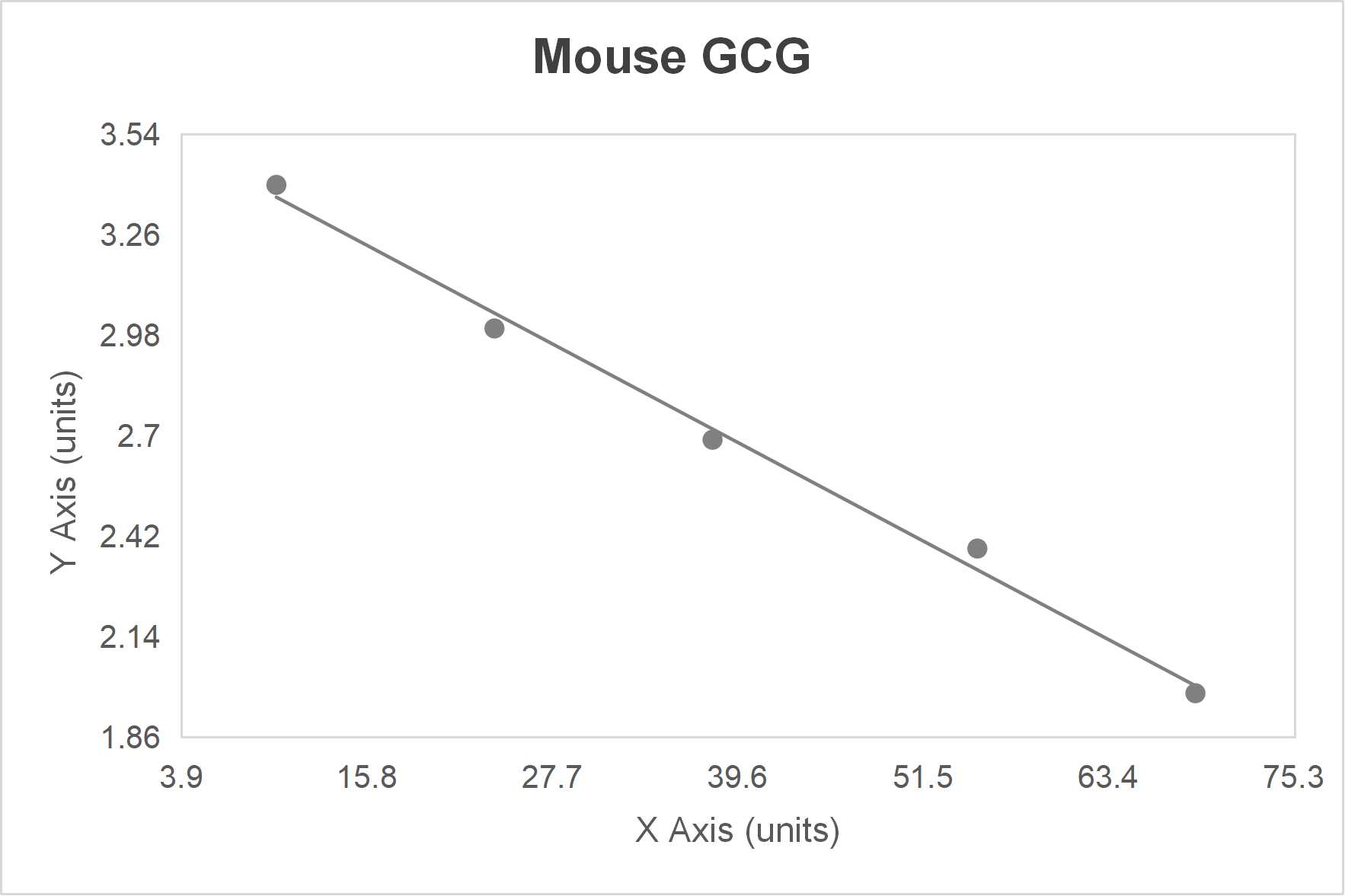
In this assay, the sample is incubated with the assay buffer and a GCG-HRP conjugate within a pre-coated microplate for one hour. During this incubation, endogenous GCG in the sample competes with the GCG-HRP conjugate for a limited number of anti-GCG antibody binding sites. Following incubation, the liquid is aspirated, and the plate is washed five times to remove unbound components. Subsequently, an HRP enzyme substrate is added to the wells and incubated, triggering an enzymatic reaction that generates a blue-colored complex. The reaction is terminated by the addition of a stop solution, which shifts the color to yellow. The absorbance is then measured at 450 nm using a microplate reader. Because the GCG in the sample and the GCG-HRP conjugate compete for the same binding sites, the absorbance intensity is inversely proportional to the GCG concentration. By plotting a standard curve, a correlation is established between color intensity and the standard concentrations, from which the GCG concentration of each sample is interpolated.
Background:
Glucagon is a hormone secreted by A cells of the islets of Langerhans, playing a pivotal role in glucose metabolism and homeostasis. Its primary function is to regulate blood glucose levels by promoting gluconeogenesis and inhibiting glycolysis. The dynamic equilibrium between glucagon and insulin is crucial for maintaining healthy metabolism. The detection of glucagon and analysis of its associated pathways provide key insights into understanding and treating obesity.
Synonyms:
GLP1; GLP2; GRPP; Glicentin-related polypeptide; Glucagen; Oxyntomodulin; Incretin hormone; GC
Applications:
Mouse glucagon (GCG) ELISA kit (1.0 pg/mL) is used to quantify GCG in serum, plasma, cell culture supernatants, body fluid, and tissue homogenate of mouse, providing data to support research in a wide range of areas, including endocrinology, obesity, metabolism, and others.
Research Area:
Endocrinology; Obesity; Metabolism
Specification
Sample Type:
Serum; Plasma; Cell culture supernatants; Body fluid; Tissue homogenate
Detection Range:
100-2500 pg/mL
Sensitivity:
1.0 pg/mL
Cross-reactivity:
No significant cross-reactivity or interference was observed.
Recovery:
94-103%
Storage:
Store at 2-8°C.