

Products
- Anti-Obesity Compound Library
- GPCR/G Protein-Targeted Compounds
- Immunology/Inflammation-Targeted Compounds
- JAK/STAT-Targeted Compounds
- MAPK-Targeted Compounds
- Membrane Transporter/Ion Channel-Targeted Compounds
- Metabolism-Targeted Compounds
- NF-κB-Targeted Compounds
- Microbiology/Virology-Targeted Compounds
- Neuronal Signaling-Targeted Compounds
- PI3K/Akt/mTOR-Targeted Compounds
- Oxidation-reduction-Targeted Compounds
- Proteases/Proteasome-Targeted Compounds
- Stem Cells/Wnt-Targeted Compounds
- Tyrosine Kinase/Adaptors-Targeted Compounds
- Ubiquitin-Targeted Compounds
Online Inquiry

Bovine hormone-sensitive lipase (HSL) ELISA kit (0.15-10.0 ng/mL)
Cat. No.:
0126WXX-884
Assay Type:
Quantitative ELISA
Target Species:
Bovine
Assay Target:
HSL
Size:
Add to basket
Product Overview
Description:
Bovine hormone-sensitive lipase (HSL) ELISA kit (0.15-10.0 ng/mL) is an ELISA-based in vitro research tool designed specifically for the quantitative detection of HSL in porcine samples with a range of 0.15-10.0 ng/mL. The kit is highly sensitive and easy to use.
Assay Principle:
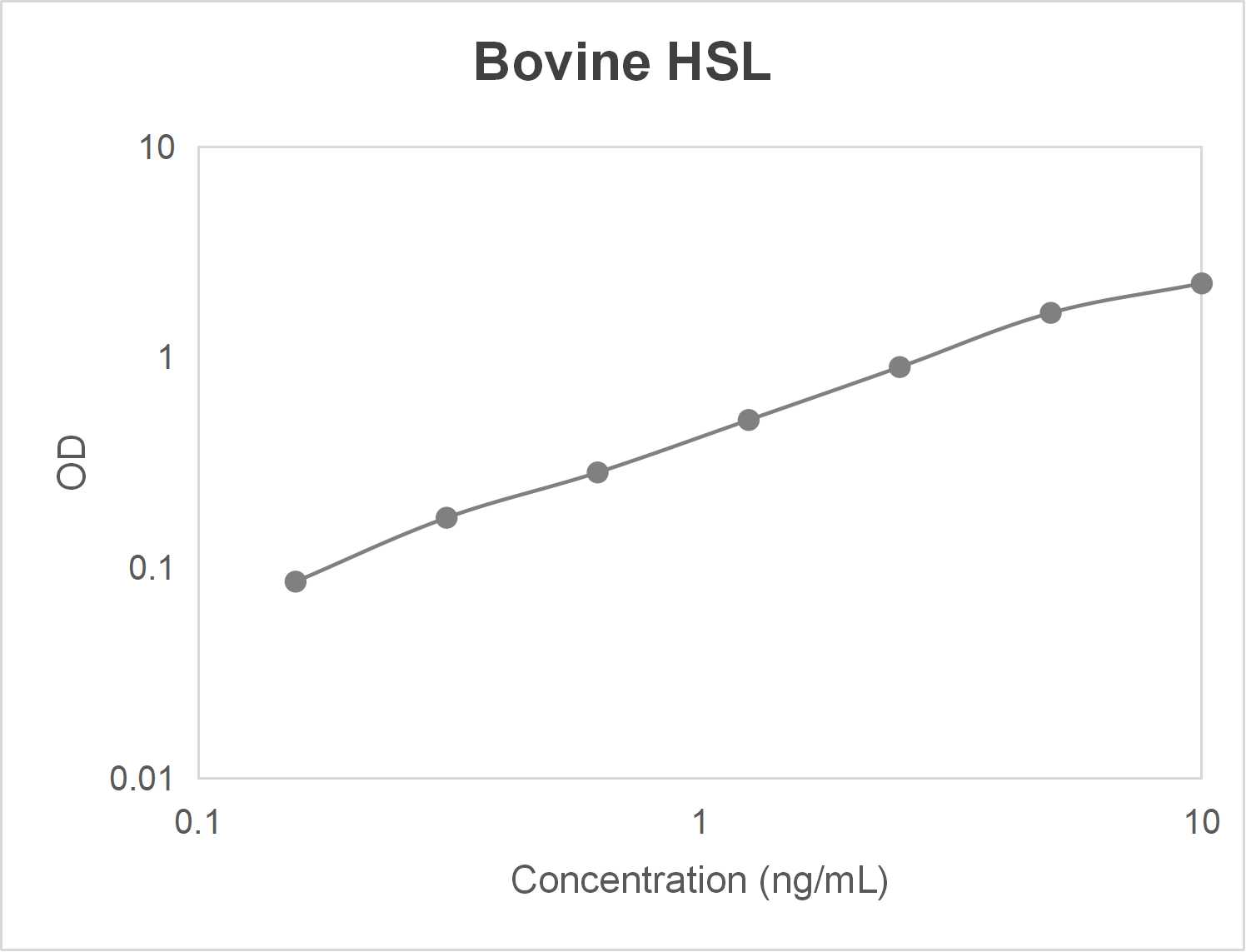
The microtiter plate included in this kit is pre-coated with a capture antibody specific to HSL. Standards or samples are introduced into the designated wells along with a biotin-conjugated polyclonal detection antibody specific for HSL. Subsequently, avidin-conjugated HRP is added to each microplate well and incubated. Following the addition of TMB substrate solution, only wells containing the HSL-biotin-avidin sandwich complex will undergo a color change. The enzymatic reaction is terminated by a sulphuric acid solution, and the absorbance is measured spectrophotometrically at 450 nm ± 2 nm. The concentration of HSL in the samples is determined by comparing the O.D. of the samples to the standard curve.
Background:
HSL is the key enzyme for fat breakdown. Belonging to the “GDXG” lipase family, this enzyme primarily hydrolyzes stored triacylglycerols into free fatty acids in adipose tissue and the heart. This process represents the rate-limiting step of lipolysis, controlling the overall speed of fat breakdown. HSL can be rapidly activated by catecholamine hormones (such as epinephrine) through a cyclic adenosine monophosphate (cAMP)-dependent phosphorylation process, while insulin regulates its dephosphorylation and inactivation. Due to its functional characteristics, HSL has become a central subject in obesity research, particularly in the regulation of fat storage and release.
Synonyms:
LHS; LIPE; Lipase, hormone sensitive; EC 3.1.1.79
EC NO.:
3.1.1.79
Applications:
Bovine hormone-sensitive lipase (HSL) ELISA kit (0.15-10.0 ng/mL) is used to quantify HSL in serum, plasma, tissue homogenates, cell culture supernatant, and other biological fluids of bovine, providing data to support research in a wide range of areas, including metabolic pathway, obesity, etc.
Research Area:
Metabolic pathway; Obesity
Specification
Sample Type:
Serum; Plasma; Tissue homogenates; Cell culture supernatants; Other biological fluids
Detection Range:
0.15-10.0 ng/mL
Cross-reactivity:
No significant cross-reactivity or interference was observed.
Storage:
Store at -20°C.
