Products
- Anti-Obesity Compound Library
- GPCR/G Protein-Targeted Compounds
- Immunology/Inflammation-Targeted Compounds
- JAK/STAT-Targeted Compounds
- MAPK-Targeted Compounds
- Membrane Transporter/Ion Channel-Targeted Compounds
- Metabolism-Targeted Compounds
- NF-κB-Targeted Compounds
- Microbiology/Virology-Targeted Compounds
- Neuronal Signaling-Targeted Compounds
- PI3K/Akt/mTOR-Targeted Compounds
- Oxidation-reduction-Targeted Compounds
- Proteases/Proteasome-Targeted Compounds
- Stem Cells/Wnt-Targeted Compounds
- Tyrosine Kinase/Adaptors-Targeted Compounds
- Ubiquitin-Targeted Compounds
Online Inquiry
Sheep leptin (LEP) ELISA kit (0.156-10 ng/mL)
Cat. No.:
0126WXX-835
Assay Type:
Quantitative sandwich ELISA
Target Species:
Sheep
Assay Target:
LEP
Size:
Add to basket
Product Overview
Description:
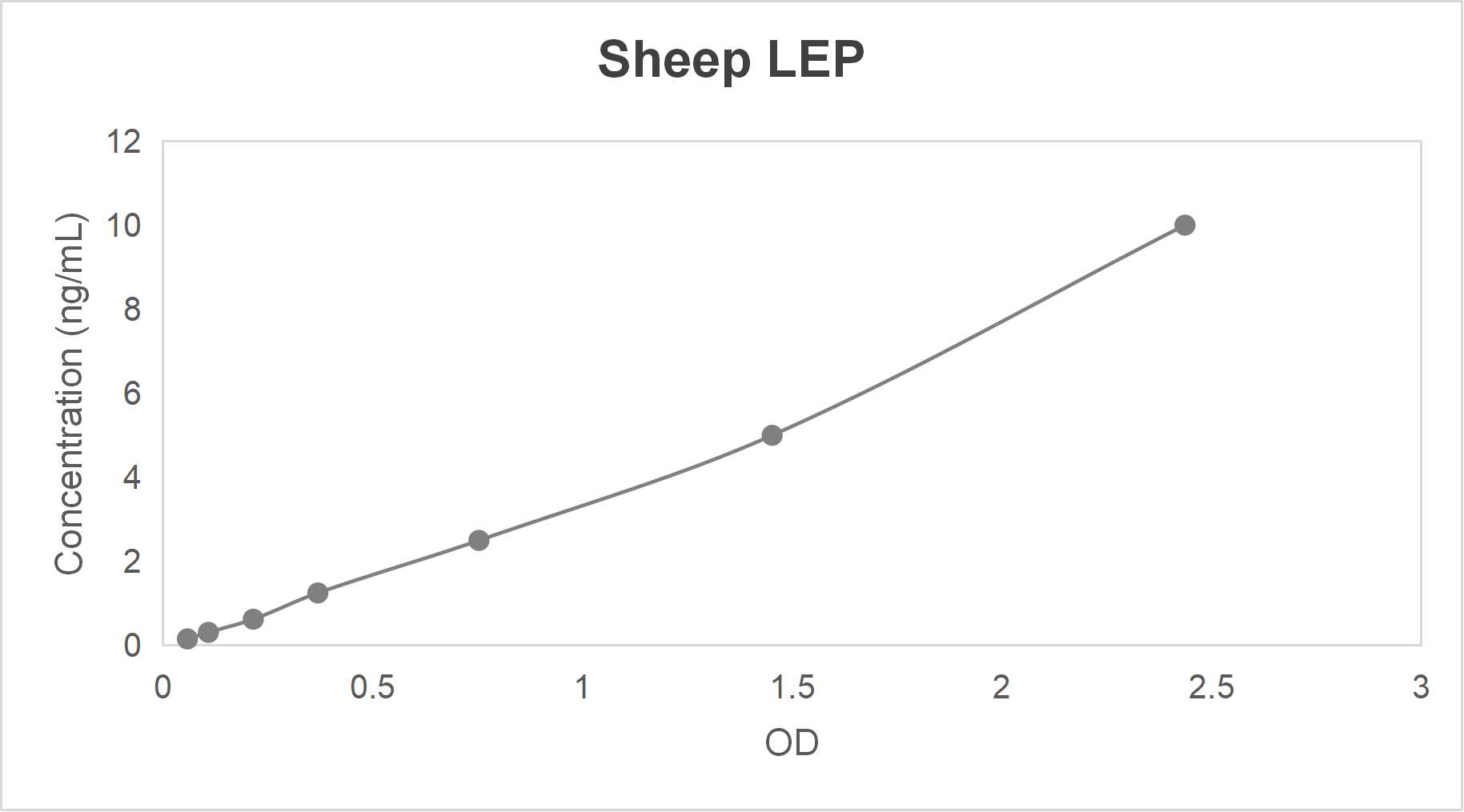
Sheep leptin (LEP) ELISA kit (0.156-10 ng/mL, <0.059 ng/mL) is an ELISA-based in vitro research tool designed specifically for the quantitative detection of LEP in sheep samples with a range of 0.156-10 ng/mL and a minimum detectable dose (sensitivity) of <0.059 ng/mL. The kit is highly sensitive and easy to use.
Assay Principle:
The microplate provided in this kit is pre-coated with an antibody specific to LEP. Standards or samples are added to the appropriate wells together with a biotin-conjugated detection antibody specific to LEP. Next, avidin conjugated to HRP is added to each well and incubated to form an immune complex. Following the addition of TMB substrate solution, only wells containing the LEP-biotin-avidin complex will exhibit a color change. The enzyme-substrate reaction is terminated by a sulphuric acid solution, and the absorbance is measured spectrophotometrically at a wavelength of 450 nm ± 10 nm. The concentration of LEP in the samples is then determined by comparing the optical density (O.D.) of the samples to the standard curve.
Background:
LEP is a hormone that plays a crucial role in regulating body fat. Secreted by fat cells, it functions as part of a signaling pathway that controls the extent of fat storage in the human body. This protein belongs to the leptin family and possesses dual functions as both a growth factor and a hormone. LEP's primary functions include: regulating food intake, controlling energy expenditure, participating in glucose homeostasis regulation, modulating adipocyte differentiation, and influencing fatty acid metabolism. Obesity research frequently focuses on deciphering the mechanisms of leptin resistance and developing countermeasures, including the development of drugs that enhance brain sensitivity to leptin or the exploration of alternative pathways for regulating appetite and energy balance. Understanding leptin-mediated signaling pathways is central to this research.
Synonyms:
OB; OBS; Obesity Homolog; Obesity Factor; Obese Protein
Applications:
Sheep leptin (LEP) ELISA kit (0.156-10 ng/mL, <0.059 ng/mL) is used to quantify LEP in serum, plasma, tissue homogenates, and cell lysates, cell culture supernatants, and other biological fluids of sheep, providing data to support research in a wide range of areas, including metabolic pathway, endocrinology, cardiovascular biology, obesity, etc.
Research Area:
Metabolic pathway; Endocrinology; Cardiovascular biology; Obesity
Specification
Sample Type:
Serum; Plasma; Tissue homogenates; Cell lysates; Cell culture supernatants; Other biological fluids
Detection Range:
0.156-10 ng/mL
Sensitivity:
<0.059 ng/mL
Precision (Intra-assay):
CV<10%
Precision (Inter-assay):
CV<12%
Cross-reactivity:
No significant cross-reactivity or interference was observed.
Storage:
Store at 2-8°C.