Products
- Anti-Obesity Compound Library
- GPCR/G Protein-Targeted Compounds
- Immunology/Inflammation-Targeted Compounds
- JAK/STAT-Targeted Compounds
- MAPK-Targeted Compounds
- Membrane Transporter/Ion Channel-Targeted Compounds
- Metabolism-Targeted Compounds
- NF-κB-Targeted Compounds
- Microbiology/Virology-Targeted Compounds
- Neuronal Signaling-Targeted Compounds
- PI3K/Akt/mTOR-Targeted Compounds
- Oxidation-reduction-Targeted Compounds
- Proteases/Proteasome-Targeted Compounds
- Stem Cells/Wnt-Targeted Compounds
- Tyrosine Kinase/Adaptors-Targeted Compounds
- Ubiquitin-Targeted Compounds
Online Inquiry
Rat peroxisome proliferator-activated receptor α (PPARα) ELISA kit (0.156-10 ng/mL)
Cat. No.:
0126WXX-1490
Assay Type:
Quantitative sandwich ELISA
Target Species:
Rat
Assay Target:
PPARα
Size:
Add to basket
Product Overview
Description:
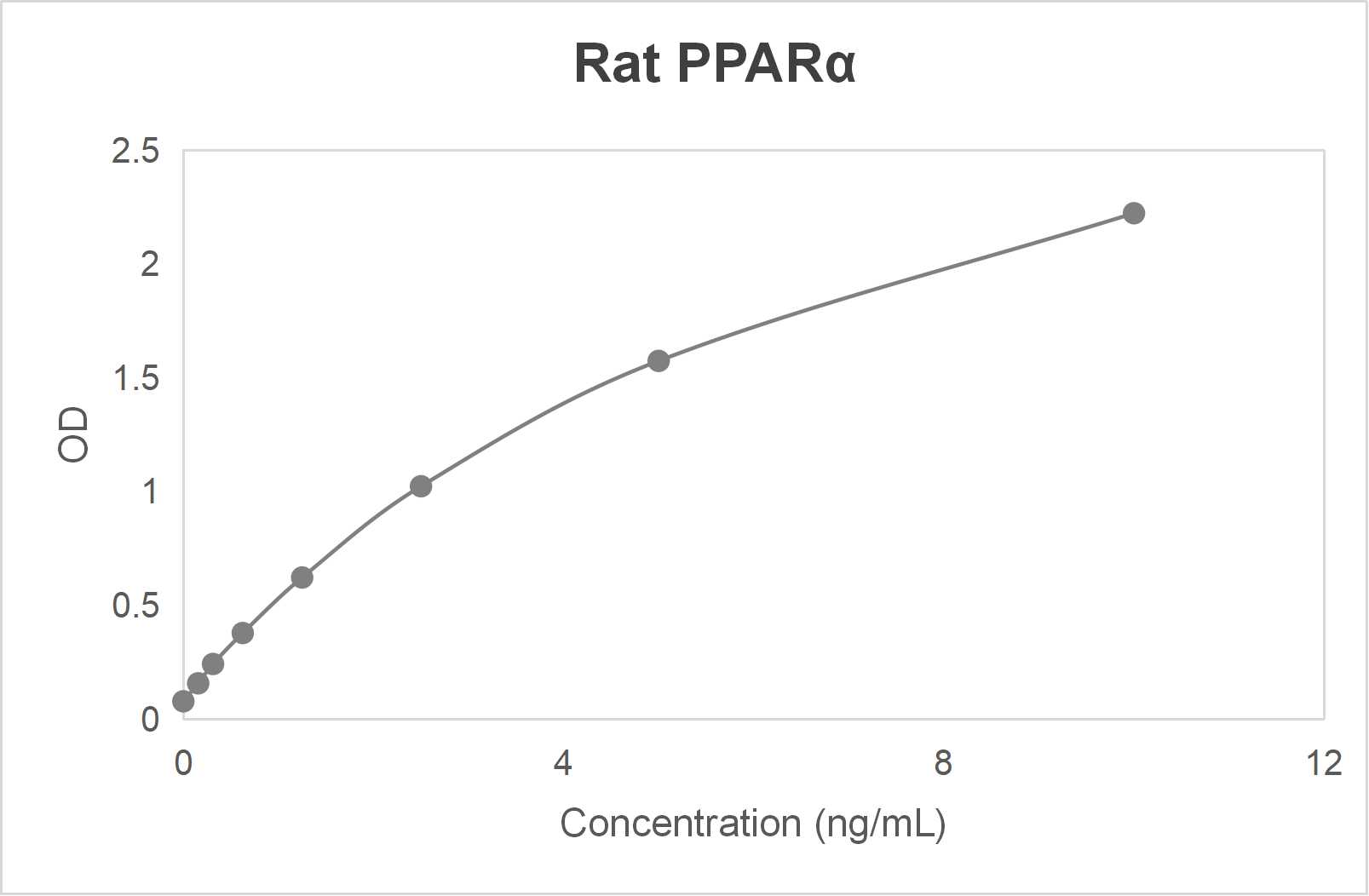
Rat peroxisome proliferator-activated receptor α (PPARα) ELISA kit (0.156-10 ng/mL) is an ELISA-based in vitro research tool designed specifically for the quantitative detection of PPARα in rat samples with a range of 0.156-10 ng/mL and a minimum detectable dose (sensitivity) of <0.05 ng/mL. The kit is highly sensitive and easy to use.
Assay Principle:
This kit utilizes the double-antibody sandwich ELISA technique. The microplate is pre-coated with an anti-rat PPARα monoclonal antibody, and a biotinylated polyclonal antibody is used for detection. Samples and detection antibodies are added to the wells and washed with PBS or TBS. Subsequently, avidin-peroxidase conjugates are introduced. Following a thorough wash, the TMB substrate produces a blue product that turns yellow upon adding the stop solution (color reagent C). The color intensity is positively correlated with the quantity of target analyte in the sample.
Background:
PPAR-alpha, a member of the NR1 nuclear hormone receptor subfamily located at chromosomal position 22q13.31, serves as a master ligand-activated transcription factor and a cornerstone regulator of lipid homeostasis in obesity research. Primarily localized within the nucleus, its transactivation activity—requiring heterodimerization with RXRA and being antagonized by NR2C2—is triggered by various endogenous ligands such as 1-palmitoyl-2-oleoyl-sn-glycerol-3-phosphocholine (16:0/18:1-GPC), satiety-regulating lipids like oleylethanolamide, and exogenous peroxisome proliferators. Beyond its fundamental role in activating the peroxisomal beta-oxidation pathway through genes such as ACOX1 and P450, PPAR-alpha orchestrates a complex physiological network including fatty acid transport, lipoprotein metabolism, and the negative regulation of appetite and glycolysis. Its multifaceted molecular functions—ranging from zinc ion binding to steroid hormone-mediated signaling—integrate critical biological processes such as insulin stimulus response, gluconeogenesis, and circadian rhythm regulation, making it an essential target for understanding and intervening in metabolic disorders and chronic obesity.
Synonyms:
Peroxisome proliferator activated receptor alpha; NR1C1; PPAR-A; HPPAR; Nuclear receptor subfamily 1 group C member 1; PPARa; PPARA; PPAR-alpha
Applications:
Rat peroxisome proliferator-activated receptor α (PPARα) ELISA kit (0.156-10 ng/mL) is used to quantify PPARα in serum, plasma, and cell culture supernatant of rats, providing data to support research in a wide range of areas, including signal transduction, developmental science, obesity, and others.
Research Area:
Signal transduction; Developmental science; Obesity
Specification
Sample Type:
Rat serum; Plasma; Cell culture supernatant
Detection Range:
0.156-10 ng/mL
Sensitivity:
<0.05 ng/mL
Precision (Intra-assay):
CV≤8%
Precision (Inter-assay):
CV≤12%
Cross-reactivity:
No significant cross-reactivity or interference was observed.
Recovery:
70-110%
Storage:
Store at 2-8°C.