Products
- Anti-Obesity Compound Library
- GPCR/G Protein-Targeted Compounds
- Immunology/Inflammation-Targeted Compounds
- JAK/STAT-Targeted Compounds
- MAPK-Targeted Compounds
- Membrane Transporter/Ion Channel-Targeted Compounds
- Metabolism-Targeted Compounds
- NF-κB-Targeted Compounds
- Microbiology/Virology-Targeted Compounds
- Neuronal Signaling-Targeted Compounds
- PI3K/Akt/mTOR-Targeted Compounds
- Oxidation-reduction-Targeted Compounds
- Proteases/Proteasome-Targeted Compounds
- Stem Cells/Wnt-Targeted Compounds
- Tyrosine Kinase/Adaptors-Targeted Compounds
- Ubiquitin-Targeted Compounds
Online Inquiry
Mouse uncoupling protein-1 (UCP1) ELISA kit (0.156-10 ng/mL)
Cat. No.:
0126WXX-2043
Assay Type:
Quantitative sandwich ELISA
Target Species:
Mouse
Assay Target:
UCP1
Size:
Add to basket
Product Overview
Description:
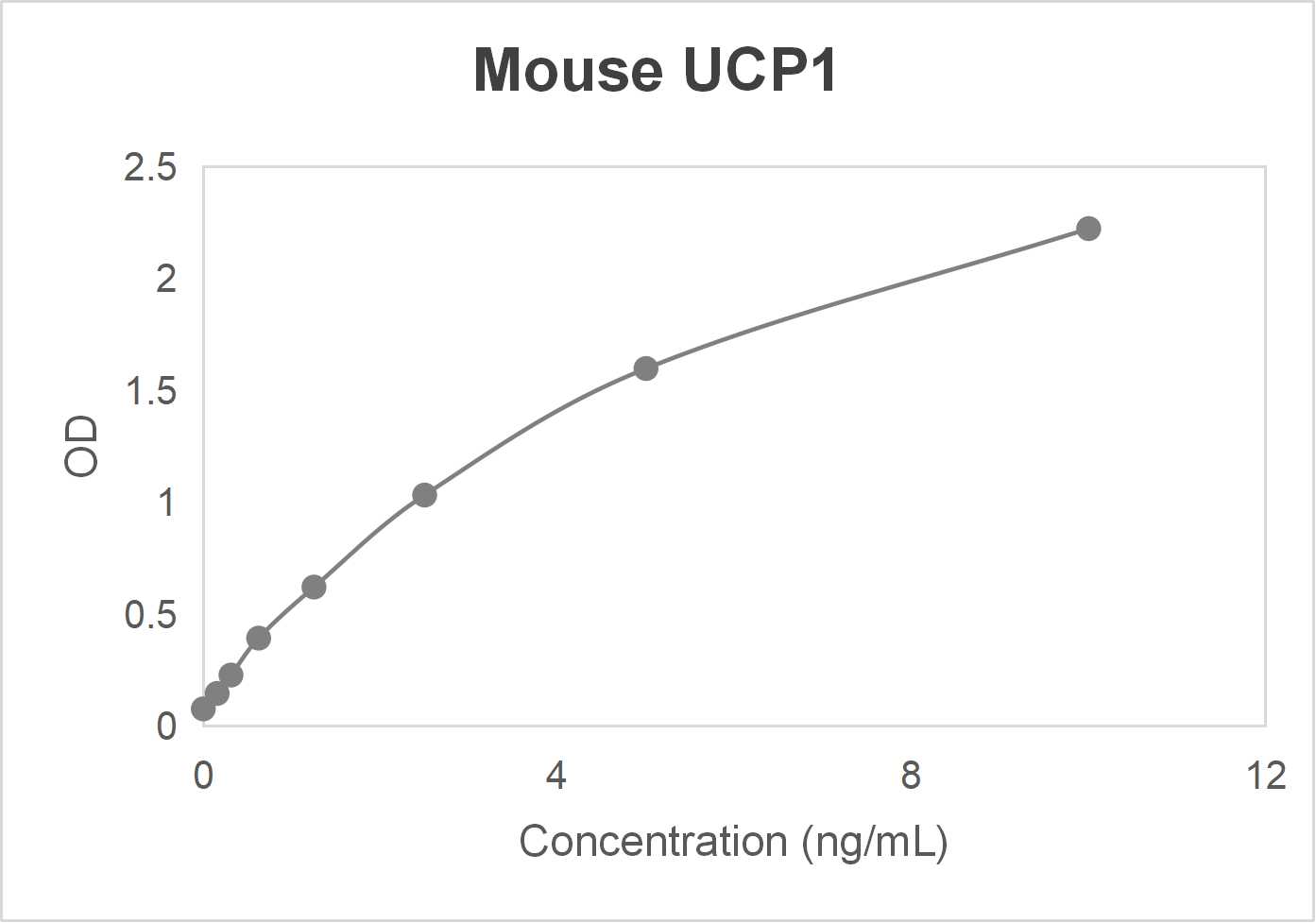
Mouse uncoupling protein-1 (UCP1) ELISA kit (0.156-10 ng/mL) is an ELISA-based in vitro research tool designed specifically for the quantitative detection of UCP1 in mouse samples with a range of 0.156-10 ng/mL and a minimum detectable dose (sensitivity) of <0.05 ng/mL. The kit is highly sensitive and easy to use.
Assay Principle:
This experiment uses a double-sandwich ELISA technique. The pre-coated antibody is a mouse UCP1 monoclonal antibody, and the detection antibody is a biotin-labeled polyclonal antibody. Samples and biotin-labeling antibodies are added to the ELISA plate wells and washed with PBS or TBS. Avidin-peroxidase conjugates are then added to the wells. After the reactants are thoroughly washed with PBS or TBS, the TMB substrate is used for coloration. TMB turns blue via peroxidase catalysis and finally turns yellow under the action of acid. The color depth and the target factors in the samples are positively correlated.
Background:
Uncoupling protein 1 (UCP1) is a mitochondrial transporter that mediates proton leakage across the inner mitochondrial membrane, uncoupling oxidative phosphorylation from ATP synthesis and dissipating energy as heat. UCP1 plays a key role in brown adipose tissue thermogenesis and energy expenditure, contributing to the regulation of whole-body metabolism. Impaired UCP1 function can reduce thermogenic capacity and promote energy storage, linking it to obesity and related metabolic disorders.
Synonyms:
SLC25A7; UCP; Thermogenin; Solute carrier family 25 member 7; Uncoupling Protein 1; Mitochondrial; Mitochondrial brown fat uncoupling protein 1
Applications:
Mouse uncoupling protein-1 (UCP1) ELISA kit (0.156-10 ng/mL) is used to quantify UCP1 in serum, plasma, and cell culture supernatant of mouse, providing data to support research in a wide range of areas, including signal transduction, obesity, and others.
Research Area:
Signal transduction; Obesity
Specification
Sample Type:
Serum; Plasma; Cell culture supernatant
Detection Range:
0.156-10 ng/mL
Sensitivity:
<0.05 ng/mL
Precision (Intra-assay):
CV≤8%
Precision (Inter-assay):
CV≤12%
Cross-reactivity:
No significant cross-reactivity or interference was observed.
Recovery:
70-110%
Storage:
Store at 2-8°C.