Products
- Anti-Obesity Compound Library
- GPCR/G Protein-Targeted Compounds
- Immunology/Inflammation-Targeted Compounds
- JAK/STAT-Targeted Compounds
- MAPK-Targeted Compounds
- Membrane Transporter/Ion Channel-Targeted Compounds
- Metabolism-Targeted Compounds
- NF-κB-Targeted Compounds
- Microbiology/Virology-Targeted Compounds
- Neuronal Signaling-Targeted Compounds
- PI3K/Akt/mTOR-Targeted Compounds
- Oxidation-reduction-Targeted Compounds
- Proteases/Proteasome-Targeted Compounds
- Stem Cells/Wnt-Targeted Compounds
- Tyrosine Kinase/Adaptors-Targeted Compounds
- Ubiquitin-Targeted Compounds
Online Inquiry
Mouse lipoprotein lipase (LPL) ELISA kit (15.625-1000 pg/mL)
Cat. No.:
0126WXX-958
Assay Type:
Quantitative sandwich ELISA
Target Species:
Mouse
Assay Target:
LPL
Size:
Add to basket
Product Overview
Description:
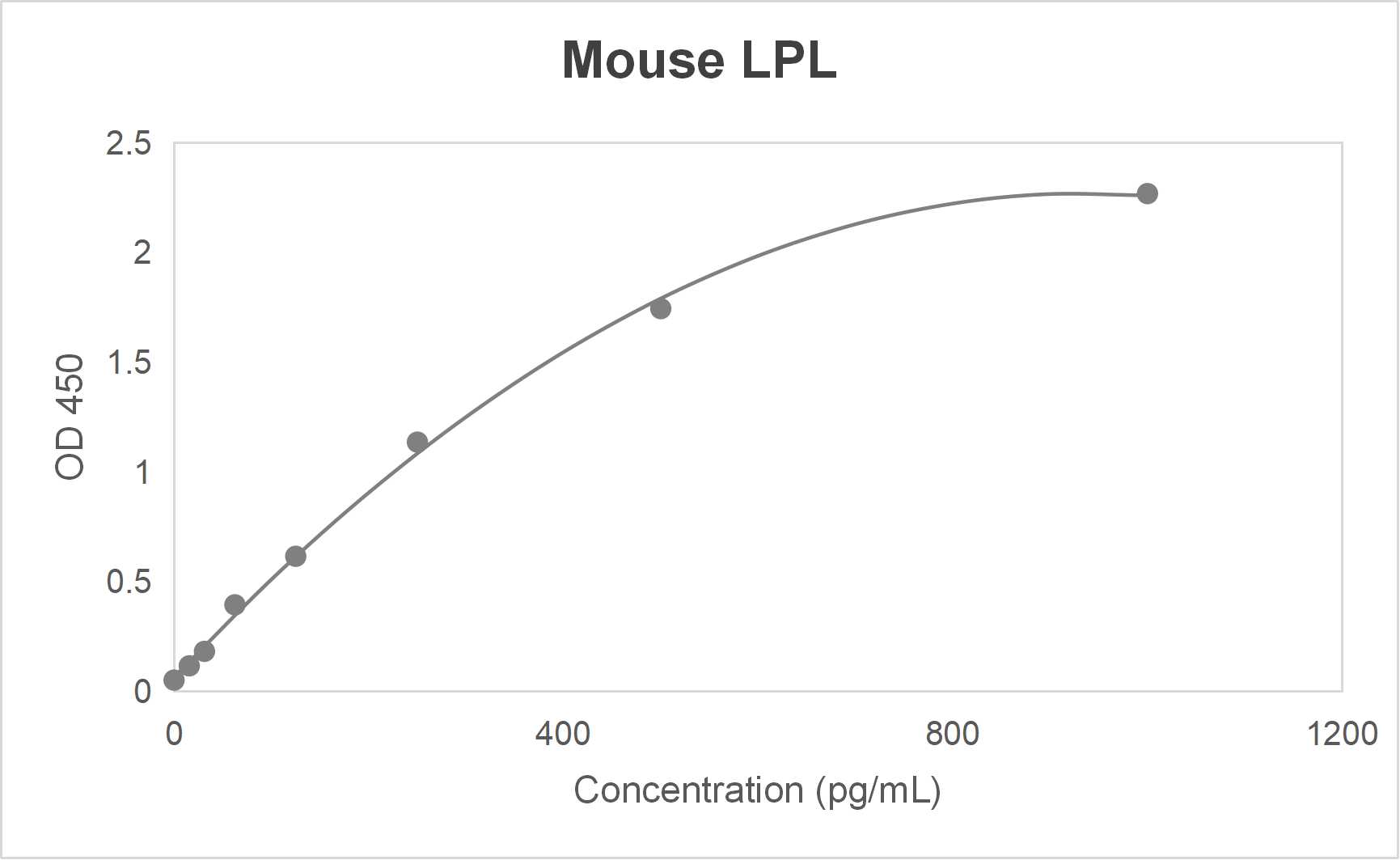
Mouse lipoprotein lipase (LPL) ELISA kit (15.625-1000 pg/mL, 9.375 pg/mL) is an ELISA-based in vitro research tool designed specifically for the quantitative detection of LPL in mice samples with a range of 15.625-1000 pg/mL and a minimum detectable dose (sensitivity) of 9.375 pg/mL. The kit is highly sensitive and easy to use.
Assay Principle:
This kit is based on sandwich ELISA technology. An anti-mouse LPL antibody is pre-coated onto 96-well plates, while a biotin-conjugated anti-mouse LPL antibody is used for detection. Standards, samples, and detection antibodies are added to the wells and washed. HRP-Streptavidin is added, and unbound conjugates are removed. TMB substrate visualizes the HRP reaction, turning yellow after adding the acidic stop solution. The density of yellow is proportional to the amount of mouse LPL captured, measured at 450 nm.
Background:
LPL is an enzyme belonging to the lipoprotein lipase family. Its primary function is to break down triglycerides (a type of fat) in the blood. Specifically, LPL hydrolyzes triglycerides present in circulating lipoproteins such as chylomicrons and very low-density lipoproteins (VLDL). The free fatty acids and monoglycerides released during this process can be utilized by cells to generate energy or stored for later use. LPL's direct relevance to obesity research lies in its pivotal role in fat storage and metabolism. Given its central function in lipid metabolism, LPL has emerged as a key biological factor in obesity studies.
Synonyms:
Clearing factor; Clearing factor lipase; EC 3.1.1.34
EC NO.:
3.1.1.34
Applications:
Mouse lipoprotein lipase (LPL) ELISA kit (15.625-1000 pg/mL, 9.375 pg/mL) is used to quantify LPL in serum, plasma, cell culture supernatant, cell or tissue lysate, and other liquid samples of mouse, providing data to support research in a wide range of areas, including signal transduction, metabolism, obesity, etc.
Research Area:
Signal Transduction; Metabolism; Obesity
Specification
Sample Type:
Serum; Plasma; Cell culture supernatant; Cell or tissue lysate; Other liquid samples
Detection Range:
15.625-1000 pg/mL
Sensitivity:
9.375 pg/mL
Cross-reactivity:
No significant cross-reactivity or interference was observed.
Storage:
Store at -20°C (microplate, standard) and 2-8°C (other reagents).

