Products
- Anti-Obesity Compound Library
- GPCR/G Protein-Targeted Compounds
- Immunology/Inflammation-Targeted Compounds
- JAK/STAT-Targeted Compounds
- MAPK-Targeted Compounds
- Membrane Transporter/Ion Channel-Targeted Compounds
- Metabolism-Targeted Compounds
- NF-κB-Targeted Compounds
- Microbiology/Virology-Targeted Compounds
- Neuronal Signaling-Targeted Compounds
- PI3K/Akt/mTOR-Targeted Compounds
- Oxidation-reduction-Targeted Compounds
- Proteases/Proteasome-Targeted Compounds
- Stem Cells/Wnt-Targeted Compounds
- Tyrosine Kinase/Adaptors-Targeted Compounds
- Ubiquitin-Targeted Compounds
Online Inquiry
Mouse leptin receptor (LEPR) ELISA kit (0.156-10 ng/mL)
Cat. No.:
0126WXX-848
Assay Type:
Quantitative sandwich ELISA
Target Species:
Mouse
Assay Target:
LEPR
Size:
Add to basket
Product Overview
Description:
Mouse leptin receptor (LEPR) ELISA kit (0.156-10 ng/mL) is an ELISA-based in vitro research tool designed specifically for the quantitative detection of LEPR in mice samples with a range of 0.156-10 ng/mL and a minimum detectable dose (sensitivity) of 0.063 ng/mL. The kit is highly sensitive and easy to use.
Assay Principle:
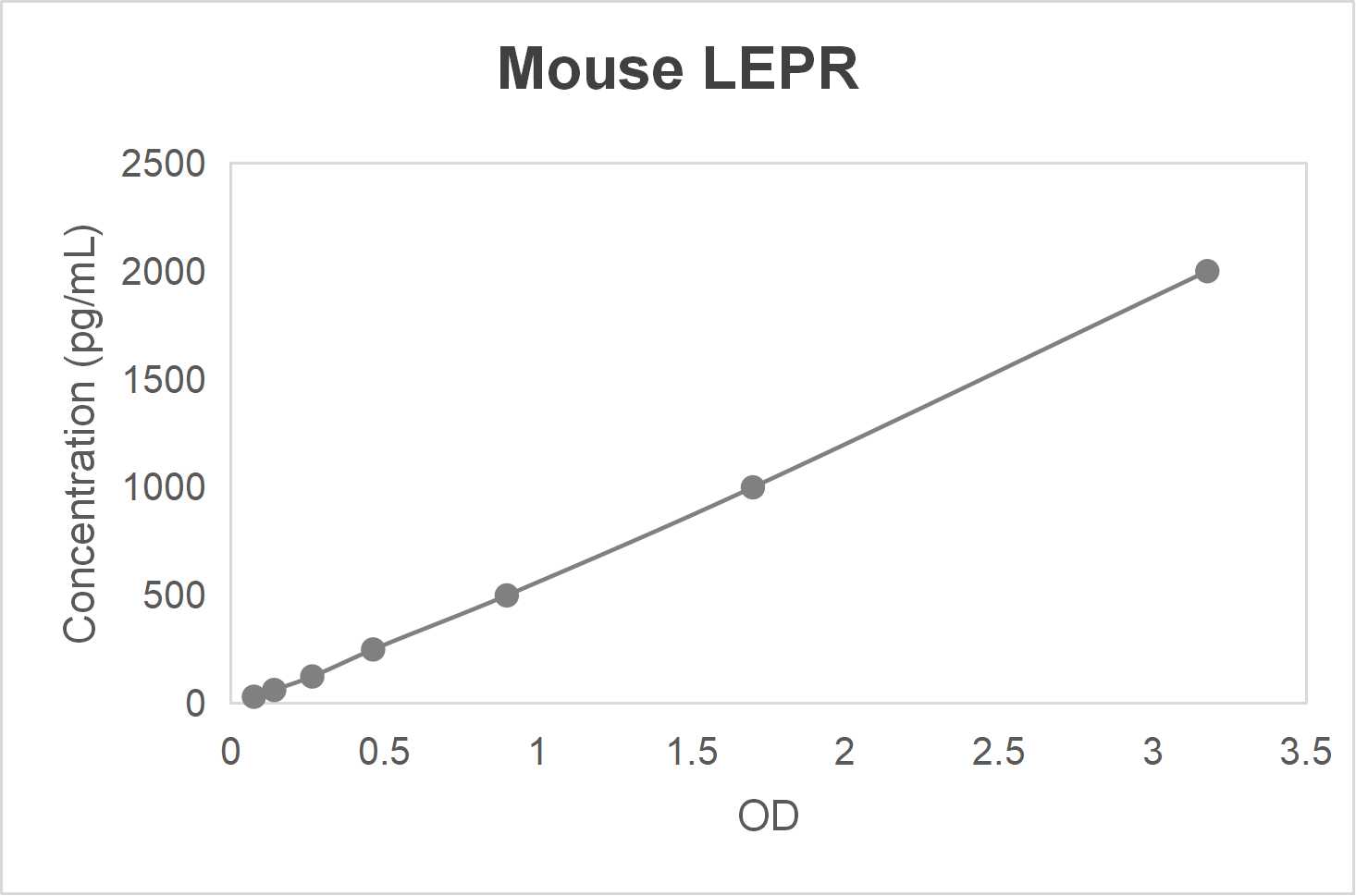
This assay utilizes a quantitative sandwich ELISA format. The provided microplate has been pre-immobilized with a capture antibody specific to the LEPR. Upon adding standards or samples to the wells, a biotin-labeled detection antibody specific to LEPR is introduced. This is followed by the addition of avidin-HRP conjugate. During incubation, a "sandwich" complex is formed. After washing, a TMB substrate solution is added, which undergoes a colorimetric change only in wells containing the target analyte. The reaction is halted by a sulphuric acid stop solution, and the absorbance is recorded spectrophotometrically at 450 nm ± 10 nm. The final LEPR concentration is calculated by mapping the sample O.D. values against a generated standard curve.
Background:
LEPR, as a peptide hormone receptor, is responsible for receiving leptin signals. When leptin binds to LEPR, it initiates a series of intracellular cascades, including the positive regulation of the JAK-STAT signaling pathway and the positive regulation of the PI3K signaling pathway. These pathways are crucial for translating leptin signals into biological responses, such as appetite suppression and metabolic regulation. The relationship between LEPR and obesity is paramount. When leptin functions as the “satiety hormone,” LEPR acts as the “satiety switch” in the brain and other tissues. Without functional receptors, leptin signals cannot be received regardless of how high leptin concentrations become.
Synonyms:
CD295; LEPR; OBR; LR
Applications:
Mouse leptin receptor (LEPR) ELISA kit (0.156-10 ng/mL) is used to quantify LEPR in tissue homogenates, cell lysates, and other biological fluids of mouse, providing data to support research in a wide range of areas, including signal transduction, CD & adhesion molecule, metabolic pathway, endocrinology, obesity, etc.
Research Area:
Signal transduction; CD & Adhesion molecule; Metabolic pathway; Endocrinology; Obesity
Specification
Sample Type:
Tissue homogenates; Cell lysates; Other biological fluids
Detection Range:
0.156-10 ng/mL
Sensitivity:
0.063 ng/mL
Precision (Intra-assay):
CV<10%
Precision (Inter-assay):
CV<12%
Cross-reactivity:
No significant cross-reactivity or interference was observed.
Storage:
Store at 2-8°C.
