Products
- Anti-Obesity Compound Library
- GPCR/G Protein-Targeted Compounds
- Immunology/Inflammation-Targeted Compounds
- JAK/STAT-Targeted Compounds
- MAPK-Targeted Compounds
- Membrane Transporter/Ion Channel-Targeted Compounds
- Metabolism-Targeted Compounds
- NF-κB-Targeted Compounds
- Microbiology/Virology-Targeted Compounds
- Neuronal Signaling-Targeted Compounds
- PI3K/Akt/mTOR-Targeted Compounds
- Oxidation-reduction-Targeted Compounds
- Proteases/Proteasome-Targeted Compounds
- Stem Cells/Wnt-Targeted Compounds
- Tyrosine Kinase/Adaptors-Targeted Compounds
- Ubiquitin-Targeted Compounds
Online Inquiry
Human cathepsin S (CTSS) ELISA kit (0.156-10 ng/mL, 0.063 ng/mL)
Cat. No.:
OB0625WXX-524
Assay Type:
Quantitative sandwich ELISA
Target Species:
Human
Assay Target:
CTSS
Size:
Add to basket
Product Overview
Description:
Human cathepsin S (CTSS) ELISA kit (0.156-10 ng/mL, 0.063 ng/mL) is an ELISA-based in vitro research tool designed specifically for the quantitative detection of CTSS in human with a range of 0.156-10 ng/mL and a specificity of 0.063 ng/mL.
Assay Principle:
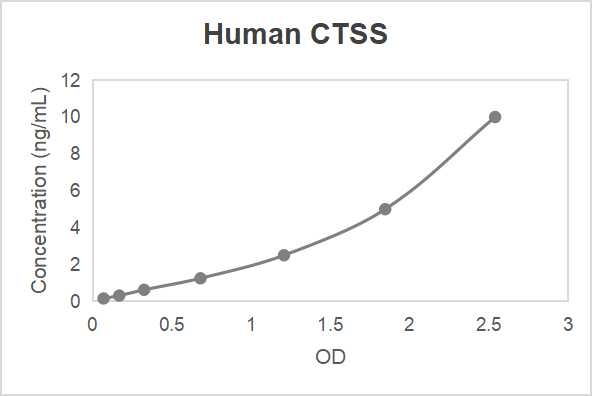
The test principle applied in this kit is Sandwich enzyme immunoassay. The microtiter plate provided in this kit has been pre-coated with an antibody specific to Cathepsin S (CTSS). Standards or samples are then added to the appropriate microtiter plate wells with a biotin-conjugated antibody specific to Cathepsin S (CTSS). Next, Avidin conjugated to horseradish peroxidase (HRP) is added to each microplate well and incubated. After TMB substrate solution is added, only those wells that contain Cathepsin S (CTSS), biotin-conjugated antibody and enzyme-conjugated Avidin will exhibit a change in color. The enzyme-substrate reaction is terminated by the addition of sulphuric acid solution and the color change is measured spectrophotometrically at a wavelength of 450nm ± 10nm. The concentration of Cathepsin S (CTSS) in the samples is then determined by comparing the O.D. of the samples to the standard curve.
Background:
CTSS is an important member of the cysteine protease family. As a potent mammalian elastase, it can degrade various extracellular components, including fibronectin, laminin, elastin, and collagen. CTSS is abnormally expressed in various disease states, such as obesity and atherosclerosis, which makes it a biomarker and a potential therapeutic target. Studies have found that CTSS inhibitors may be a possible strategy for treating obesity.
Synonyms:
CTS-S; EC 3.4.22.27
EC NO.:
3.4.22.27
Applications:
Human cathepsin S (CTSS) ELISA kit (0.156-10 ng/mL, 0.063 ng/mL) is used to quantify CTSS in serum, plasma, tissue homogenates, and other biological fluid samples of human, providing data to support a wide range of studies.
Research Area:
Obesity research; Immune response; Signaling pathway; Protein degradation
Specification
Sample Type:
Serum; Plasma; Tissue homogenates; Other biological fluids
Detection Range:
0.156-10 ng/mL
Sensitivity:
0.063 ng/mL
Precision (Intra-assay):
CV<10%
Precision (Inter-assay):
CV<12%
Cross-reactivity:
No significant cross-reactivity or interference was observed.
Storage:
Store at 2-8°C.