Products
- Anti-Obesity Compound Library
- GPCR/G Protein-Targeted Compounds
- Immunology/Inflammation-Targeted Compounds
- JAK/STAT-Targeted Compounds
- MAPK-Targeted Compounds
- Membrane Transporter/Ion Channel-Targeted Compounds
- Metabolism-Targeted Compounds
- NF-κB-Targeted Compounds
- Microbiology/Virology-Targeted Compounds
- Neuronal Signaling-Targeted Compounds
- PI3K/Akt/mTOR-Targeted Compounds
- Oxidation-reduction-Targeted Compounds
- Proteases/Proteasome-Targeted Compounds
- Stem Cells/Wnt-Targeted Compounds
- Tyrosine Kinase/Adaptors-Targeted Compounds
- Ubiquitin-Targeted Compounds
Online Inquiry
Canine leptin receptor (LEPR) ELISA kit (0.312-20 ng/mL)
Cat. No.:
0126WXX-836
Assay Type:
Quantitative sandwich ELISA
Target Species:
Canine
Assay Target:
LEPR
Size:
Add to basket
Product Overview
Description:
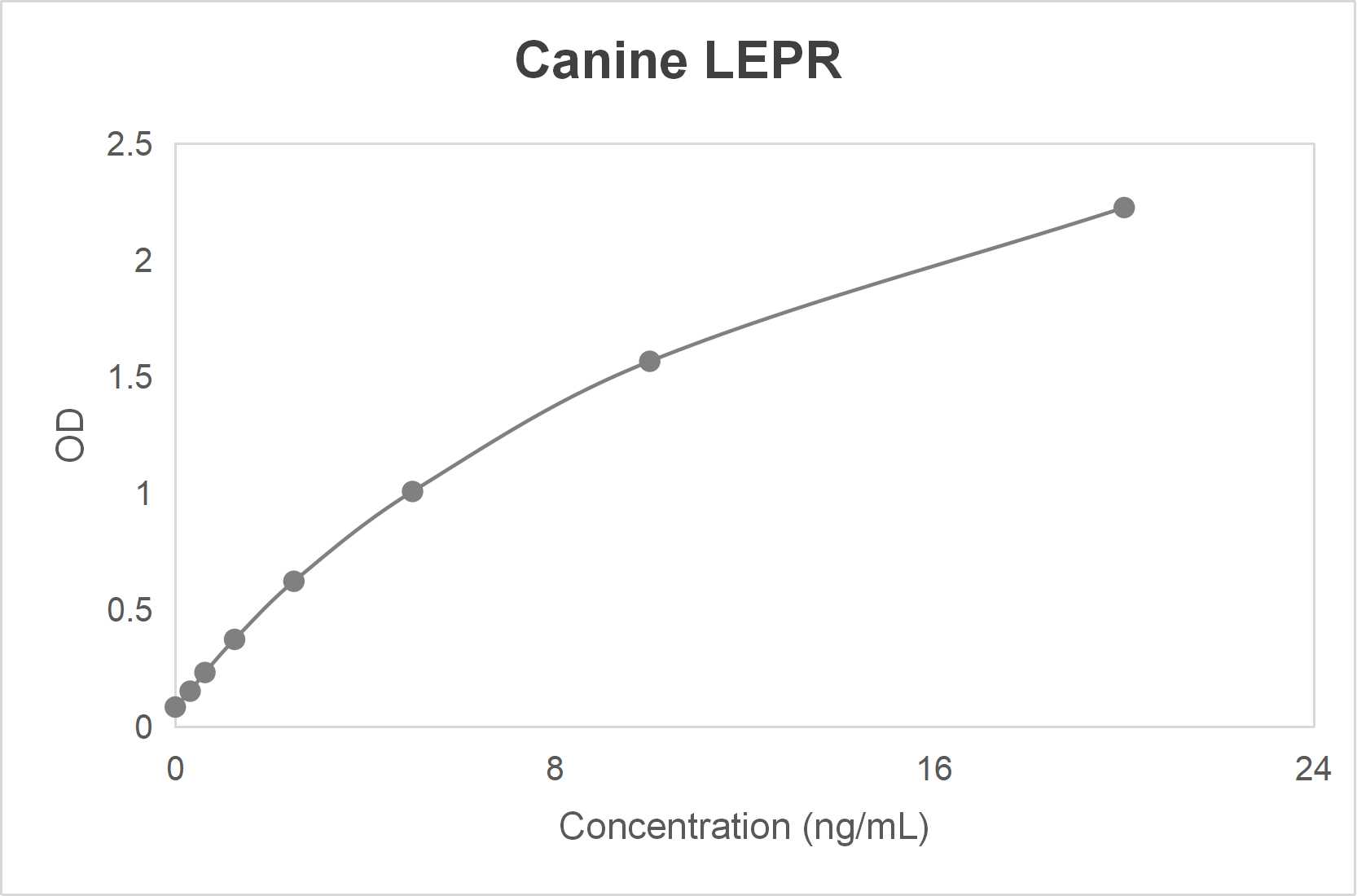
Canine leptin receptor (LEPR) ELISA kit (0.312-20 ng/mL) is an ELISA-based in vitro research tool designed specifically for the quantitative detection of LEPR in canine samples with a range of 0.312-20 ng/mL and a minimum detectable dose (sensitivity) of 0.06 ng/mL. The kit is highly sensitive and easy to use.
Assay Principle:
This assay utilizes a standard double-antibody sandwich ELISA format. The microplate is pre-sensitized with a canine LEPR monoclonal antibody, while a biotin-labeled polyclonal antibody serves as the detection agent. Samples and the biotinylated antibody are introduced into the wells, followed by a wash cycle with PBS or TBS. Avidin-peroxidase conjugates are then added sequentially. After a final thorough wash, TMB substrate is added for visualization. Under peroxidase catalysis, the TMB turns blue and eventually shifts to yellow upon the addition of acid. The resulting color depth is positively correlated with the concentration of LEPR in the sample.
Background:
LEPR, as a peptide hormone receptor, is responsible for receiving leptin signals. When leptin binds to LEPR, it initiates a series of intracellular cascades, including the positive regulation of the JAK-STAT signaling pathway and the positive regulation of the PI3K signaling pathway. These pathways are crucial for translating leptin signals into biological responses, such as appetite suppression and metabolic regulation. The relationship between LEPR and obesity is paramount. When leptin functions as the “satiety hormone,” LEPR acts as the “satiety switch” in the brain and other tissues. Without functional receptors, leptin signals cannot be received regardless of how high leptin concentrations become.
Synonyms:
CD295; LEPR; OBR; LR
Applications:
Canine leptin receptor (LEPR) ELISA kit (0.312-20 ng/mL) is used to quantify LEPR in serum, plasma, cell culture supernatant, and organizations of canine, providing data to support research in a wide range of areas, including signal transduction, CD & adhesion molecule, metabolic pathway, endocrinology, obesity, etc.
Research Area:
Signal transduction; CD & Adhesion molecule; Metabolic pathway; Endocrinology; Obesity
Specification
Sample Type:
Serum; Plasma; Cell culture supernatant; Organizations
Detection Range:
0.312-20 ng/mL
Sensitivity:
0.06 ng/mL
Precision (Intra-assay):
CV≤8%
Precision (Inter-assay):
CV≤12%
Cross-reactivity:
No significant cross-reactivity or interference was observed.
Storage:
Store at 2-8°C.