Products
- Anti-Obesity Compound Library
- GPCR/G Protein-Targeted Compounds
- Immunology/Inflammation-Targeted Compounds
- JAK/STAT-Targeted Compounds
- MAPK-Targeted Compounds
- Membrane Transporter/Ion Channel-Targeted Compounds
- Metabolism-Targeted Compounds
- NF-κB-Targeted Compounds
- Microbiology/Virology-Targeted Compounds
- Neuronal Signaling-Targeted Compounds
- PI3K/Akt/mTOR-Targeted Compounds
- Oxidation-reduction-Targeted Compounds
- Proteases/Proteasome-Targeted Compounds
- Stem Cells/Wnt-Targeted Compounds
- Tyrosine Kinase/Adaptors-Targeted Compounds
- Ubiquitin-Targeted Compounds
Online Inquiry
Mouse tumor necrosis factor receptor superfamily member 1B (TNF-RII) ELISA kit (15.625-1000 pg/mL)
Cat. No.:
0126WXX-1924
Assay Type:
Quantitative sandwich ELISA
Target Species:
Mouse
Assay Target:
TNF-RII
Size:
Add to basket
Product Overview
Description:
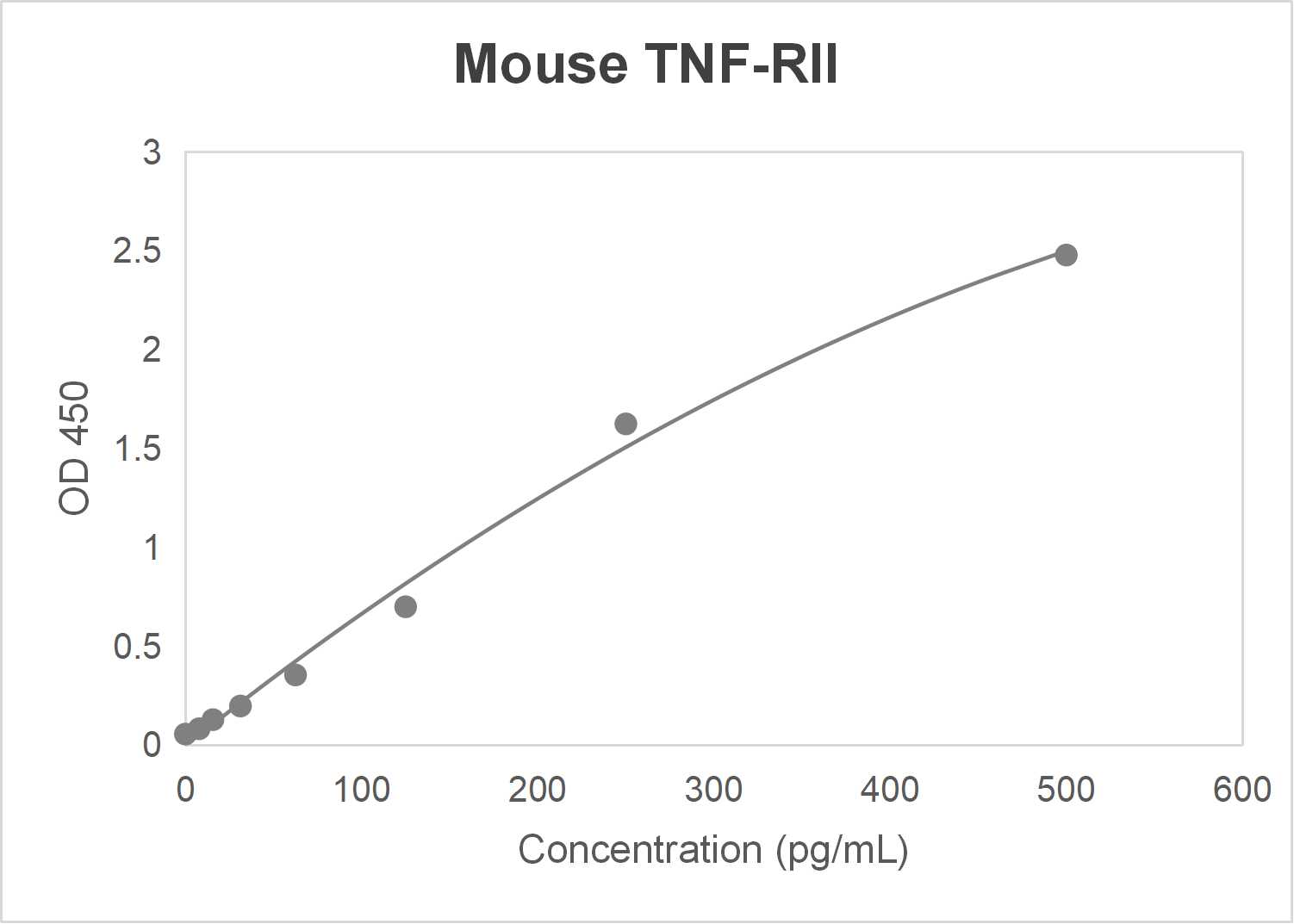
Mouse tumor necrosis factor receptor superfamily member 1B (TNF-RII) ELISA kit (15.625-1000 pg/mL) is an ELISA-based in vitro research tool designed specifically for the quantitative detection of TNF-RII in mouse samples with a range of 15.625-1000 pg/mL and a minimum detectable dose (sensitivity) of 9.375 pg/mL. The kit is highly sensitive and easy to use.
Assay Principle:
This kit is based on sandwich enzyme-linked immunosorbent assay technology. An anti-mouse TNF-RII antibody is pre-immobilized onto 96-well plates, and a biotin-conjugated anti-mouse TNF-RII antibody is used for detection. Standards, test samples, and the biotinylated detection antibody are added sequentially and washed with buffer. HRP-streptavidin is then introduced, and unbound conjugates are cleared via washing. TMB substrates are used to visualize the HRP-catalyzed reaction; the resulting blue product turns yellow after adding an acidic stop solution. The intensity of the yellow color is proportional to the amount of mouse TNF-RII captured, and the concentration is calculated from the O.D. measured at 450 nm.
Background:
TNF-RII, also known as TNFRSF1B or TNF-R2, is a transmembrane receptor on the cell surface that primarily binds to the pro-inflammatory cytokine tumor necrosis factor TNF-α and plays a crucial role in mediating its biological functions. Unlike TNF-RI, which primarily mediates apoptosis, TNF-RII signaling predominantly activates cell survival and proliferation signals by recruiting the TRAF protein family. In obesity research, TNF-α is a key inflammatory factor released from hypertrophic adipose tissue and is considered one of the primary drivers of insulin resistance. TNF-RII is recognized as mediating most of TNF-α's metabolic effects, particularly in immune cells and endothelial cells. Elevated TNF-RII activity correlates with chronic inflammation, adipose tissue remodeling, and impaired insulin signaling, positioning it as a potential target linking obesity-induced chronic inflammation to metabolic dysfunction.
Synonyms:
CD120b antigen; CD120b; Etanercept; p75 TNF receptor; p75TBPII; p75TNFR; Soluble TNFR1B variant 1; TNF RII; TNFBRp80 TNF-alpha receptor; TNF-R2; TNFR2TNFR1B; TNF-R75; TNFR80; TNFRII; TNF-R-II; TNFR-II; TNFRSF1B; Tumor necrosis factor beta receptor; Tumor necrosis factor binding protein 2; Tumor necrosis factor receptor 2; Tumor necrosis factor receptor superfamily; member 1B; Tumor necrosis factor receptor type II
Applications:
Mouse tumor necrosis factor receptor superfamily member 1B (TNF-RII) ELISA kit (15.625-1000 pg/mL) is used to quantify TNF-RII in serum, plasma, cell culture supernatant, cell or tissue lysate, and other liquid samples of mouse, providing data to support research in a wide range of areas, including inflammation and immunology, metabolism, obesity, and others.
Research Area:
Inflammation and immunology; Metabolism; Obesity
Specification
Sample Type:
Serum; Plasma; Cell culture supernatant; Cell or tissue lysate; Other liquid samples
Detection Range:
15.625-1000 pg/mL
Sensitivity:
9.375 pg/mL
Cross-reactivity:
No significant cross-reactivity or interference was observed.
Recovery:
85-104%
Storage:
Store at -20°C (microplate; standard) and 2-8°C (other reagents).