Products
Online Inquiry

Please note that we are not a pharmacy or clinic, so we are unable to see patients and do not offer diagnostic and treatment services for individuals.

Vitamin B12 test kit

Human peroxisome proliferator-activated receptor gamma (PPARγ) ELISA kit (0.781-50 ng/mL)
Cat. No.: 0126WXX-1511
Assay Type: Quantitative sandwich ELISA
Target Species: Human
Assay Target: PPARγ
Size:
Human peroxisome proliferator-activated receptor gamma (PPARγ) ELISA kit (0.781-50 ng/mL)
Add to basket

Product Overview

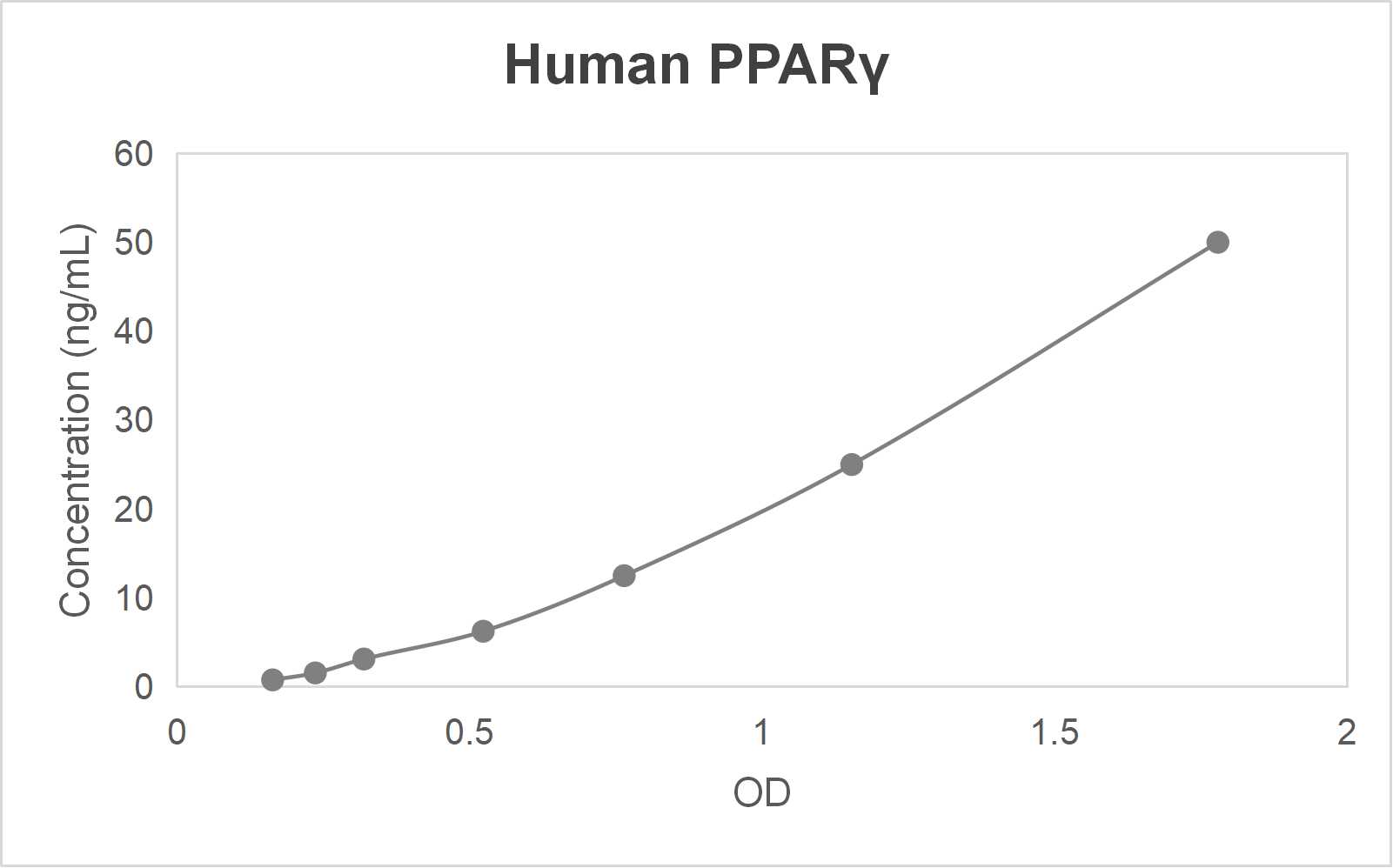
Description: Human peroxisome proliferator-activated receptor gamma (PPARγ) ELISA kit (0.781-50 ng/mL) is an ELISA-based in vitro research tool designed specifically for the quantitative detection of PPARγ in human samples with a range of 0.781-50 ng/mL and a minimum detectable dose (sensitivity) of 0.29 ng/mL. The kit is highly sensitive and easy to use.
Assay Principle: The microtiter plate provided in this kit is pre-coated with an antibody specific to PPARG. Standards or samples are added to the appropriate wells with a biotin-conjugated detection antibody. Subsequently, avidin-conjugated HRP is added and incubated. After the addition of TMB substrate, only those wells containing the PPARG complex will exhibit a color change. The enzyme-substrate reaction is terminated by a sulphuric acid solution, and the absorbance is measured at 450 nm ± 10 nm. The concentration of PPARG is determined by comparing the O.D. of the samples to the standard curve.
Background: PPAR-gamma (Peroxisome Proliferator-Activated Receptor Gamma), a prominent member of the nuclear hormone receptor superfamily located at chromosomal position 3p25, functions as a master ligand-dependent transcription factor essential for adipogenesis, lipid homeostasis, and glucose metabolism. Preferentially expressed in adipocytes, vascular smooth muscle cells, and macrophages, this DNA-binding nuclear receptor operates as a heterodimer with the retinoid X receptor and interacts with coactivators such as NCOA6 to significantly enhance the transcription of target genes. Its biological activity, which is modulated by MAP kinase-mediated phosphorylation and insulin stimuli, governs critical processes including white and brown fat cell differentiation, long-chain fatty acid transport, and the regulation of systemic insulin sensitivity. Beyond its primary metabolic roles, PPAR-gamma serves as a receptor for fatty acids and hypolipidemic drugs, influencing diverse physiological pathways ranging from the negative regulation of inflammation and smooth muscle cell proliferation to the orchestration of circadian rhythms and blood pressure. Consequently, dysregulation or genetic variation in PPAR-gamma is fundamentally linked to the pathogenesis of obesity, non-insulin-dependent diabetes mellitus, and familial partial lipodystrophy, underscoring its pivotal role as a central hub in metabolic health and disease.
Synonyms: PPAR-G; PPARG1; PPARG2; NR1C3; Glitazone receptor; Nuclear receptor subfamily 1 group C member 3; PPARg; Peroxisome proliferator activated receptor gamma; PPAR-γ; Peroxisome proliferator-activated receptor γ
Applications: Human peroxisome proliferator-activated receptor gamma (PPARγ) ELISA kit (0.781-50 ng/mL) is used to quantify PPARγ in serum, plasma, tissue homogenates, and cell lysates, cell culture supernatants, and other biological fluids of human, providing data to support research in a wide range of areas, including metabolic pathway, endocrinology, cardiovascular biology, developmental science, bone metabolism, obesity, and others.
Research Area: Metabolic pathway; Endocrinology; Cardiovascular biology; Developmental science; Bone metabolism; Obesity

Specification

Sample Type: Serum; Plasma; Tissue homogenates; Cell lysates; Cell culture supernatants; Other biological fluids
Detection Range: 0.781-50 ng/mL
Sensitivity: 0.29 ng/mL
Precision (Intra-assay): CV<10%
Precision (Inter-assay): CV<12%
Cross-reactivity: No significant cross-reactivity or interference was observed.
Storage: Store at 4°C (TMB substrate; wash buffer; stop solution) and -20°C (others).
Inquiry
0
Inquiry Basket

Copyright © Protheragen. All rights reserves.