Products
- Anti-Obesity Compound Library
- GPCR/G Protein-Targeted Compounds
- Immunology/Inflammation-Targeted Compounds
- JAK/STAT-Targeted Compounds
- MAPK-Targeted Compounds
- Membrane Transporter/Ion Channel-Targeted Compounds
- Metabolism-Targeted Compounds
- NF-κB-Targeted Compounds
- Microbiology/Virology-Targeted Compounds
- Neuronal Signaling-Targeted Compounds
- PI3K/Akt/mTOR-Targeted Compounds
- Oxidation-reduction-Targeted Compounds
- Proteases/Proteasome-Targeted Compounds
- Stem Cells/Wnt-Targeted Compounds
- Tyrosine Kinase/Adaptors-Targeted Compounds
- Ubiquitin-Targeted Compounds
Online Inquiry
Dog uncoupling protein 3 (UCP3) ELISA kit (0.625-40 ng/mL)
Cat. No.:
0126WXX-2069
Assay Type:
Quantitative ELISA
Target Species:
Dog
Assay Target:
UCP3
Size:
Add to basket
Product Overview
Description:
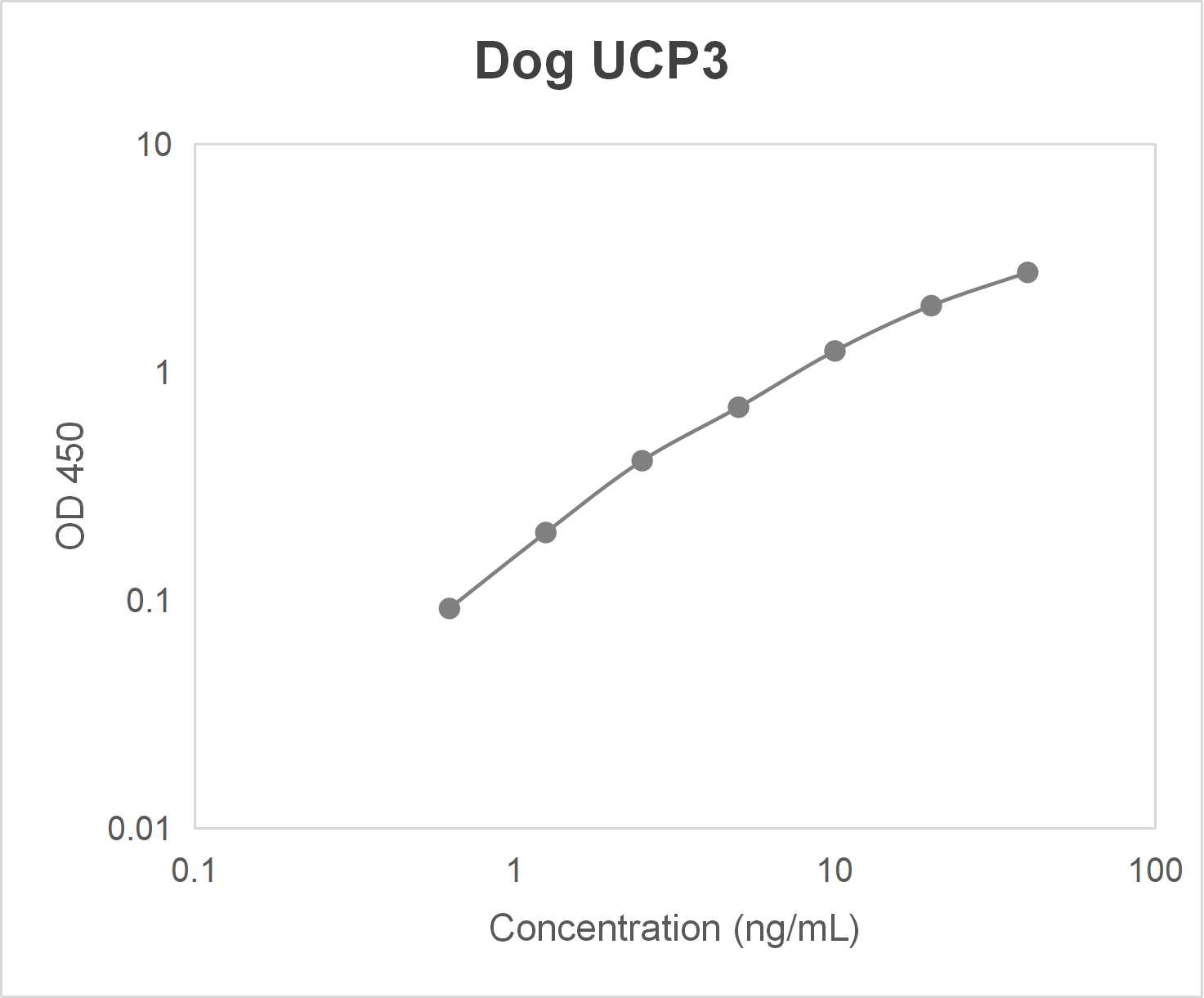
Dog uncoupling protein 3 (UCP3) ELISA kit (0.625-40 ng/mL) is an ELISA-based in vitro research tool designed specifically for the quantitative detection of UCP3 in dog samples with a range of 0.625-40 ng/mL and a minimum detectable dose (sensitivity) of <0.285 ng/mL. The kit is highly sensitive and easy to use.
Assay Principle:
The provided microtiter plate has been pre-immobilized with an antibody specific to the target antigen. Standards or samples are introduced into the designated wells along with a biotin-conjugated detection antibody and avidin-conjugated HRP. Following incubation, a TMB substrate solution is introduced. Color development occurs exclusively in wells containing the target-biotin-avidin complex. The enzymatic reaction is terminated with a sulphuric acid solution, and the absorbance is recorded at 450 nm ± 2 nm. The concentration of the target antigen is then calculated by comparing the sample O.D. values to the generated standard curve.
Background:
UCP3 is a key member of the UCP family, functioning as a transporter located in the inner mitochondrial membrane. Its primary role is to create a proton leakage pathway, allowing protons to bypass the ATP synthase and thereby decouple the oxidative phosphorylation process. This decoupling results in energy that would otherwise be used for ATP synthesis being dissipated as heat rather than stored in chemical bonds. In obesity research, UCP3 serves as a key regulator of thermogenesis and systemic energy balance, exhibiting high expression primarily in skeletal muscle. Studies indicate that elevated UCP3 levels may contribute to increased basal metabolic rate, enhanced fatty acid oxidation, and resistance to weight gain, positioning it as a potential therapeutic target for obesity treatment and improved insulin sensitivity.
Synonyms:
SLC25A9; Mitochondrial uncoupling protein 3; UCP 3; Solute carrier family 25 member 9; Uncoupling protein 3; mitochondrial
Applications:
Dog uncoupling protein 3 (UCP3) ELISA kit (0.625-40 ng/mL) is used to quantify UCP3 in serum, plasma, tissue homogenates, cell culture supernatant, and other biological fluids of dog, providing data to support research in a wide range of areas, including metabolism, mitochondrial function, oxidative stress, exercise physiology and energy balance, obesity, and others.
Research Area:
Metabolism; Mitochondrial function; Oxidative stress; Exercise physiology and energy balance; Obesity
Specification
Sample Type:
Serum; Plasma; Tissue homogenates; Cell culture supernatants; Other biological fluids
Detection Range:
0.625-40 ng/mL
Sensitivity:
<0.285 ng/mL
Precision (Intra-assay):
CV≤4.6%
Precision (Inter-assay):
CV≤8.1%
Cross-reactivity:
No significant cross-reactivity or interference was observed.
Storage:
Store at -20°C.