

Liver Organoid Modeling Service for Obesity Research
InquiryObesity is a systemic metabolic disorder frequently culminating in non-alcoholic fatty liver disease (NAFLD) and its progressive form, non-alcoholic steatohepatitis (NASH). Traditional 2D Cell Cultures and Animal Models often fail to replicate the complex architecture and metabolic nuances of the human liver, particularly the lipid accumulation and inflammatory signaling pathways seen in obese patients.
Advancing Metabolic Research: Next-Generation Liver Organoid Modeling for Obesity
Protheragen provides an industry-leading liver organoid modeling service specifically designed for obesity research. By utilizing patient-derived stem cells or gene-edited cell lines, we create 3D micro-tissues that accurately mimic hepatic steatosis, insulin resistance, and fibrotic progression. Our preclinical models allow researchers to observe real-time lipid droplet formation and evaluate therapeutic interventions with high translational relevance, bridging the gap between laboratory discovery and clinical success.
Core Technologies
Protheragen integrates several proprietary and cutting-edge technologies to deliver high-fidelity liver models:
- 3D Bio-Scaffold Integration
We utilize specialized extracellular matrices (ECM) that facilitate the polarization of hepatocytes, ensuring the development of functional bile canaliculi and realistic nutrient transport.
- Induced Pluripotent Stem Cell (iPSC) Differentiation
Our optimized protocols transform iPSCs into mature, metabolically active hepatocytes, allowing for the study of genetic predispositions to obesity.
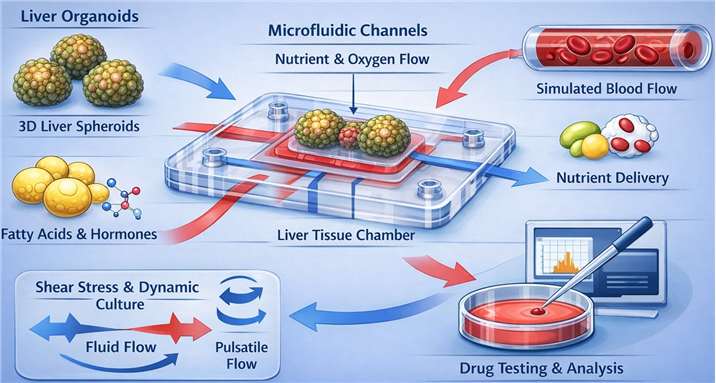
- Microfluidic "Liver-on-Chip" Systems
To simulate the systemic nature of obesity, we integrate organoids into microfluidic circuits that mimic blood flow and nutrient delivery, providing a dynamic environment for drug testing.
- Gene-editing Metabolic Engineering
We offer gene-editing services to knock in or knock out key metabolic regulators (e.g., PNPLA3 variants) to create disease-specific models of fatty liver.
Solution Scope
The Protheragen service portfolio covers a wide range of obesity-related liver pathologies:
- Steatosis Modeling
Quantification of macrovesicular and microvesicular fat accumulation.
- Inflammation & NASH Profiling
Monitoring the transition from simple fat accumulation to inflammatory cytokine release (IL-6, TNF-alpha).
- Fibrosis Induction
Utilizing co-culture models with hepatic stellate cells to study the deposition of collagen and extracellular matrix remodeling.
- Insulin Resistance Assays
Evaluating glucose uptake and AKT signaling pathways under obese-mimetic conditions.
- Lipid Metabolism Kinetics
Real-time tracking of fatty acid oxidation and VLDL secretion.
Contact Our Team for More Information and to Discuss Your Project.
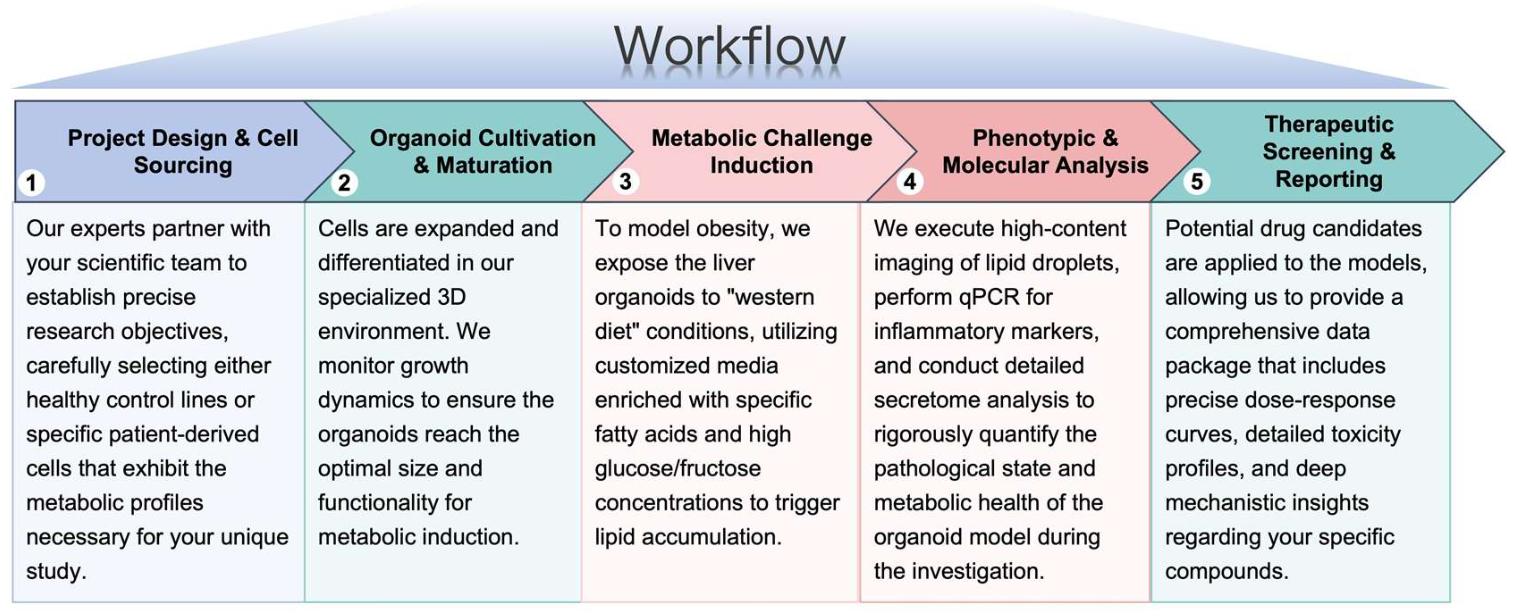
Workflow
Our streamlined service process ensures rigorous quality control and reproducible data for every project:
Fields of Application
The high-fidelity liver organoid models developed by Protheragen serve as a transformative bridge between foundational metabolic theory and successful preclinical drug development across a spectrum of critical research areas.
Identifying novel small molecules or biologics that target lipid metabolic pathways.
- Nutraceutical Testing
Validating the efficacy of dietary supplements in reducing hepatic fat load.
Assessing the hepatotoxic potential of new compounds in a compromised, "obese" liver environment.
- Precision Medicine
Developing patient-specific models to predict individual responses to metabolic therapies.
Advantages
Protheragen stands at the forefront of preclinical modeling by offering:
Human-Centric Reliability
Unlike rodent models, our organoids express human-specific metabolic enzymes and transporters, significantly reducing the risk of false positives in drug development.
High-Throughput Compatibility and Deep Characterization
Our platform is optimized for 96-well and 384-well formats, making it ideal for large-scale library screening. Every model is validated via published data comparisons, ensuring that the gene expression profiles and metabolic outputs align with clinically observed obesity markers.
Customization
We don't believe in a one-size-fits-all approach. We tailor the lipid composition and genetic background of the organoids to match your specific therapeutic target.
Publication Data
Title: Research progress and application of liver organoids for disease modeling and regenerative therapy
Journal: Journal of Molecular Medicine, 2024
DOI: https://doi.org/10.1007/s00109-024-02455-3
Summary: This paper focuses on the correlation between different types of drug abuse (methamphetamine smoking, heroin injection, new-type drugs) and pulmonary lesions, aiming to clarify the specific CT imaging characteristics of drug-related lung diseases and provide a reliable basis for clinical diagnosis. A total of 189 drug abusers (experimental group) and 355 non-drug abusers (control group) were included in the study. All subjects underwent chest CT scans using a Siemens SOMATOM Force dual-source CT machine, and three senior radiologists performed blind image interpretation. Propensity score matching (PSM) was used to balance baseline characteristics, and statistical methods such as multivariate logistic regression were employed to analyze the association between drug types and pulmonary lesions. The results showed that drug abusers had a significantly higher detection rate of pulmonary lesions (71.4%) than the control group, and different drugs presented distinct lesion patterns. This study provides important clinical reference for the early diagnosis, type differentiation, and pathological mechanism research of drug-related pulmonary diseases.
Key Findings
- Drug-Specific Pulmonary Lesion Patterns: Methamphetamine smokers were mainly characterized by chronic inflammation (38.0%) and micronodules (34.8%), with a younger onset age (average 33.7 years) suggesting early oxidative stress injury; heroin injectors had a high incidence of emphysema (28.2%) and bullae (20.0%), which may be related to alveolar destruction mediated by non-sterile operation and MMP-9; new-type drugs were strongly associated with alveolar infiltration (66.7%), pathologically manifested as pulmonary alveolar proteinosis.
- High Diagnostic Value of Chest CT: The detection rate of pulmonary lesions in drug abusers by CT reached 71.4%, which was significantly higher than that of chest X-ray, reducing missed diagnoses by 62%. CT can accurately identify lesion types such as chronic inflammation, micronodules, emphysema, and alveolar infiltration, providing intuitive imaging evidence for clinical diagnosis.
- Quantifiable Disease Risk Association: Multivariate regression analysis confirmed that heroin injection increased the risk of emphysema by 2.8 times compared with methamphetamine smoking (OR=2.8, 95%CI:1.5-5.3); new-type drugs increased the risk of alveolar infiltration by 21.4 times compared with the control group (OR=21.4, 95%CI:6.2-73.8); smoking history had no significant modifying effect on the association between drugs and lesions.
- Reliable Study Design Supports Conclusions: After PSM, the standardized mean difference (SMD) of baseline characteristics between the experimental group and the control group was all <0.1, ensuring the balance of confounding factors; the blind interpretation by three senior radiologists and strict statistical analysis methods improved the reliability and repeatability of the research results.
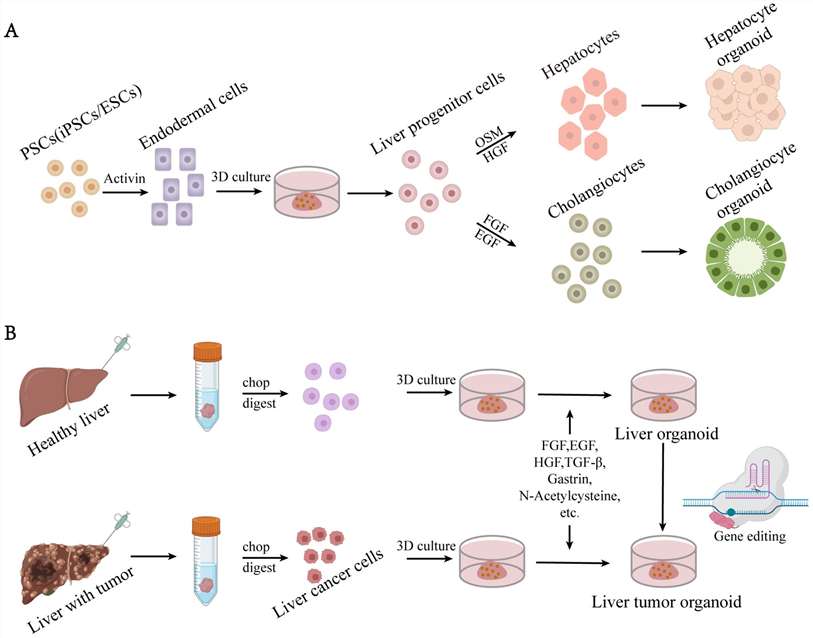
Fig. 1 The liver organoids construction. (Hu, et al., 2024)
Customer Review
From Static 2D Models to Human-Relevant Fibrosis Insight
"The transition from 2D cultures to Protheragen's liver organoids was a turning point for our NASH program. The ability to see human-specific fibrotic responses in a dish allowed us to prioritize our lead compounds with much higher confidence. Their technical team provided deep insights into lipid kinetics that we simply couldn't get elsewhere."
Senior Director of Metabolic Research, Global Biopharma
Custom Genetic Obesity Models Backed by Publication-Grade Validation Data
"We approached Protheragen for a highly customized project involving rare genetic variants of obesity. Not only did they successfully develop the model, but the published data they provided for validation was impeccable. We are already planning our next series of screenings with their team."
Principal Investigator, Leading Metabolic Research Institute
Frequently Asked Questions
-
How long does it take to establish an obesity-induced liver organoid model?
Typically, the process from cell seeding to a fully induced "obese" state takes 3 to 5 weeks, depending on the complexity of the co-culture.
-
Can you model the interaction between the gut and the liver?
Yes, through our associated services, we offer multi-organ chips that simulate the gut-liver axis, crucial for obesity research.
-
Are your models suitable for RNA-seq analysis?
Absolutely. Our organoids provide high-quality genetic material suitable for bulk or single-cell RNA sequencing.
-
How do you quantify lipid accumulation?
We use Nile Red or boron-dipyrromethene staining coupled with automated high-content imaging, as well as biochemical assays for triglycerides.
-
Do the organoids contain non-parenchymal cells?
We offer "Enhanced Models" that include Kupffer cells and Stellate cells to better simulate inflammation and fibrosis.
-
Can I provide my own proprietary cell lines for the service?
Yes, Protheragen frequently works with client-provided materials under strict confidentiality.
-
What makes organoids better than 2D hepatocyte cultures?
Organoids maintain their metabolic function and phenotype significantly longer than 2D cultures, which typically lose functionality within days.
-
How do you ensure the reproducibility of your results?
We use standardized synthetic matrices and automated liquid handling to minimize batch-to-batch variation.
-
Is it possible to study the effects of exercise or caloric restriction?
We can simulate these conditions by manipulating the nutrient concentration and hormonal signals (like adiponectin) in the culture media.
How to Contact Us
Protheragen is committed to accelerating the discovery of life-changing therapies for obesity and metabolic disease. Our sophisticated liver organoid platforms provide the precision, scalability, and human relevance required for modern preclinical success.
Contact Protheragen for More Information and to Discuss Your Project
Reference
- Hu, Y.; et al. Research progress and application of liver organoids for disease modeling and regenerative therapy. J Mol Med. 2024, 102, 859–874. (CC BY 4.0)
All of our services and products are intended for preclinical research use only and cannot be used to diagnose, treat or manage patients.